Lessons Learned on the 10-Year Anniversary of Establishing Nepal’s First Bone Marrow Transplant Center
Author
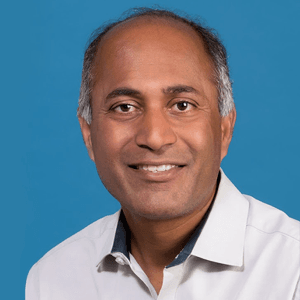
Dr. Binay Shah
Bridges on Bridges: Global Health is a Collaborative Effort
Being an effective global health practitioner involves building and crossing bridges. Much of the work Binaytara, my global oncology nonprofit, does certainly falls in this purview: connecting the right patients with the right treatments, the right countries with the right resources, the right healthcare providers with the right education to make a difference in their oncology practices. Binaytara was founded to bridge a chasmic access gap in cancer care—and in every instance where we have come one step closer to this mission becoming a reality, strategic partnerships and connections are at the center.
To global health stakeholders looking to make an impact, my advice is this. Ask yourself: Where do I want to go? This is your end point. What are the resources I have? This is your starting point. And most importantly: Who has the resources to help me get where I need to go? This is the catalyst for impact.
A Case Study in Connections: Establishing Nepal’s First Bone Marrow Transplant Center
I’ll begin with a story that illustrates how passion and efficacy play different roles in forming global health partnerships.
In 2011, I was in my first year of practice as an oncologist. Binaytara existed even then, although it looked a little different than it does today: our staff didn’t extend far beyond my wife Tara and myself, and we were 100% reliant on donations. Still, we were making a name for ourselves. A physician at University of Illinois Chicago, Dr. Damiano Rondelli, approached me one day and expressed interest in what we were doing. “We'd love to have you involved,” I told him, “but if you're hoping to get paid, don't be part of it." Luckily, he was not in it for compensation. He traveled with me to Nepal, where I was hosting a couple of oncology education events.
That was when we identified a critical hematology infrastructure need: a bone marrow transplant center. Briefly, bone marrow transplants are lifesaving treatments for individuals with blood cancers like leukemia, lymphoma, multiple myeloma and myelodysplastic syndrome. Patients go through what we think of as traditional cancer treatment—chemotherapy and/or radiation—which eliminates their diseased bone marrow. Following this depletion, however, the body is less equipped to make new blood cells. Bone marrow transplants (BMTs) involve introducing a donor’s healthy stem cells into the patient’s bloodstream to essentially restart that ability to make healthy blood cells as a crucial last stage of recovery. It’s a success story in a field where successes are hard-won.
In the United States, the first successful BMT took place in 1956. In 2011, Nepal still didn’t have a single bone marrow transplant center for its population of 30 million people. The access gap was unacceptable. I signed a memorandum of understanding between Binaytara and BP Koirala Memorial Cancer Hospital, the largest government cancer hospital in Nepal, to help them establish a BMT center, but the effort didn’t move forward as coordination and logistics challenges across nations proved insurmountable.
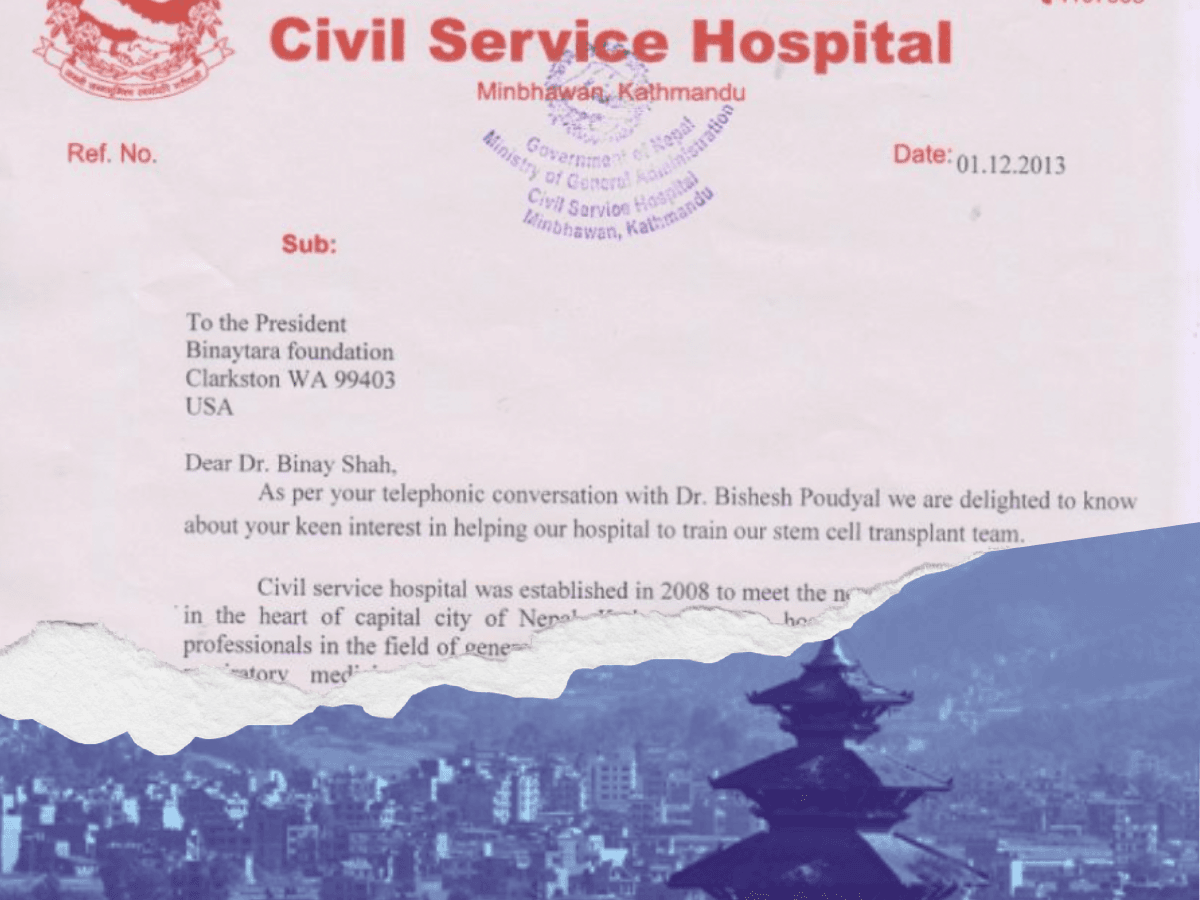
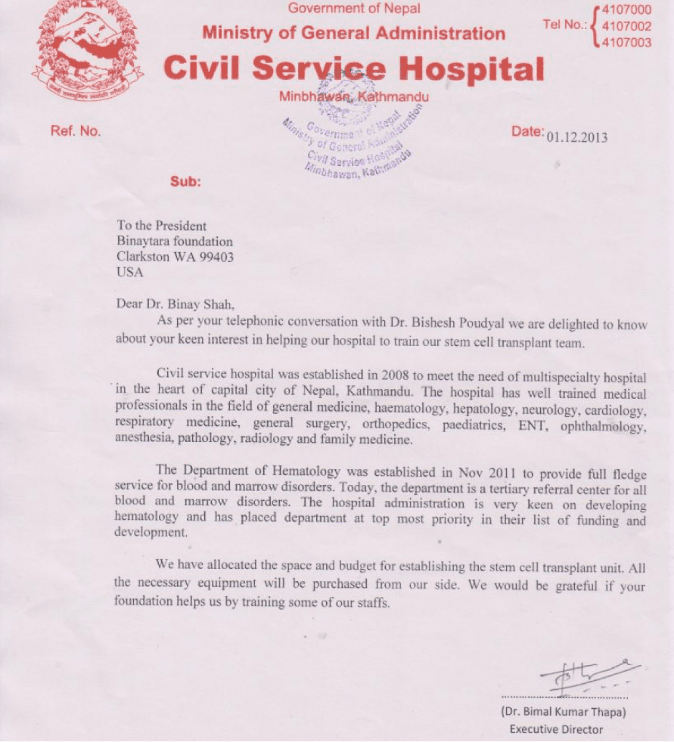
Almost a year later, I received an email from Bishesh Poudyal, a doctor at the Civil Service Hospital in Kathmandu, asking me to help him establish a bone marrow transplant center at the hospital. Although he practiced there, he couldn’t wave a wand and secure the approvals and funding by himself. I found myself signing an MOU with Dr. Bimal Kumar Thapa, Executive Director of Civil Service Hospital. This time I was armed with lessons from my last effort: I needed to connect the right people and institutions.
For one, I knew an understaffed BMT center would help no one, so we needed a place to send doctors and nurses for training while the necessary infrastructure was built and equipment installed. To this end, we funded a training program at UIC, facilitating yet another MOU—this time between Civil Service Hospital and Dr. Timothy Erickson, Director of the Center for Global Health at UIC. This included Binaytara sponsoring training of a nurse who served as their transplant nurse, a pathologist, and a geneticist. Dr. Poudyal went on to complete his training in Chicago, and in 2016, Nepal’s first bone marrow transplant was performed at the center we helped establish. It was a milestone in cancer care in my home country, and it was inspiring evidence of what we could achieve in global health through strategic partnerships.
Passion Flags; Good Partners Persist
10 years later, as of this writing, the BMT center at Civil Service Hospital remains the only one in Nepal. Binaytara is building on that success by working towards constructing a world-class cancer hospital in Madhesh Province, Nepal, which will include the second BMT center in the country. The ripple-out impact of the first BMT center is already apparent a decade on. The center has established a hematology fellowship program, meaning they are performing lifesaving transplants and training the next generation of transplant specialists. This kind of self-multiplying benefit is a hallmark of truly transformational healthcare system reform, and the best case I can think of for investing in the space.
This project illustrates the importance of connections, strategically formed and strategically executed. While on the surface this is not groundbreaking advice, I mean to stress that, when picking the “right” people and institutions to partner with, passion is only one part of the equation. Real global oncology outcome improvement—especially a financially and technically complex one like establishing a BMT center, enabling hundreds of patients with severe hematologic malignancies to access a lifesaving procedure over the course of a decade—is bureaucratic, tedious, and one government denial away from collapsing like a house of cards: somewhere along the way, passion is going to flag.
Civil Service Hospital leadership was phenomenal. They committed to upgrading their facility, invested in their healthcare professionals, and supported training every step of the way. Dr. Poudyal was capable of acquiring the knowledge and training to head the operation. The University of Illinois Chicago was a strong institutional partner that provided the platform to train Poudyal and other personnel. We needed partners who were committed not just for six months or a year, but for the long term: willing and able.
Much like the BMT procedure itself, the establishment of the BMT center at Civil Service Hospital is highly complex and requires close collaboration. Cancer health equity has a long way to go in Nepal, but this early experience helped Binaytara embark on our next goal of building a comprehensive cancer hospital, an endeavor that takes partnership with local leaders, civil society, government, and individuals with the passion and the will to see it through together.
Binay Shah, MD is the founder of Binaytara, a global oncology nonprofit working to reduce cancer health disparities.
Recommended Articles