Early-Career Blood Cancer Researchers Share $200,000 After Pitching Live to Expert Judges in Nashville

Author
Binaytara Team
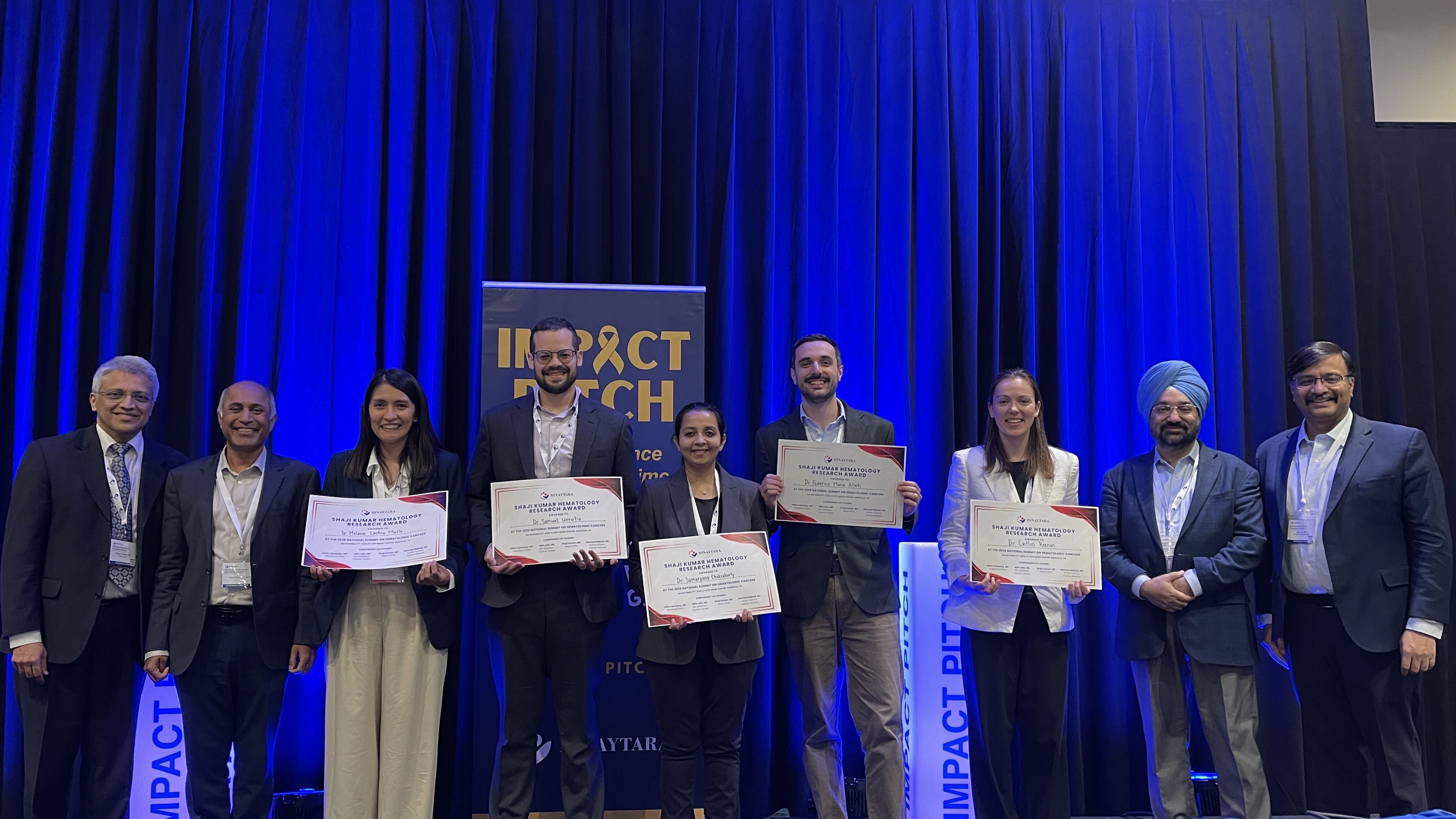
Researchers from Tufts Medical Center, MD Anderson Cancer Center, Peru’s Instituto Nacional de Enfermedades Neoplásicas, Albert Einstein College of Medicine and Washington University in St. Louis receive the Shaji Kumar Hematology Research Awards at the 2026 National Summit on Hematologic Cancers.
NASHVILLE, Tenn., Oct. 20, 2026 — Five early-career researchers working to improve how blood cancers are diagnosed and treated have won a combined $200,000 in research funding after pitching their projects live to a panel of leading hematologists on Oct. 17 at the 2026 National Summit on Hematologic Cancers.
During the Summit’s Impact Pitch session, each of the nine finalists had seven minutes to present a research proposal and seven minutes to answer questions from four judges, in front of the conference audience. The judges then chose the winners. The funds go directly to research costs, with no institutional overhead, and awardees will report on their progress at a future Summit.
“There is a lack of funding for cancer research out there. Binaytara has invested $400,000 this year alone to provide research grants to groom future leaders in cancer care ,” said Dr. Binay Shah, president and co-founder of Binaytara and conference director. “When the decision happens in the open, in front of peers, the strongest idea in the room wins.”
The awards are named for Dr. Shaji Kumar, the Mayo Clinic myeloma specialist who co-chairs the Summit, and are part of more than $400,000 that the global oncology nonprofit Binaytara has committed to early-career cancer researchers in 2026.
The 2026 Awardees
Faculty within 10 years of completing fellowship were eligible for up to $50,000, and current fellows for up to $25,000.
Two Awards Given to Hematology/Oncology Fellows - $25,000 each
Caitlin Keenan, MD, Tufts Medical Center - Enhancing response to hypomethylating agents in acute myeloid leukemia via folate deprivation: Dr. Keenan’s earlier research found that people with acute myeloid leukemia who responded best to a common class of treatment, called hypomethylating agents, tended to have lower levels of folate, a B vitamin, when they started therapy. This project will test in the lab whether lowering folate, or adding methotrexate, a widely used drug that blocks folate, makes these treatments work better. Because these are simple, inexpensive steps, positive results could reach patients quickly, particularly those with TP53-mutated AML, an especially hard-to-treat form of the disease.
Federico Mario Aletti, MD, University of Texas MD Anderson Cancer Center - Preclinical safety studies of anti-KIR3DL2 CAR T cells incorporating a novel antibody-drug conjugate-targetable safety switch: CAR T-cell therapy, which reprograms a patient’s own immune cells to attack cancer, has transformed care for some blood cancers but has lagged for T-cell lymphomas because the cancer cells closely resemble healthy immune cells. Dr. Aletti, of MD Anderson Cancer Center, is developing CAR T cells that target a marker found on many aggressive T-cell lymphomas but rarely on healthy cells, along with a built-in “off switch” that lets doctors quickly eliminate the engineered cells with an existing FDA-approved drug if serious side effects occur. The work moves the therapy toward clinical trials, and the off switch could make other cell therapies safer as well.
Three Awards Given to Early-Career Hematology/Oncology Faculty - $50,000 each
Melanie Castro Mollo, MD, Instituto Nacional de Enfermedades Neoplásicas - Venetoclax plus low-intensity chemotherapy for adults with Ph negative ALL adapted for a middle-income country: In Peru, about 30% of adults over 40 with acute lymphoblastic leukemia die within two months of starting treatment, not because the chemotherapy fails but because it is so harsh. Dr. Castro Mollo, of Peru’s national cancer institute in Lima, will test a gentler approach that pairs lower-dose chemotherapy with venetoclax, an affordable pill already available locally, so most treatment can happen at home. The goal is to cut early deaths to 10%, and success could offer a model for other countries where costly immunotherapies remain out of reach.
Samarpana Chakraborty, PhD, Albert Einstein College of Medicine - Combined STAT3 degradation and RAS inhibition in myeloproliferative neoplasms: Myeloproliferative neoplasms are blood cancers in which the bone marrow overproduces blood cells, and while current drugs ease symptoms, they rarely eliminate the disease, often stop working and cannot prevent progression to acute leukemia. Dr. Chakraborty will test a two-drug combination that shuts down two backup routes cancer cells use to survive, and early lab results show the pair kills cancer cells far more effectively than either drug alone. If the combination works in drug-resistant cells and patient samples while sparing healthy cells, it could open a new treatment path for patients who have run out of options.
Samuel Urrutia, MD, MSc, Washington University in St. Louis - Implementation of whole-genome sequencing for acute myeloid leukemia in Latin America: In Paraguay and Peru, the genetic tests doctors need to choose the right leukemia treatment must be sent to outside labs, where they can cost more than $3,000, about two-thirds of the average Paraguayan’s annual salary, and take up to two months to come back. Dr. Urrutia’s project brings that testing home, using whole-genome sequencing in local labs to replace several separate tests with one and return results in five to 10 days, early enough to guide treatment during a patient’s first hospital stay. By expanding to 40 more patients and measuring the approach’s costs, the work aims to build an affordable, sustainable testing program that could serve blood cancer patients across the Andean region.
"I am honored to have received such a prestigious award, and above all to have presented our research to an audience of leading experts in the field. I am confident that, with the support of Binaytara, we will soon be able to offer a novel, safe and effective treatment option, and new hope to patients with relapsed/refractory cutaneous and systemic T-cell lymphomas," said Dr. Alleti, a fellow at University of Texas MD Anderson Cancer Center.
"With this award we will be able to bring state-of-the-art diagnostics to inform leukemia treatment and prognosis in two countries in Latin America. This funding will serve as the foundation of an international genomics consortium for leukemias in the region," said Dr. Urrutia, assistant professor of medicine at Washington University in St. Louis.
How the Awards were Decided
More than 700 researchers from 18 countries on five continents submitted abstracts. Every finalist then passed two rounds of peer review before reaching the stage: acceptance of their abstract by the Summit's scientific review committee, and review of a full research proposal by the Binaytara Research Award Committee.
The final round was the Impact Pitch. The four judges were Dr. Hetty Carraway of Cleveland Clinic, Dr. Shaji Kumar of Mayo Clinic, Dr. Jorge Cortes of the University of Alabama at Birmingham and Dr. Martha Mims of Baylor College of Medicine.
Binaytara introduced the Impact Pitch format in March 2026 and has since used it to decide its lung cancer and precision oncology research awards.
About the National Summit on Hematologic Cancers
The Summit is Binaytara's annual CME-accredited meeting on leukemia, lymphoma, myeloma and myeloproliferative neoplasms, built around the cases where the evidence runs out. This year's meeting, held Oct. 16–17, brought 300 hematologists, oncologists, advanced practice providers, pharmacists, nurses and researchers from across the United States and abroad to Nashville, the fourth year the Summit has met in the city.
Its “Gray Zone” sessions put two or three real patient cases in leukemia, lymphoma, myeloma, MPN/CML and CLL in front of expert panels with instructions to surface disagreement rather than resolve it early. Sessions were recorded and developed into a consensus position statement published in the International Journal of Cancer Care and Delivery, Binaytara’s peer-reviewed open-access journal, so what is argued out in Nashville becomes citable guidance for clinicians who were not in the room.
The 2026 meeting was co-chaired by Dr. Navneet Majhail of Nashville-based Sarah Cannon Cancer Network, Dr. Kumar of Mayo Clinic, Dr. Carraway of Cleveland Clinic, and Dr. Nitin Jain of MD Anderson Cancer Center.
Photos and interviews: Images from the Impact Pitch are available for editorial use. Awardees and Dr. Binay Shah are available for interview.
About Binaytara
Binaytara is a global oncology nonprofit working to minimize cancer health disparities. In the United States, Binaytara is one of the largest providers of CME-accredited hematology and oncology education, reaching thousands of clinicians a year through conferences, the free OncoBlast app and the open-access International Journal of Cancer Care and Delivery. It conducts implementation science research through the Binaytara Cancer Research Institute, and funds early-career investigators through research awards decided in its live Impact Pitch competition. In Nepal, Binaytara provides cancer screening and diagnostics in Janakpur and is building a comprehensive cancer hospital for Madhesh Province. Founded in 2007 by Dr. Binay Shah and Tara Shah, Binaytara is a 501(c)(3) nonprofit headquartered in Bellevue, Washington.
###
Media Contacts
Claire Anderson, Vice President, FINN Partners, [email protected], 360-742-0752
Matt Lambert, Director of Marketing and Communications, Binaytara, [email protected], 206-849-2433
Recommended Articles