Binaytara's Signature Impact Pitch Returns with Field-Leading Experts at the 6th Precision Oncology Summit

Author
Binaytara Team
The 6th annual Binaytara Precision Oncology Summit—taking place in less than two weeks in San Francisco, California—will host the third-ever Impact Pitch. This science-meets-showtime session is a research pitching challenge, open to authors of top submitted abstracts. The winner will walk away with the Binaytara Precision Oncology Research Award of up to $25,000.
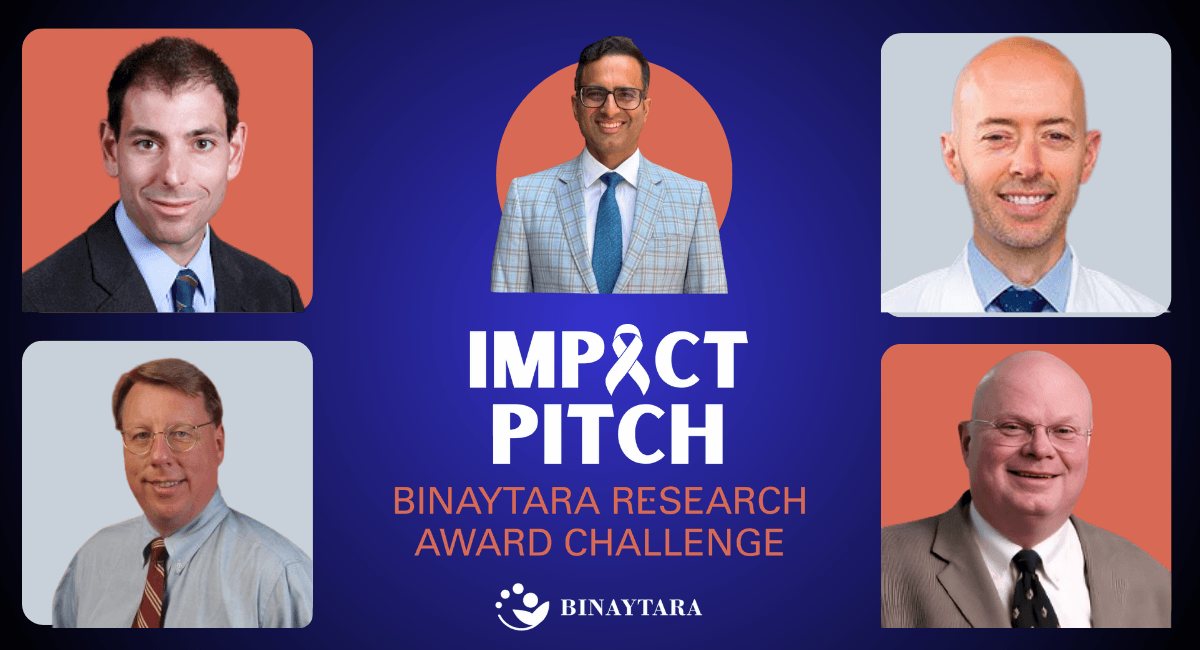
The format of the challenge encourages research communication skills. Participants take the stage to make a case for an original research project in the field of precision medicine. They are observed by a panel of experts: the Catalysts, field-leading investigators and clinicians who will offer real-time mentorship and critique—and ultimately decide whose research receives $25,000 in funding.
Who will ask the toughest questions? Who will challenge whether a laboratory discovery can actually scale to save a patient's life? Learn about the team helping to shape the next generation of precision medicine.
Mark Pegram, MD: Patient Outcomes Come First
Mark Pegram, MD, will temporarily switch hats to act as Catalyst in the Impact Pitch—the research-focused oncologist is also co-chair for the Precision Oncology Summit. The meeting has benefitted from his clinical rigor on the planning side, and that same expertise will find a new home on the Catalyst panel.
Along with being on the Binaytara Board of Directors, Dr. Pegram is the Suzy Yuan-Huey Hung Endowed Professor of Medical Oncology at the Stanford University School of Medicine, Associate Director of Clinical Research at the Stanford Comprehensive Cancer Institute (SCCI), Associate Dean for Clinical Research Quality at the Stanford University School of Medicine, and Medical Director of the Stanford Clinical Translational Research Unit. He has authored more than 110 publications across topics. His research specialty is “molecular mechanisms of targeted therapy resistance in breast and other cancers” — in other words, the science behind why precision medicine doesn’t work for certain people. He is involved in numerous clinical trials in this vein.
Given the clinician-researcher’s outcomes-driven clinical focus, Dr. Pegram’s line of questioning will home in on patient outcomes. How will a given proposal translate into meaningfully better patient outcomes? How will outcomes inform research design?
James Ford, MD: High Risk, Early Response
James Ford, MD, will join Pegram in his dual role at the Precision Oncology Summit: both conference co-chair and Impact Pitch Catalyst. Dr. Ford, who received both his undergraduate and medical degrees from Yale University, is a Professor of Medicine (Oncology) and Genetics at Stanford University. He is also Director of the Stanford Cancer Genetics Clinic and the Cancer Genomics Program at the Stanford University Medical Center.
His clinical interests involve the treatment of people with genetic predispositions to cancer; he studies the role of the p53 and BRCA1 tumor suppressor genes in DNA repair, and works to match the specific molecular signatures of certain cancers with the best targeted treatment. The Stanford Cancer Genetics Clinic works to identify high-risk patients, offering counseling, testing, and diagnosis.
In the Impact Pitch, Dr. Ford is liable to wonder: What about people who are genetically predisposed to the disease? How can a given project advance preventive medicine, showing up for patients before the burden of cancer has grown?
James Brugarolas, MD: The Translational Pipeline
By the time the Impact Pitch comes around in the Precision Oncology Summit’s packed two-day agenda, audiences will recognize James Brugarolas, MD, from his Day 1 talk, “An Academic Journey from Gene Discovery to First-in-Class FDA Approval for Familial and Sporadic Kidney Cancer.”
A tenured Professor in the Department of Internal Medicine at UT Southwestern Medical Center (UTSW) and a member of its Division of Hematology/Oncology, Dr. Brugolas is a physician-scientist who specializes in kidney cancer. He holds the Sherry Wigley Crow Cancer Research Endowed Chair in Honor of Robert Lewis Kirby, MD, and is the founding director of the Kidney Cancer Program (KCP) at the Harold C. Simmons Comprehensive Cancer Center.
His lab’s work has identified the genes that cause kidney cancer, created the first genetic system to classify different tumor types, and developed advanced mouse models to safely test new treatments. Furthermore, they discovered a key protein that the cancer relies on to survive, identified what makes tumors become aggressive, and explained the biological mysteries behind why the disease progresses differently in each patient.
The throughline that connects his work is more than just kidney cancer: Dr. Brugarolas is interested in taking laboratory discoveries and translating them into real interventions. He will evaluate pitches on drug design, tumor vulnerabilities, and whether cool-sounding science can actually be commercialized.
Trever Bivona, MD, PhD
Joining the Catalyst panel is Trever G. Bivona, MD, PhD, a Professor of Medicine and Cellular and Molecular Pharmacology at UCSF, and a Senior Investigator at the Chan-Zuckerberg Biohub Cancer Center. As both a cell biologist and a board-certified medical oncologist, Dr. Bivona’s career is dedicated to studying the exact mechanics of tumor initiation, growth, and metastasis.
Dr. Bivona acts as the Director of the NCI-funded Bay Area Drug Resistance and Sensitivity Center within the federal Cancer Moonshot program. His lab's ground-breaking discoveries have mapped out how tumors outsmart modern medicine—including uncovering how cancer cells change form to hide from drugs, or go entirely dormant to evade treatment.
Because of this focus, Dr. Bivona brings the ultimate stress-test perspective to the Impact Pitch panel: the long game. He is highly likely to challenge pitchers on the longevity of their designs. Your drug or tool might work beautifully on day one, but what happens on day one hundred when the cancer tries to find a biological escape hatch?
Moderator: Varun Monga, MD
Last but not least, the Precision Oncology Summit’s Impact Pitch will benefit from having Varun Monga, MD, as moderator. Dr. Varun Monga is a medical oncologist at UCSF who cares for patients with bone and soft tissue growths, including sarcomas. Dr. Monga works directly within UCSF's early-phase experimental therapeutics program, where he enrolls and treats patients in phase 1 clinical trials, evaluating promising new treatments with human volunteers.
Because Dr. Monga lives at the intersection of laboratory science and initial human trials, he is uniquely qualified to steer the evening’s high-velocity conversation. He knows exactly what it takes to guide a raw scientific concept into its very first clinical trials. As moderator, Dr. Monga will keep the pitches moving, balance the judges' critiques, and ensure the focus remains right where it belongs: on cutting-edge innovation that can scale to save lives.
Join Impact Pitch Leadership at the 6th Binaytara Precision Oncology Summit
The Impact Pitch is where science meets real-world execution. Come watch these leading clinical minds put tomorrow's oncology breakthroughs to the ultimate test. Register for the 6th annual Binaytara Precision Oncology Summit in San Francisco to witness the live pitches, connect with global experts, and see who takes home the $25,000 Research Award.
Recommended Articles