
Author
Binaytara Team
Your Path to the Shaji Kumar Hematology Awards: Tips from the Scientific Review Committee
Hematology fellows and early-career faculty now have a major opportunity to showcase impactful research and compete for up to $50,000 in funding through the Shaji Kumar Hematology Research Awards. Here’s what the Scientific Review Committee says separates strong abstract submissions from the rest.
Key Takeaways: What, When, and Why to Submit
- Abstract deadline: August 15 (rolling review) for the National Summit on Hematologic Cancers (Oct 16–17, Nashville, TN).
- Funding opportunity: Shaji Kumar Hematology Research Awards offer up to $50,000 (faculty) and $25,000 (fellows), with $250,000 total funding.
- Eligibility: Early-career hematology faculty (≤10 years post-fellowship), and hematology fellows.
- What to submit: Novel clinical, translational, or impactful case-based hematology research.
- Winning formula: Clear structure (intro → hypothesis → methods → results → conclusion), concise writing, and strong clinical relevance.
- Reviewer priority: Research that improves patient outcomes, shows innovation, and has future development potential.
- Bonus exposure: Accepted abstracts are presented and published in a peer-reviewed journal.
National Summit on Hematologic Cancers: First Steps
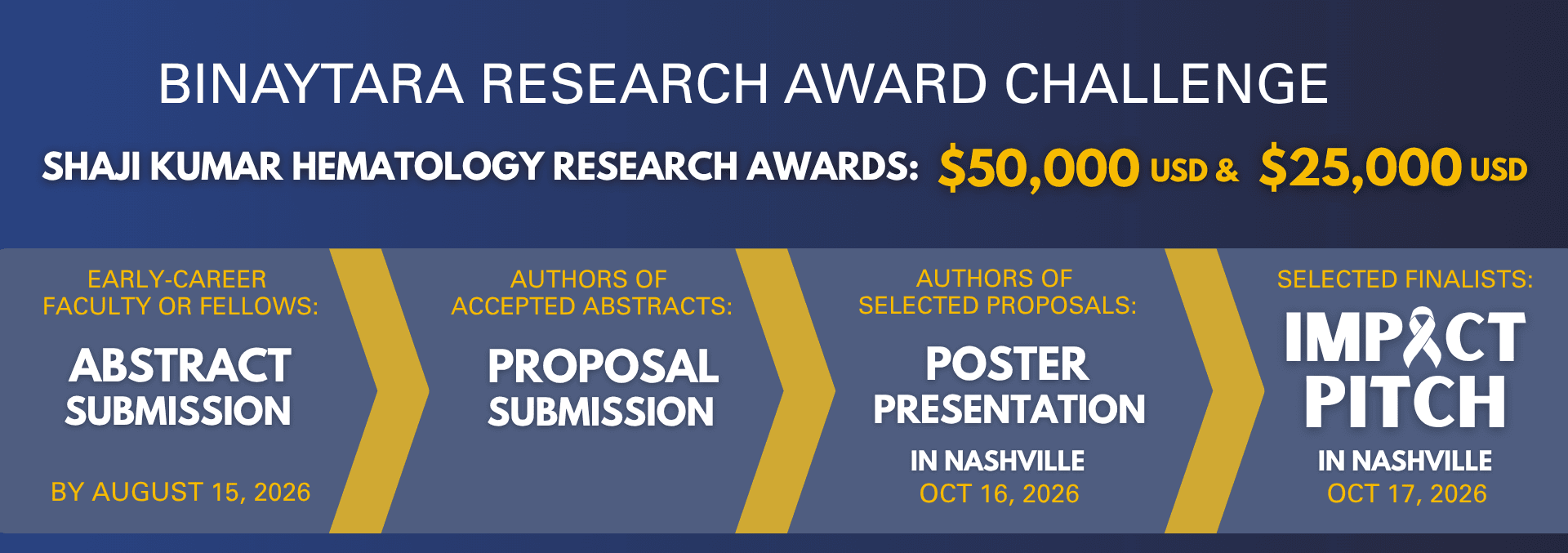
Binaytara is now accepting abstract submissions for the National Summit on Hematologic Cancers, which will take place on October 16 - 17. At the Summit, Binaytara will disseminate the inaugural Shaji Kumar Hematology Research Awards of up to $50,000 per awardee, with $250,000 in total funding available.
Put like this, the path from ideation to funding looks downright simple in its straightforwardness—but as neat as oversimplification can look, every investigator knows: there are a thousand points between Point A and Point B. At a time when research funding is both more necessary than ever and harder to come by, “I wanted it to be more transparent,” Binaytara President Dr. Binay Shah explained of his nonprofit’s research award process. “And facilitate the growth of early-career investigators,” he added.
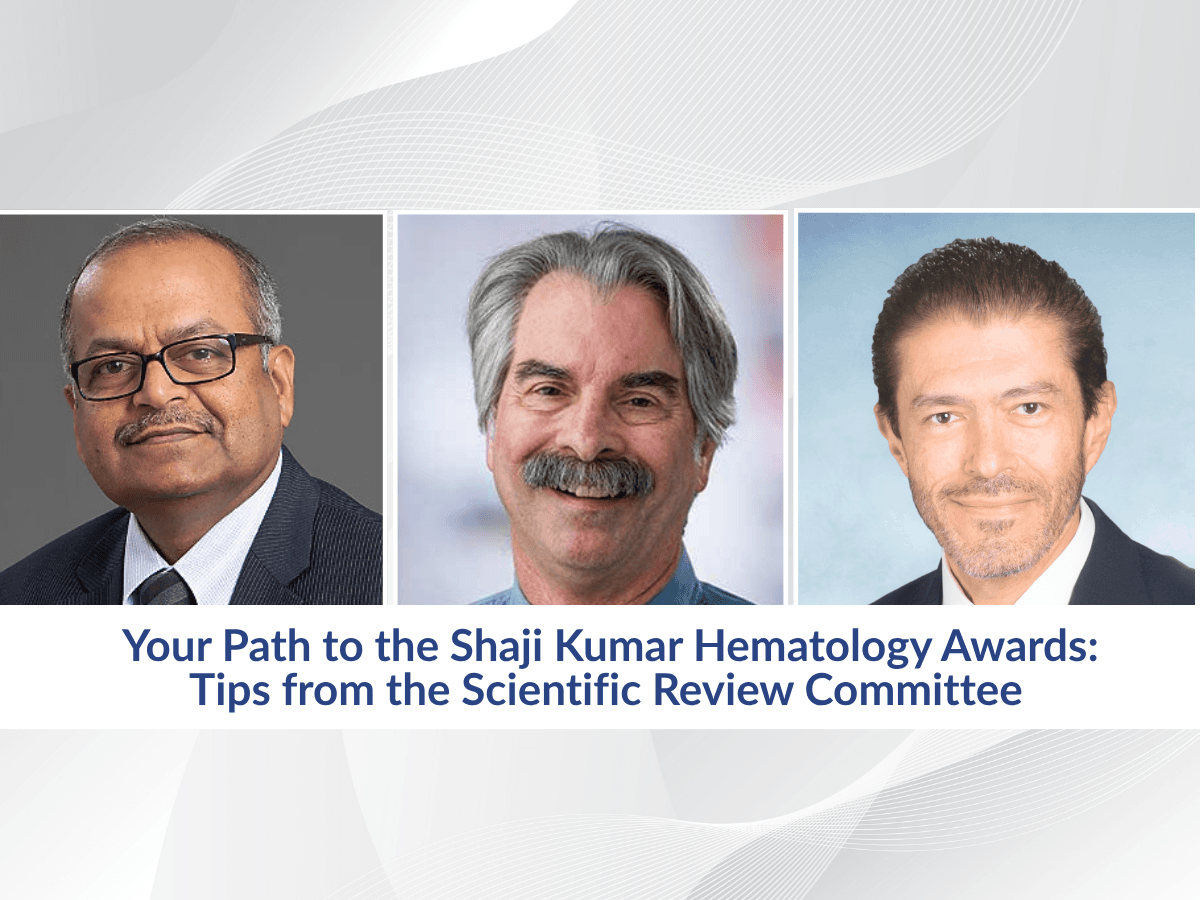
To map out the steps between the starting line and the finish, then, we spoke to the National Summit on Hematologic Cancers’ Scientific Review Committee: Dr. Parameswaran Venugopal, from Rush University; Dr. Jerald Radich, from Fred Hutchinson Cancer Center; and Dr. Jorge Cortes, from O’Neal Cancer Center at the University of Alabama at Birmingham. If you’re a hematology fellow or an early-career faculty member and are considering submitting research to the National Summit on Hematologic Cancers, here are five tips you should keep in mind—straight from the people who will be reviewing your work.
What Does it Take to Impress the Scientific Review Committee?
1. Keep the award timeline and criteria in mind
“The Binaytara National Summit on Hematologic Cancers is an excellent platform to showcase innovative clinical or translational research,” Dr. Venugopal described the process. “Accepted abstracts will not only be presented at the meeting but also published in [the peer-reviewed medical journal] the International Journal of Cancer Care and Delivery. In addition, authors of accepted abstracts will have the opportunity to submit research proposals for the Shaji Kumar Hematology Research Awards, which provide substantial financial support for early-career investigators and fellows.”
More granularly, the process starts with abstract submission. As Dr. Radich concisely put it, “Any research subject pertaining to hematologic malignancies is fair game.” Dr. Cortes elaborated: “Anything from original research to case series, and even exceptional case reports that provide novel perspectives on a disease or treatment, are acceptable.”
The Shaji Kumar Hematology Research Awards are open to hematology fellows and early-career faculty. Fellows are eligible for awards up to $25,000, while faculty within ten years of fellowship are eligible for awards up to $50,000. Multiple awards will be disseminated, with $250,000 of total funding on the table. Awardee candidates are selected from first authors of accepted abstracts, which are reviewed on a rolling basis until the deadline of August 15th.
To recap: Submit novel hematology research to the National Summit on Hematologic Cancers, knowing that the conference comes with multiple avenues to showcase your research, including online publication and presenting at the conference.
2. Be organized, be purposeful, and—Dr. Radich cannot stress this enough—be concise
The National Summit on Hematologic Cancers’ Scientific Review Committee members are driving some of the most important translational research in hematology today. They’re precisely the team to identify the next generation of practice-changing clinical investigation—but that expertise comes with a time crunch.
Dr. Radich, for one, invites no ambiguities. “When considering an abstract, remember your audience,” the molecular genetics researcher stressed. “Your reviewers are overworked, have little time, and are likely reading your abstract on a plane. Thus, be clear, be simple, be concise. Assume that the reviewer is not an expert in your particular topic. Lead with a sentence or two of introduction, then state a clear hypothesis, and how you tested that hypothesis. Finish with telling them what you told them. It is key that the reviewer can understand your abstract in one reading—if it is so complicated that it needs a second reading, you have failed.”
“It is important that abstracts can tell the story the trainee or early-career faculty is trying to deliver,” Dr. Cortes added.
To recap: Your reviewers want you to succeed, but success sometimes looks like cutting fluff. Follow a clear formula—introduction, hypothesis, testing details, and finally a clear and reiterative conclusion—to make sure the crux of your research comes through on a first readthrough.
3. Translational is best: consider patient outcomes and wider relevance
For Drs. Cortes and Venugopal, clarity and purpose go hand in hand. Good research doesn’t happen in a vacuum, but as part of a larger conversation driving toward a clear goal. It should never leave a reviewer wondering, “Why does this matter?”
“For early-career investigators considering submitting an abstract, my advice is to focus on clarity, clinical relevance, and the potential impact of your work on patient care,” Dr. Venugopal said. “Strong abstracts clearly define the question being addressed, present well-organized data, and highlight why the findings matter for the hematology community.”
“Emphasize what is novel and why it is important,” Dr. Cortes echoed, “as well as the potential it may have to advance the care of patients or the understanding of the hematologic disease under study.”
To recap: If you’re struggling to address why your research matters in a broader context, that’s coming through to the scientific reviewers. Take a moment to consider what your research could mean for patients or the hematology clinicians treating them, and make sure that that translational grounding forms a thread throughout your entire abstract.
4. Think about where your research can go from here
Dr. Cortes in particular is excited about research that has the potential for development. In an effort to get ahead of the “Why does this matter?” question, investigators may be tempted to overstate the scope of their work—to the detriment of their investigation’s quality and actual real-world feasibility. But research that forms a stepping stone to a larger project (albeit with its own self-contained and self-evident clinical implications) will go further with the Scientific Review Committee.
“We are looking for novel concepts where the trainee or the eligible faculty are driving the research,” Dr. Cortes said, “and particularly if there is a plan for additional work; leading, perhaps, to future study.”
To recap: Be realistic about what your investigation accomplishes, and for whom, at this stage. But consider how it might develop after that—how you might deepen the impact of your work and extend your reach, especially to underserved communities.
5. Have fun (yes, really)
Is there room for fun in hematology research? The National Summit on Hematologic Cancers’ Scientific Review Committee is here to answer in the affirmative.“Mostly,” Dr. Radich concluded, “have fun. Go from a blank piece of paper to a version of yourself to be proud of.”
Executing and sharing a research project is, in itself, something to be proud of, and with this mindset, the less-than-thrilling part of the research process is just part of the journey. Plus, the Scientific Review Committee can promise some good times—in the more traditional sense—to come.
“This is a great opportunity to be part of a great conference alongside some of the leading experts in hematologic malignancy research, to highlight your research, and possibly even get funded to continue advancing your research,” Dr. Cortes said. “I hope to see you and your research there.”
National Summit on Hematologic Cancers: Next Steps
The National Summit on Hematologic Cancers will take place on October 16 - 17 in Nashville, Tennessee. Submissions will be reviewed on a rolling basis until the deadline of August 15th. Visit the abstract site to learn more about full abstract submission criteria. Read more about the Scientific Review Committee, along with the Abstract Committee Chairs, here. If you are interested in submitting research in conjunction with another conference, browse Binaytara’s other abstract-eligible oncology events.
Frequently Asked Questions About the Shaji Kumar Hematology Research Awards
Who can apply for the awards?
Hematology fellows and early-career faculty within 10 years of completing training.
What types of research are accepted?
Clinical, translational, original studies, case series, and high-impact case reports in hematologic malignancies.
How much funding is available?
Up to $50,000 per faculty awardee, $25,000 for fellows, with $250,000 total.
What do reviewers look for most?
Clarity, conciseness, novelty, clinical relevance, and impact on patient care.
Do I need a fully developed project?
No—but strong proposals show clear results and a roadmap for future research.
What are the key dates?
Abstract deadline: August 15 (rolling review). Conference: October 16–17 (Nashville, TN).
What’s the biggest mistake to avoid?
Overcomplicating your abstract—reviewers should understand it in one read.
Recommended Articles