Building Skills, Making Impact: Spotlight on Binaytara Summer Intern Divyanshu Kumar
Author
Binaytara Team
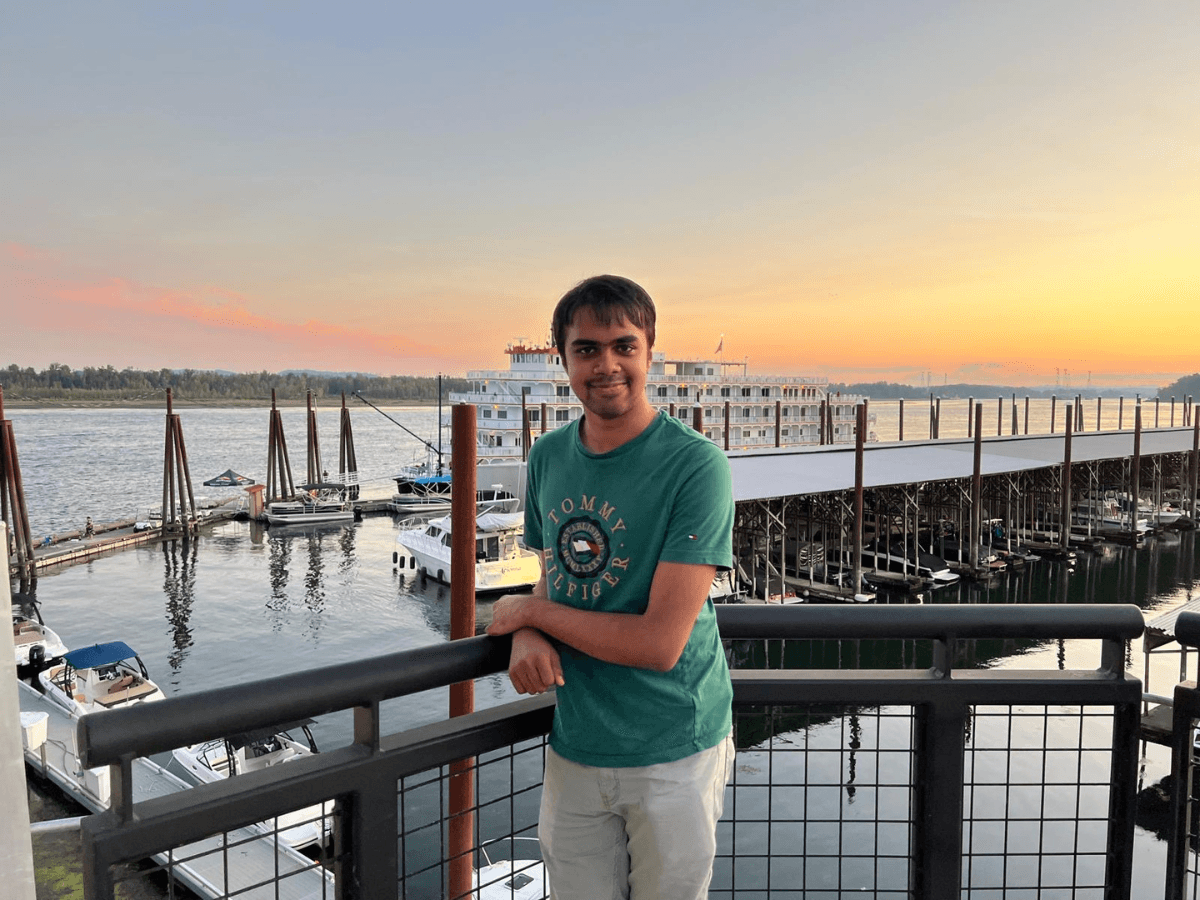
Driven by a love of problem-solving and a commitment to health equity, UW Bothell math major Divyanshu Kumar spent summer 2025 as a Binaytara research & development intern, exploring AI and edge computing for cancer detection and collaborating across teams to tackle global cancer disparities.
Meet one of our 2025 summer interns, Divyanshu Kumar, a junior at the University of Washington Bothell majoring in mathematics. He brings his passion for math, problem-solving, and artificial intelligence to tackling real-world challenges in global health.
Intern Profile: UW Bothell Math Major on AI & Global Health
In this interview, Divyanshu discusses his academic background, research methodology, and vision for the future of AI-driven healthcare equity. He further shares some insights on interdisciplinary collaboration, the challenges of addressing cancer disparities, and the transformative power of applying mathematical principles to minimize cancer disparities.
Binaytara | Question: Can you briefly introduce yourself?
Divyanshu | Answer: “My name is Divyanshu Kumar, and I am a summer intern working as a research and development intern at Binaytara. I am also part of the marketing and communication team.”
Q: What motivated you to study mathematics? What interests you about it?
A: “Since my school years before college, I have always been interested in problem-solving, and I have always been good at math. Studying it in college, I find it versatile.. I know that mathematics gives knowledge of algorithms for innovative devices and biomedical systems, which is one career path I would like to follow in the future.”
From Volunteer to Intern: Joining Binaytara to Tackle Cancer Disparities
Q: What inspired you to intern at Binaytara this summer?
A: “Last fall, in November 2024, I had the opportunity to volunteer at the Global Oncology Summit in Seattle. I had the opportunity to listen to presentations from scientists, researchers, and doctors who were talking about technological intelligence to resolve cancer disparity across the world. This confirmed my interest in coming here to learn more about the bigger picture of the problem that Binaytara is trying to solve regarding cancer disparities. I knew that interning at Binaytara would help me work closely with colleagues and mentors who would further expose me to how research is done. I am also interested specifically in the technological feasibility and cost-effectiveness of models that underserved cancer patients can use.”
Research Focus: Edge Computing for AI-Driven Cancer Detection
Q: Can you tell us about the research you are working on?
A: “I conducted a meta-analysis from six research papers, five from the PubMed database, and another independent research paper done by a hospital in Finland. My topic was about edge computing in AI and cancer detection, which is an alternative to the traditional approach of AI requiring centralized data and large volumes of data that rely on remote servers. Traditional methods require fast internet connectivity, which is a problem for communities such as rural areas, where not only is cancer care limited, but internet connection is also a problem.
Edge computing uses localized data that runs on servers within hospitals and other locations near the device and requires low bandwidth, as opposed to the high-end and fast connectivity of the traditional approach. Another benefit of this new technology is that it can be portable; rather than having to rely on a device at a single location that processes data from a server far away, you can take the device with you wherever you go.”
Presenting the Work: Global Oncology Summit 2025
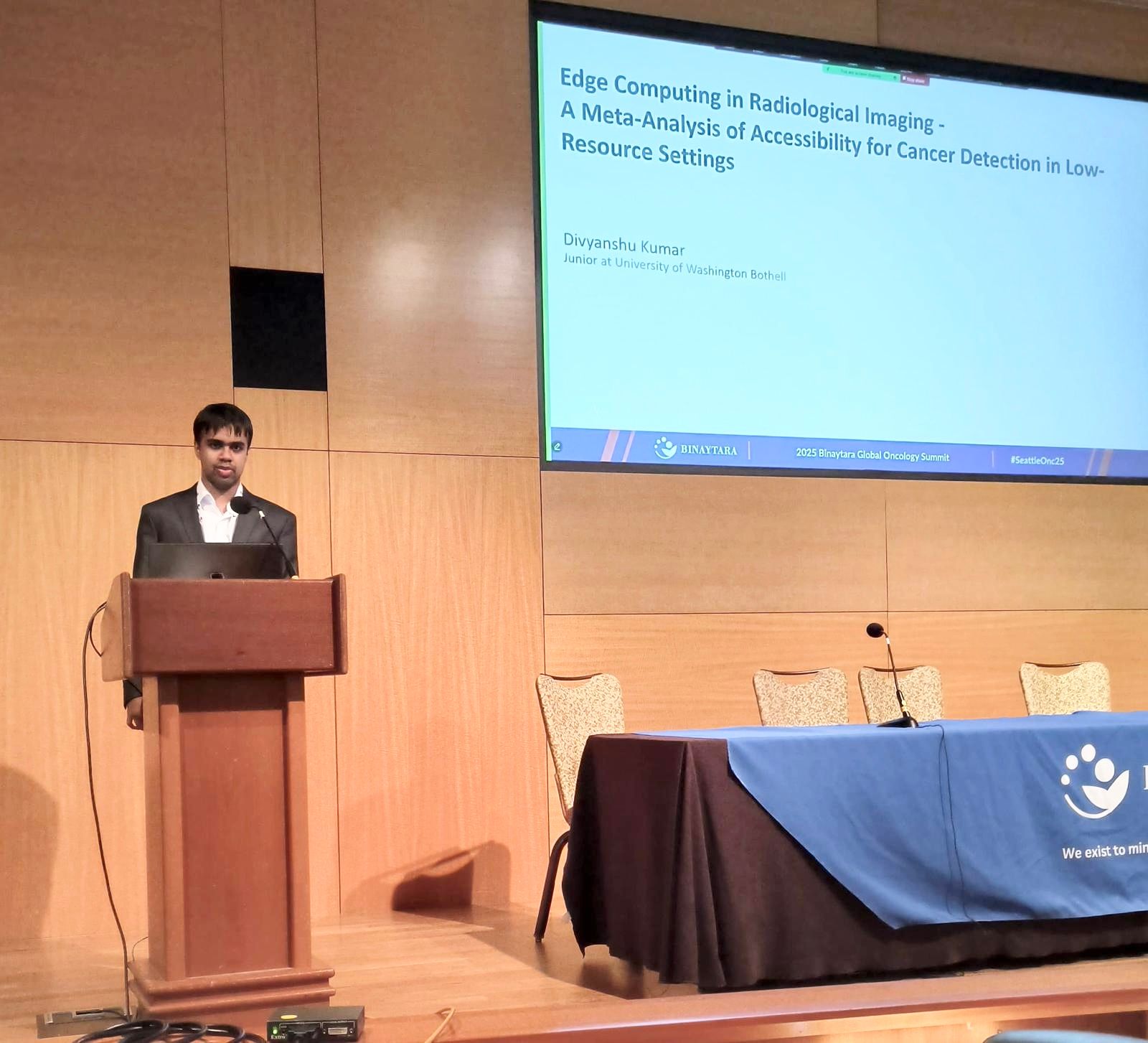
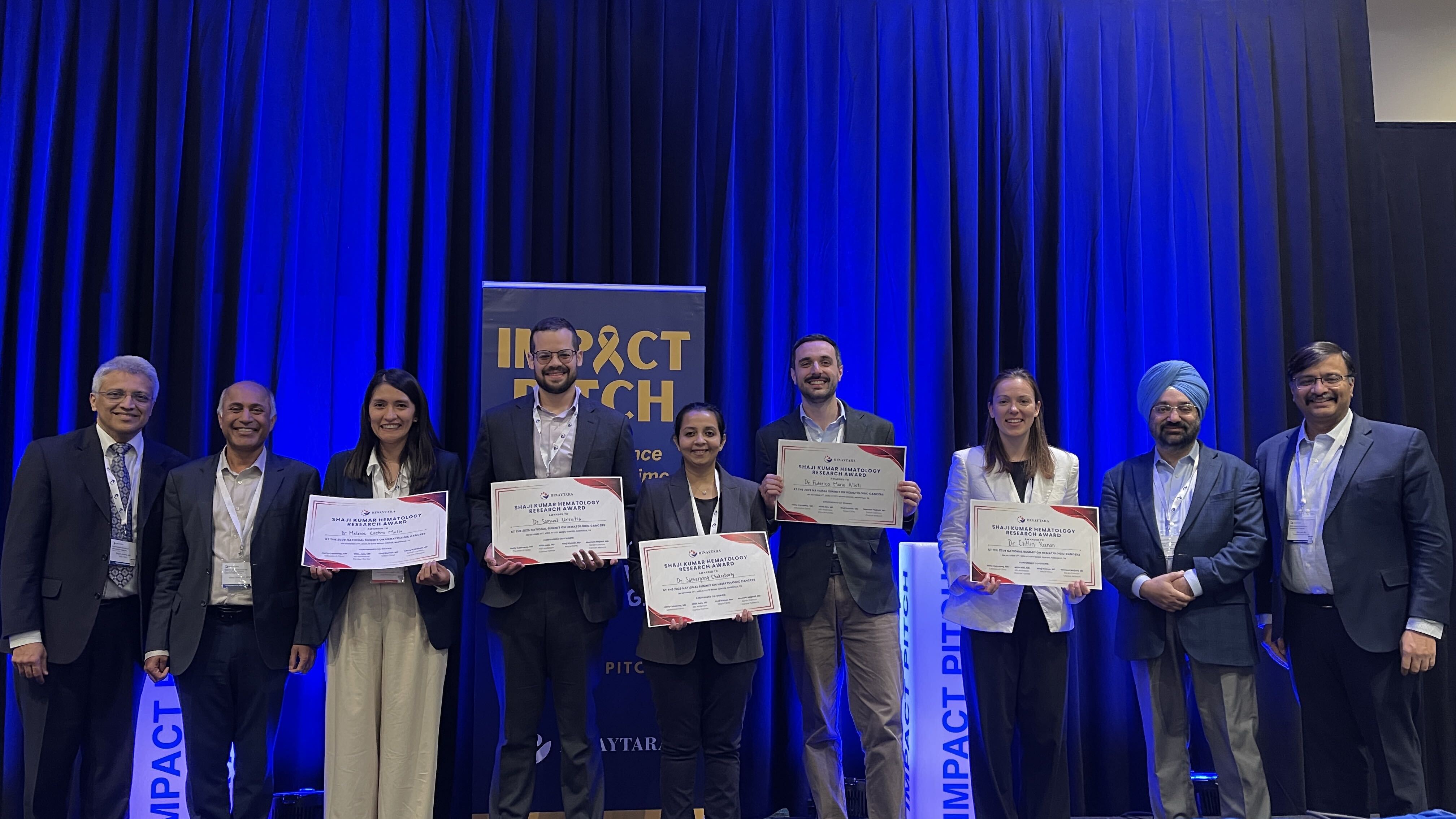
Divyanshu Kumar presenting at the Binaytara Global Oncology Summit.
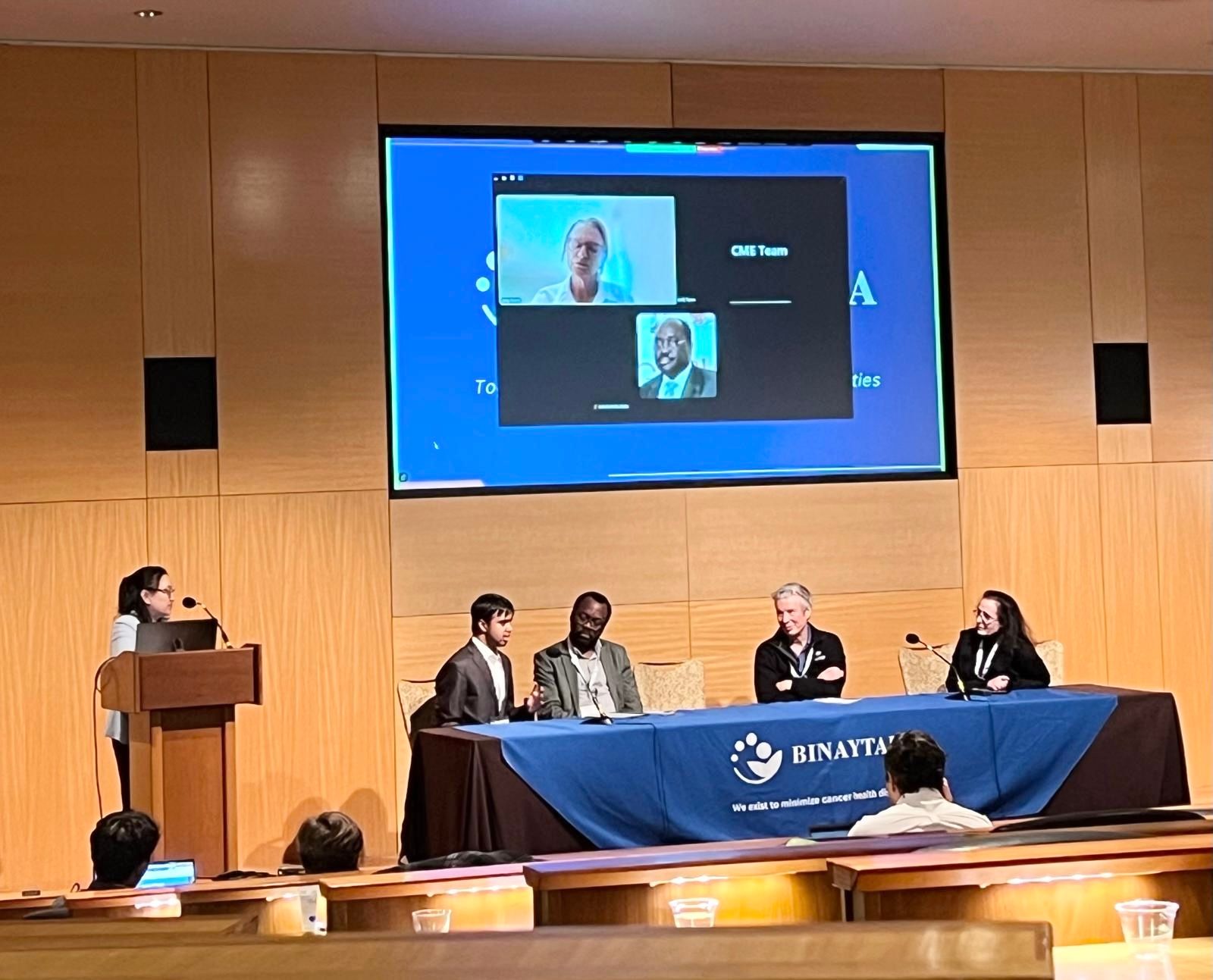
Divyanshu Kumar participating in a Binaytara Global Oncology Summit panel discussion with other speakers.
Q: Where will you be presenting this research?
A: “After completing my research, I have submitted an application for the Global Oncology Summit for fall 2025, held on November 1st. I hope to present my research at the summit to an audience including doctors and researchers. I would like them to hear it and answer any questions they have. I feel like it would be an eye-opening experience for me to present to a crowd of experts and people a lot more knowledgeable than me.”
Q: Will you continue this research when you return to school?
A: “My school offers summer research internships that select students into their cohorts based on research interests and previous experiences. I hope to take this research to my school's summer research program for 2026 to further expand my knowledge on using new AI devices and biomedical devices to address disparities across the world. I also want to narrow my interest down because I hope to, after undergrad, pursue a Master's and PhD in graduate school to do more research with professors and mentors.”
Learning by Doing: Cross-Team Collaboration & Mentorship
Q: What kind of support did you receive for your research?
A: “From my team in the office, I received support in a way that I should not have felt afraid to reach out or ask questions, because this was my first research experience, so I knew I would need all the help I could get. I reached out to Matt and Aishat for guidance on my project and feedback on how to improve an abstract paper. I started by writing a brief outline of what I wanted my project to be about and created a five-step plan over five weeks to start and finish my project. I was able to take in any feedback or questions after they read my abstract, and I was able to build upon that.”
Q: Can you talk about other projects you worked on this summer?
A: “I wrote an article that summarized cancer research addressing a new method of cervical cancer screening for women, where women do not go to the hospital, but rather a device is mailed to you, and you can perform the screening yourself. I am also helping my two colleagues, Audrey and Maeve, under Matt's guidance, on a research project led by a researcher from Nepal working in Thailand. Through my involvement in this project, I gained experience in how screening is done and the process of performing research, which helped me with my own abstract research project.”
Q: How has it been working with different teams at Binaytara?
A: “It has been a rewarding experience because working across different teams has helped me gain confidence in learning from my mistakes. I'm not afraid to ask questions, I am not afraid to be wrong or make a mistake, and I am confident and not afraid to seek help from my colleagues. I am also happy to assist people with tasks and ongoing work they need help with. For example, with the fundraising department, there are rows and rows of a spreadsheet to be filled out, and I was happy to partake in that.”
Q: What's been your most memorable moment working at Binaytara?
A: “My most memorable moments have been the team meetings because I like hearing from my colleagues and learning about what they have done and what their goals are. Since I don't speak to them in the office as much in that specific manner, it is nice to hear back from them, and also for me to tell them what I am doing and what my highlights are. I also enjoyed having the opportunity to listen to Matt and Jess talk about the overall purpose of marketing and communications.”
Takeaways: Time Management, Communication, and Confidence
Q: If you could sum up your whole experience in one sentence, what would you say?
A: “My experience as an intern at Binaytara has been valuable for me in the sense of applying my technical skills and knowledge outside the classroom and bringing it to work to further strengthen my skills of problem solving, communication, and collaboration.”
Q: What's one skill you have developed here that you will be taking back to college?
A: “Time management. Since my first day, I was given tasks, and then I was doing more and more work day by day. At first, I was unsure of how to do it all, but with the help of Matt and my other teammates, I was able to divide up the work day by day and use my time wisely. This can be applied to school because I take multiple classes and have several assignments, homework, and tests. If I can apply my time management skills here in an office, I can for sure apply them in classroom settings where I am managing many assignments and preparing for tests.”
Advice to Future Interns: Embrace Challenges and Grow
Q: Any final words of encouragement for students thinking about interning at Binaytara?
A: “I will speak from experience, everyone starts as a beginner, regardless of the internship position. So if you feel like you are out of place or you do not belong here on the first day, that is normal, and you are on the same page as any other intern. Rather than doubting yourself, remember that what defines you as an intern is your ability to face challenges. Rather than seeing challenges as moments of difficulty and discouragement, see them as new opportunities to shine and try something new.”
Interested in a Binaytara Internship? How to Apply
Want to gain hands-on experience in global health and health disparities? Check out our Global Health and Health Disparities Internship Program. For more information and other short-term internship opportunities, contact the Binaytara Internship Program Director, Matt Lambert, at [email protected].
Recommended Articles