Dr. Sonali Smith on Binaytara's Cellular Therapy Summit: Implementation Science, Cancer Health Disparities, and the Cusp of Progress

Author
Binaytara Team
"
One of the most important pieces about disparities is that in some ways, we don't need to continue to develop newer and newer therapies, if we can make sure that everybody can get the therapies that already exist.
Sonali Smith, MD
Speaker, Seattle Cellular Therapy Summit
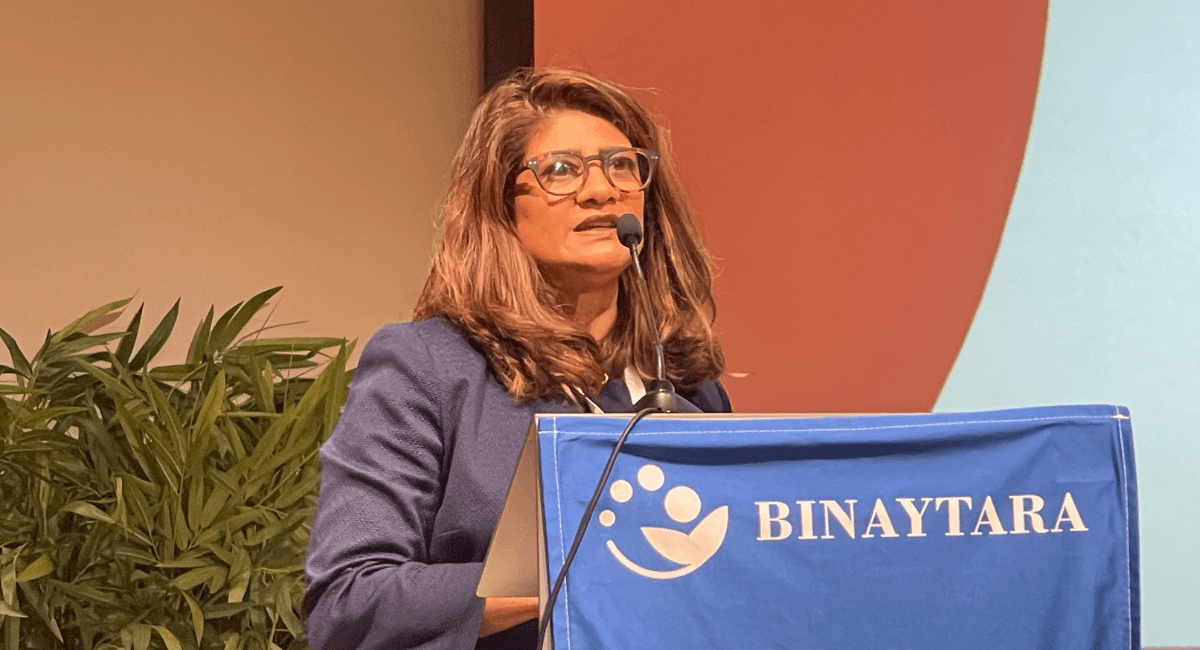
Dr. Sonali Smith at the Seattle Cellular Therapy Summit
Binaytara’s Seattle Cellular Therapy Summit took place on August 14 and 15. The meeting gathered experts across disciplines to discuss updates in cellular therapy—the use of living cells to treat disease, including therapies that modify a patient's or donor's immune cells to recognize and attack cancer cells.
Dr. Sonali Smith (Elwood V. Jensen Professor of Medicine, Section Chief of Hematology/Oncology, Co-Leader of the Cancer Service Line, and Co-Director of the Lymphoma Program at the University of Chicago in the Department of Medicine) joined colleagues to speak on cellular therapy for aggressive B-cell lymphoma. Following a survey of the current state of the field, the oncologist predicted how diffuse large B-cell lymphoma (DLBCL), a common subtype of aggressive B-cell lymphoma, might be treated in the not-so-distant future.
Dr. Smith’s talk was aimed at the oncology doctors, nurses, and health care providers attending the conference, which focuses on translating scientific advances into optimized care pathways and improved outcomes.
After the fact, Dr. Smith spoke to the Binaytara team about both the clinical and not-so-clinical sides of the meeting: highlights from the conference, why her field’s rapid pace is actually operationally problematic, and how to empower patients to learn about the latest treatment options.
The following interview has been edited for length and clarity.
Binaytara: What has been a highlight of the conference for you?
Sonali Smith, MD: I mean, can I say the boat ride from last night? You know, I think one of the nice things about all of these smaller meetings—and Binaytara does this very well—is to be able to bring the people in the field together in an informal setting.
And, of course we do a lot of socialization. But we also talk about lymphoma or myeloma—whatever it might be—more casually. It's those informal connections that I think are really important.
Binaytara: What is the biggest barrier between where we are now and integrating genomic subtyping into clinical practice and precision medicine [for diffuse large B-cell lymphoma]?
Sonali Smith, MD: I think the biggest barriers are—well, a couple of things.
One is that there are multiple platforms that are being developed, or multiple approaches. Whether it's the NCI approach or the Dana-Farber approach; MD Anderson is looking at the tumor microenvironment, and the United Kingdom has a different approach, too. So a big barrier is that we are not aligned as a field on a uniform way of assessing genomic classification for diffuse large B-cell lymphoma.
The other is that, once we do agree on something, you have to find a way to commercialize the approach, or at least have it available through a CLIA-certified laboratory, so that it can be used not just in specialized centers, but also in non-specialized centers.
And then, the third piece of it, which I alluded to in my talk, is that we don't really have the drugs for all of the different subtypes.
For one of the subtypes, C5, we have some promising drugs, like BTK inhibitors. But for some of the other classes or groups, C3 and C4 (these are part of the Dana-Farber approach), we don't really know which drugs to test.
And so I think we're still a ways away from using that as our approach to precision medicine.
Binaytara: What would it look like for the field to standardize and unify around one standard approach—take these factions and put heads together? What would that look like?
Sonali Smith, MD: I mean, it would probably have to be a multi-day meeting where people can agree that, in some ways, done is better than perfect.
Maybe the challenge is that the field is moving at a pace where we can’t quite reach a point where we can actually take stock of everything and say, “All right, let’s align around this.” We’re just almost there. But not quite.
So, to be honest, I think refining the tools, and then aligning around them, is going to be important.
Binaytara: And then, for the access that we do have, do you see any kind of disparities in how those are being made available, with certain patients getting access and certain patients not? Do you have any worries there?
Sonali Smith, MD: You know, I will say, you asked me about the highlights of the meeting. I'll tell you, within the meeting itself, the highlight for me really was learning a lot about what the University of Washington and the Hutch are doing around making sure that these newer therapies are available throughout the state.
And it really comes down to implementation science and collaboration.
To be able to see Dr. [Mazyar] Shadman and Dr. [Sibel] Blau give their talks back-to-back about what they're doing here, it was really very impressive.
And one of the most important pieces about disparities is that in some ways, we don't need to continue to develop newer and newer therapies, if we can make sure that everybody can get the therapies that already exist. We’d improve survival dramatically if we could just do that.
So I think that was really a highlight. It was great to hear about it.
Binaytara: Lastly, for patients not at academic centers, what would you tell them about learning about and accessing these treatments?
Sonali Smith, MD: Yeah, reaching patients around the country is a real challenge, and I don't think any one academic institution can do it. I think this is where some of the advocacy groups, like the Lymphoma Research Foundation, really can do more outreach.
I will tell you, there's such heterogeneity in the knowledge base of the doctors to advise their patients. And a lot of times, patients are sort of left to their own devices to try to figure out what their options and opportunities are. That gap also needs to be bridged. Empowering patients to know where to look is one area where advocacy groups play such an important role.
Recommended Articles