When Trusted Neighbors Become Trained Healthcare Advocates: Training Female Health Workers in Janakpur

Author
Binaytara Team
When Trusted Neighbors Become Trained Healthcare Advocates: Training Female Health Workers in Janakpur
In Madhesh Province, Nepal, cervical cancer screening rates remain critically low, and a good test alone can’t fix that. The Binaytara Cancer Research Institute trained 36 Female Community Health Volunteers, trusted local women, to become screening advocates in their communities. After training, knowledge and confidence rose sharply, offering an early model for culturally tailored, community-led cervical cancer prevention.
The Cervical Cancer Screening Gap
Despite the fact that it’s possible to screen for cervical cancer using low-cost, scalable technology, the disease persists in low- and middle-income countries. In places like Madhesh Province, Nepal, the cervical cancer disease burden is high and the screening rate is critically low. As Binaytara Cancer Research Institute Implementation Science Officer Jin Mou, MD, PhD, pointed out, “A good test can't fix a broken referral pathway or an unasked cultural question.”
That is, accessible technology is a start. Culturally-tailored care is the catalyst that leverages a starting point into real impact. What are the real-life barriers keeping a particular community from accessing equitable cancer care? What will it take to build a program that overcomes them?
These were the guiding questions behind Binaytara’s HPV-based cervical cancer screening camps in Madhesh Province, Nepal. This led to targeted program design: feasible technology to conduct the tests (DNA tests using isothermal assays), same-day results to minimize time burden, mobile camps to eliminate travel barriers, and no fee for participants to ensure accessibility. Binaytara Cancer Research Institute (BCRI) also piloted a community-based approach, utilizing the help of Nepal’s grassroots healthworkers, Female Community Health Volunteers (FCHVs). It was this latter initiative that earned BCRI a poster presentation slot at ASCO’s 2026 Annual Meeting, the largest oncology conference in the world.
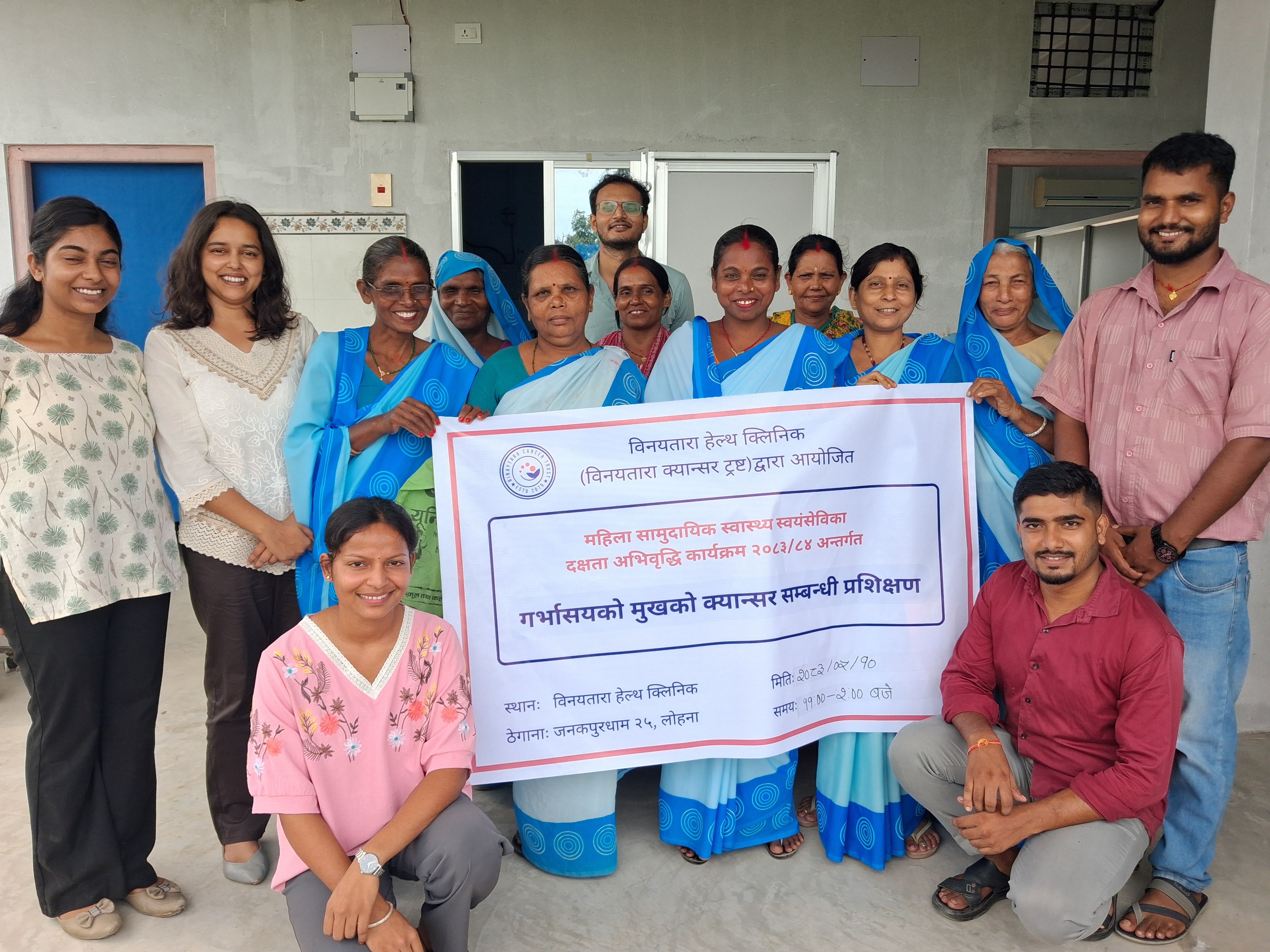
FCHVs traditionally deal in maternal and newborn care and nutrition, so the program wasn’t ready to ship untouched. For the FCHVs to be effective healthcare advocates for cervical cancer, training was in order. Binaytara’s Nepal Team trained 12 FCHVs for the 2025 screening camps, and found that the women were effective touchpoints to drive participation at the camps.
To BCRI, that showed that impact waited in a more robust FCHV program. What if more FCHVs participated—and even more pivotally, what if their training was targeted to turn them into effective cervical cancer screening advocates in their communities?
Effectively Training FCHVs
First, the team had to establish an effectiveness baseline. To assess the training sessions’ effectiveness in the upcoming 2026 round of screening camps, BCRI assessed the situation empirically (in fact, a scientific manuscript is in the works about the team’s findings).
They worked with 36 total FCHVs; three times last year’s cadre. BCRI Medical Officer Dr. Amit Chaudhary took the lead creating the training materials. He made them multilingual, multimodal—including graphics, text, and video—and hyperfocused on understandability across literacy levels.
Before the sessions, the FCHVs’ knowledge about cervical cancer was limited. 25% knew that HPV is the primary cause of cervical cancer; 53% correctly identified HPV vaccination as a way to prevent cervical cancer; 58% felt very confident explaining the screening process. Afterwards, confidence metrics were measurably higher.
Binaytara Cancer Research Institute FCHV Cervical Cancer Training Improvements
25% → 89% knew HPV is the primary cause of cervical cancer
53% → 87% correctly identified HPV vaccination as a way to prevent cervical cancer
58% → 84% felt very confident explaining the screening process
While these substantial improvements suggest that Dr. Chaudhary’s training was effective, testimonials from participants confirm it: 100% of the FCHVs felt the training was easy to understand.
Lessons in Lesson-Making
As BCRI’s forthcoming manuscript readily acknowledges, the program is in its early stages; and with a location- and size-limited sample size, their findings should be taken with these limitations in mind.
Still: this early success lends credence to Binaytara’s C.A.R.E. model—the nonprofit’s comprehensive, multi-pronged approach to minimizing cancer health disparities. The aptly-named initialism stands for Cancer Care Centers, Advocacy, Research, and Education. These different pathways overlap and intercept constantly, as Dr. Chaudhary and the team’s educational endeavor proves. It sits at the intersection of education, advocacy, and research, all the more effective for its multidimensionality.
Keep an eye out for the published findings. If you aren’t already, subscribe to Binaytara’s email newsletter, and indicate that you’re interested in its global health program. Plus, the flagship Summit on Cancer Health Disparities, coming up in March 2027, is strongly informed by improving health outcomes in low-resource settings; if you’re a clinician or researcher with work in the space, consider attending or checking out the conference’s call for abstracts.
Recommended Articles