
Stanford's Alexander Salter Wins Binaytara Precision Oncology Research Award
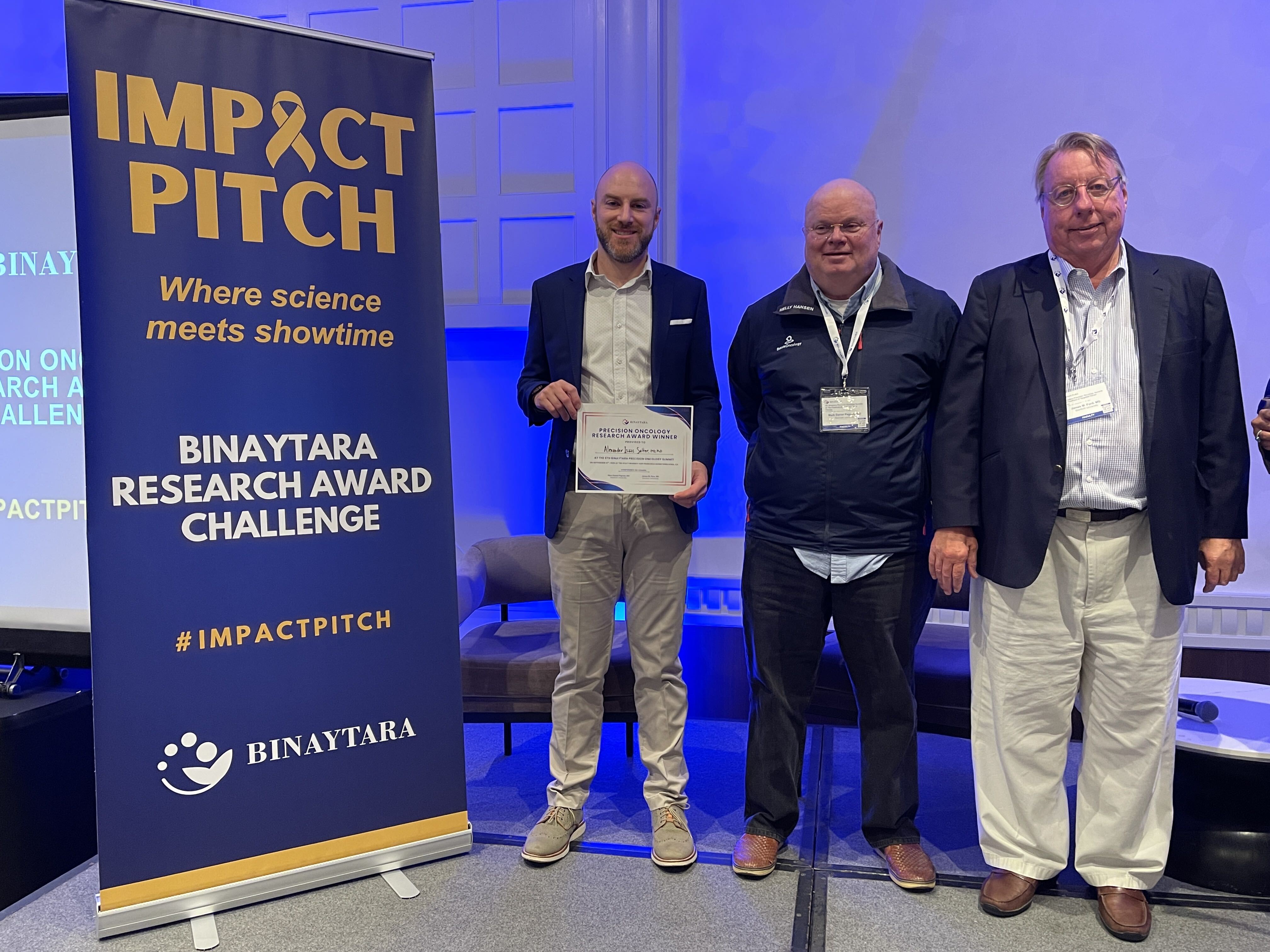
Dr. Salter to Develop the First-in-Human Trial for an ‘Off-Switch’ to Curb CAR T Toxicity
SAN FRANCISCO - Alexander Salter, MD, PhD, of Stanford University is the winner of the Binaytara Precision Oncology Research Award, presented at the 6th Binaytara Precision Oncology Summit on September 12, 2026. Dr. Salter received the $25,000 award for his proposal on a first-in-human phase I trial of drug-regulatable B7-H3 CAR T cells for advanced solid tumors.
The award was decided at the Impact Pitch: Binaytara Research Award Challenge, a competition held live in front of the summit attendees. Dr. Salter was one of three finalists selected to pitch their research. Each finalist delivered a seven-minute presentation followed by eight minutes of live question-and-answer with a panel of judges, known as the Catalysts, in front of the summit audience. The Catalysts then deliberated privately before selecting a winner.
This year's Catalyst panel included Trever Bivona, MD, PhD, of UCSF; James Brugarolas, MD, of UT Southwestern Medical Center; and Mark Pegram, MD, and James Ford, MD, both of Stanford University and co-chairs of the Precision Oncology Summit. The session was moderated by Varun Monga, MD, of UCSF.
To reach the Impact Pitch stage, Dr. Salter first had an abstract accepted for presentation at the summit, then submitted a separate research proposal for the award. His abstract, "First-in-Human Phase I Trial of Drug-Regulatable B7-H3 CAR T Cells for Advanced Solid Tumors," was published in the International Journal of Cancer Care and Delivery and co-authored with Allison Betof, MD, PhD, and Crystal Mackall, MD also from Stanford University.
The research targets B7-H3 (CD276), a protein highly expressed across many solid tumors. Dr. Salter's team developed a drug-regulatable CAR T-cell platform, called SNIP, that allows physicians to switch CAR T-cell activity on and off using an oral hepatitis C protease inhibitor, voxilaprevir. The approach is designed to preserve the antitumor activity of B7-H3 CAR T cells seen in earlier clinical work while giving clinicians a way to control treatment-related toxicity. The phase I dose-escalation trial, now underway at Stanford, will enroll adolescents and adults with relapsed or refractory B7-H3-positive high-grade sarcoma, ovarian cancer, non-small cell lung cancer and uveal melanoma.
"First off, thank you to the entire organization for sponsoring my work. Participating in the Impact Pitch was a great experience. I think it helped formulate why my scientific work might be impactful and how to convey that to an audience and folks who aren't necessarily involved or don't know much about what I work on. It was a great experience in and of itself, as well as great preparation for applying to other awards, especially as a lot of foundations are moving toward in-person pitch events," Dr. Salter said.
"With the money from the award, I'm planning on using that to really start our innovative correlative analysis for this new drug-regulatable CAR T-cell trial. The money will help cover reagent costs, personnel time, and sample processing, enabling us to do this innovative work at Stanford in hopes of helping patients," he said.
The Binaytara Precision Oncology Research Award supports early-career investigators, including hematology/oncology fellows, postdoctoral researchers and oncologists within 10 years of completing fellowship, whose work advances genomics-driven treatment, targeted therapeutics, translational research or diagnostic innovation in precision oncology. Award recipients are expected to acknowledge Binaytara support in resulting publications and to present progress at a future Precision Oncology Summit.
The 6th Binaytara Precision Oncology Summit, a CME-accredited two-day conference held in San Francisco, brought together experts in cancer genomics, molecular diagnostics and targeted therapy to address topics across the precision oncology continuum, including antibody-drug conjugates, radioligand therapies, targeted protein degraders and cell therapies.
About Binaytara
Binaytara is a global oncology nonprofit dedicated to advancing cancer education, care and research. Headquartered in Bellevue, Washington, Binaytara works to reduce disparities in cancer care through conferences, research funding, journal publishing and community programs.
Recommended Articles
What a Summer Volunteer Position with Binaytara Taught Aanshi Deep about Equitable Cancer Care
Learn More