
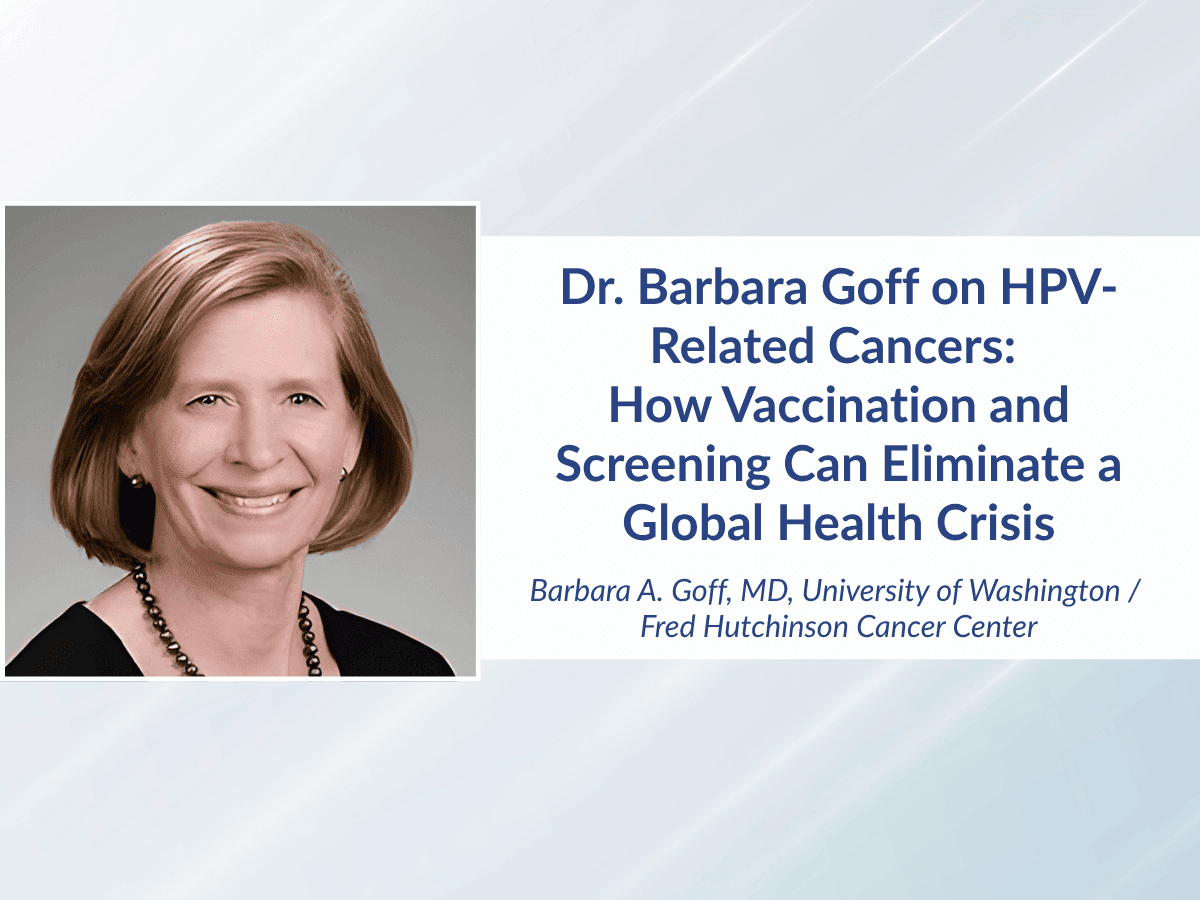
Dr. Barbara Goff on HPV-Related Cancers: How Vaccination and Screening Can Eliminate a Global Health Crisis
HPV-related cancers cause over 830,000 cases globally each year—but most are preventable. In this expert commentary, Dr. Barbara Goff explains how vaccination, screening innovations, and equitable access can eliminate this global health crisis.
The Global HPV Cancer Burden: A Preventable Crisis
Human papillomavirus (HPV) is responsible for an estimated 830,000 new cancer cases and more than 400,000 deaths worldwide each year. What makes this burden particularly striking — and particularly urgent — is that the majority of these cancers are either 90 to 100% preventable through vaccination or detectable at a pre-invasive stage through established screening protocols. Yet access to both prevention and early detection remains deeply unequal across the globe.
The World Health Organization has set an ambitious goal: the eradication of cervical cancer by 2030. Achieving it will require not just scientific tools — which already exist — but a sustained commitment to equitable implementation across high-, middle-, and low-income countries alike. As the data make clear, without meaningful change in current practice, HPV-related cancers are projected to decrease by roughly 4% in Europe by 2045 — while increasing by 105% in Africa over the same period.
How HPV Causes Cancer: Understanding the Biology
Nearly all of us will be exposed to HPV at some point — most commonly in our teens, twenties, or early thirties. For the vast majority, the immune system clears the infection within 18 to 36 months, and no lasting harm is done. But in a subset of individuals, the virus is not cleared. Instead, it integrates into host cells and begins producing proteins — E6 and E7 — that disable two critical tumor suppressor genes, P53 and RB1. With those protective mechanisms knocked out, cells can grow without regulation, progressing from pre-invasive lesions to invasive cancer.
This mechanism underlies all HPV-related cancers. HPV accounts for over 90% of cervical cancer cases — likely closer to 100% — as well as significant proportions of anal, vaginal, vulvar, penile, and oropharyngeal cancers. Notably, oropharyngeal (head and neck) HPV cancers are rising rapidly, particularly among men, and in the United States they now surpass cervical cancer in incidence. HPV accounts for approximately 20 to 40% of oral and pharyngeal cancers.
Geography as Destiny: Global Disparities in HPV-Related Cancers
HPV Cancer Rates by Region
The global distribution of HPV-related cancers mirrors, in many ways, the patterns seen with other infection-driven malignancies. High-burden areas include Africa and Oceania, which have the highest incidence and death rates. Asia, due to its sheer population size, accounts for 58% of all HPV-related cancers globally. Seventy-seven percent of HPV cancers occur in low- and middle-income countries — a disproportion driven directly by limited access to vaccination and screening programs.
Why Low-Resource Settings Face Higher Risk
The age-adjusted figures are stark: in the highest-burden regions, incidence reaches 77 cases per 100,000 people, with 52 deaths per 100,000. In North America, those numbers are 20 and 6, respectively. In the lowest-burden regions such as the Middle East, they fall to 5 and 1. The gender disparity compounds the picture: an estimated 736,000 women develop HPV-related cancers annually compared to approximately 95,000 men, and nearly 400,000 women die of HPV-related cancers each year versus 44,000 men — driven overwhelmingly by cervical cancer mortality in low-income settings.
Screening for HPV-Related Cancers: Pap Smears, HPV Testing, and Self-Collection
Cervical cancer has the most mature and well-validated screening infrastructure of any HPV-related malignancy, with two primary modalities: the Pap smear and HPV testing.
Pap Smear vs. HPV Testing: Key Differences
The Pap smear, introduced in the United States in 1941, has been responsible for an approximately 86% decline in cervical cancer in high human development index countries — a remarkable achievement, particularly given that its sensitivity is only 50 to 80%, with a false-negative rate of 10 to 20%. Its success is a testament to what consistent population-level screening can accomplish even with an imperfect tool.
HPV testing, introduced in 1999 as an adjunct to Pap smears, offers substantially improved sensitivity of approximately 98%, with a specificity of 87% and a positive predictive value of 88%. FDA approval as a primary screening modality came in 2014, and the modality has steadily become the preferred approach. Unlike Pap smears, HPV testing does not require a cytologist, significantly reducing cost and logistical complexity — important advantages for low-resource settings. In the U.S., an HPV test runs between $80 and $150.
The Rise of Self-Collected HPV Testing
A transformative development came in 2024, when self-collected HPV testing received FDA approval. A 2025 meta-analysis found that self-collection with a mail-in option doubled screening rates among people who were not regularly screened — precisely the population at highest risk for cervical cancer. While the sensitivity for detecting CIN2 or greater (74 to 86%) and specificity (80%) are somewhat lower than clinician-collected samples, the dramatically higher participation rate more than compensates for this modest reduction. This approach holds particular promise for expanding equitable access in low- and middle-income countries, where clinic-based screening is limited.
For other HPV-related cancers, screening approaches are less established: oropharyngeal and penile cancers rely on visual inspection and biopsy of symptomatic patients; vulvar cancers on visual inspection at routine gynecologic exams; and anal cancer on anal cytology, now recommended for high-risk individuals.
Prevention Through Vaccination: A Breakthrough in Cancer Prevention
If screening is the net that catches HPV-related cancers early, vaccination is the wall that prevents them from occurring at all. The HPV vaccine story is one of the most compelling preventive oncology narratives of the past two decades.
Who Should Get the HPV Vaccine?
The original Gardasil vaccine, targeting HPV strains 6, 11, 16, and 18, was approved for girls aged 9 to 26 in 2006 and for boys in 2009. Strains 16 and 18 are the two most oncogenic types, responsible for the majority of HPV-related cancers. In 2014, a nine-valent vaccine (HPV9) was approved, adding five additional oncogenic strains. By 2018, HPV9 was approved for men and women up to age 45. In 2019, over 100 countries had incorporated HPV vaccination into routine vaccination schedules, and in 2020 the FDA approved HPV9 specifically for the prevention of oropharyngeal cancers.
How Effective Is the HPV Vaccine?
The vaccine's safety and efficacy record is exceptional. There has been no increase in serious adverse events compared to placebo, and immunogenicity is near-universal — 99 to 100% seroconversion, compared to only 50 to 70% from natural HPV infection. In HPV-naive individuals, the vaccine provides 91 to 100% protection against HPV 16 and 18, and 90% protection against CIN2 or greater. Even in individuals who have already had sexual debut and may have been previously exposed, efficacy remains meaningful: 76% against HPV 16 and 18, and 50% against CIN2 or greater.
One Dose vs. Multiple Doses: What the Data Shows
The dosing schedule has also evolved to improve implementation. The original three-dose regimen proved challenging for many patients to complete. Non-inferiority studies demonstrated that two doses were equally effective in girls under 15, and more recently a trial of 20,000 girls aged 12 to 16 found one dose to be as efficacious as two — a finding with profound implications for global rollout and cost reduction.
Beyond cervical cancer, HPV vaccination reduces the incidence of anal epithelial neoplasia by 50 to 70%, genital warts by 90 to 100%, oral HPV infections by 80%, and significantly reduces head and neck cancer risk in vaccinated individuals compared to unvaccinated peers.
Clinical Takeaways: How Providers Can Reduce HPV Cancer Risk
- Vaccinate early and broadly. A single dose of HPV vaccine before sexual debut is highly effective in preventing HPV infection and HPV-related cancers. Clinicians should advocate for vaccination at ages 9 to 12 and counsel patients through age 45 on the benefit of vaccination.
- Transition to HPV-based primary screening. HPV testing offers superior sensitivity to Pap smears and does not require a cytologist, making it both more accurate and more scalable. Self-collected HPV testing should be considered for patients who are not regularly screened.
- The WHO 90-70-90 framework is actionable. The WHO's eradication pathway calls for 90% of girls vaccinated by age 15, HPV self-screening at ages 35 and 45, and 90% of pre-cancers treated by community health workers. This model is achievable — Rwanda has already demonstrated it.
- Oropharyngeal cancer is a growing priority. HPV-related head and neck cancers now surpass cervical cancer in U.S. incidence. Clinicians across specialties should incorporate HPV risk assessment and vaccination counseling into care regardless of patient sex.
- Vaccination disparities within the U.S. require attention. Rates below 50% in states such as Wyoming, Oklahoma, and Mississippi contrast sharply with rates above 70–75% in states such as Massachusetts and New Hampshire. Local advocacy and public health engagement remain essential.
- Support global funding mechanisms. The erosion of international health funding threatens to reverse decades of progress in HPV prevention and screening in low- and middle-income countries.
What Patients Need to Know About HPV Prevention
HPV is an extremely common virus, and most people who get it never know it — their immune system clears it on its own. But some HPV infections persist and can lead to cancer over time, most commonly cervical cancer, but also cancers of the throat, anus, vulva, vagina, and penis. The good news is that these cancers are largely preventable. If you or your child hasn't been vaccinated against HPV, talk to your doctor — it's safe, highly effective, and recommended through age 45. If you are eligible for cervical cancer screening, a self-collected HPV test is now an option that can be done at home and mailed in. Early detection and prevention save lives — and with HPV, both are within reach.
Key Takeaways on HPV Prevention and Screening
- HPV causes over 830,000 cancers and 400,000 deaths annually worldwide, with 77% of cases occurring in low- and middle-income countries — a disparity driven by unequal access to vaccination and screening.
- Cervical cancer screening has been transformed by HPV testing (98% sensitivity) and, since 2024, FDA-approved self-collected HPV tests that double participation rates among the unscreened — the very population most at risk.
- A single HPV vaccine dose before sexual debut provides 91 to 100% protection against the two most oncogenic strains (HPV 16 and 18), and the vaccine also reduces risk of anal, oral, and oropharyngeal cancers.
- Oropharyngeal HPV cancers now surpass cervical cancers in the United States, highlighting that HPV is a cross-specialty concern affecting patients of all sexes.
- Rwanda's success story proves eradication is possible: a national school-based HPV vaccination program achieving 90% coverage, combined with self-screening, has already begun reducing cervical cancer incidence — demonstrating that the WHO's 2030 eradication goal is achievable with political will and investment.
References and Resources
- World Health Organization. Global strategy to accelerate the elimination of cervical cancer as a public health problem. Available at: who.int
- U.S. Food and Drug Administration. HPV Vaccine Approval History. Available at: fda.gov
- U.S. Preventive Services Task Force. Cervical Cancer Screening Recommendations. Available at: uspreventiveservicestaskforce.org
- Meta-analysis on HPV self-testing vs. clinician-collected HPV (2025). (Referenced in presentation; full citation details not provided in transcript.)
- American Cancer Society. HPV and Cancer. Available at: cancer.org
- Centers for Disease Control and Prevention. HPV Vaccination Coverage Data. Available at: cdc.gov
About Dr. Barbara A. Goff

Dr. Barbara A. Goff is Professor and Chair of the Department of Obstetrics and Gynecology and Surgeon-in-Chief at UW Medical Center, as well as an affiliate physician at Fred Hutchinson Cancer Center in Seattle. She received her MD from the University of Pennsylvania, completed her OB/GYN residency at Brigham and Women's Hospital (Harvard Medical School), and her gynecologic oncology fellowship at Massachusetts General Hospital. She joined the faculty of the University of Washington in 1993 and became Chair of Obstetrics and Gynecology in 2017. Dr. Goff's research spans early detection of ovarian cancer, novel therapeutics, surgical skills training, and quality outcomes in gynecologic oncology. She has authored over 100 peer-reviewed articles and multiple textbook chapters, served as president of the Society of Gynecologic Oncology, and is a recipient of the Society's Distinguished Service Award (2024) and the PRIMO Women in Oncology Award (2024). She has been recognized as a Top Doctor by both Seattle Magazine and Seattle Met for more than a decade.
Frequently Asked Questions About HPV and Cancer
1. What cancers are caused by HPV?
HPV is responsible for nearly all cervical cancers and contributes to anal, vaginal, vulvar, penile, and oropharyngeal cancers.
2. How effective is the HPV vaccine?
The HPV vaccine provides up to 91–100% protection against the most cancer-causing strains when given before exposure.
3. At what age should HPV vaccination begin?
Vaccination is recommended starting at ages 9–12 and is approved for individuals up to age 45.
4. What is the difference between a Pap smear and HPV testing?
Pap smears detect abnormal cells, while HPV testing detects the virus itself and is more sensitive for early detection.
5. Can HPV-related cancers be eliminated?
Yes—through widespread vaccination, screening, and treatment, cervical cancer could be eliminated as a public health problem.