

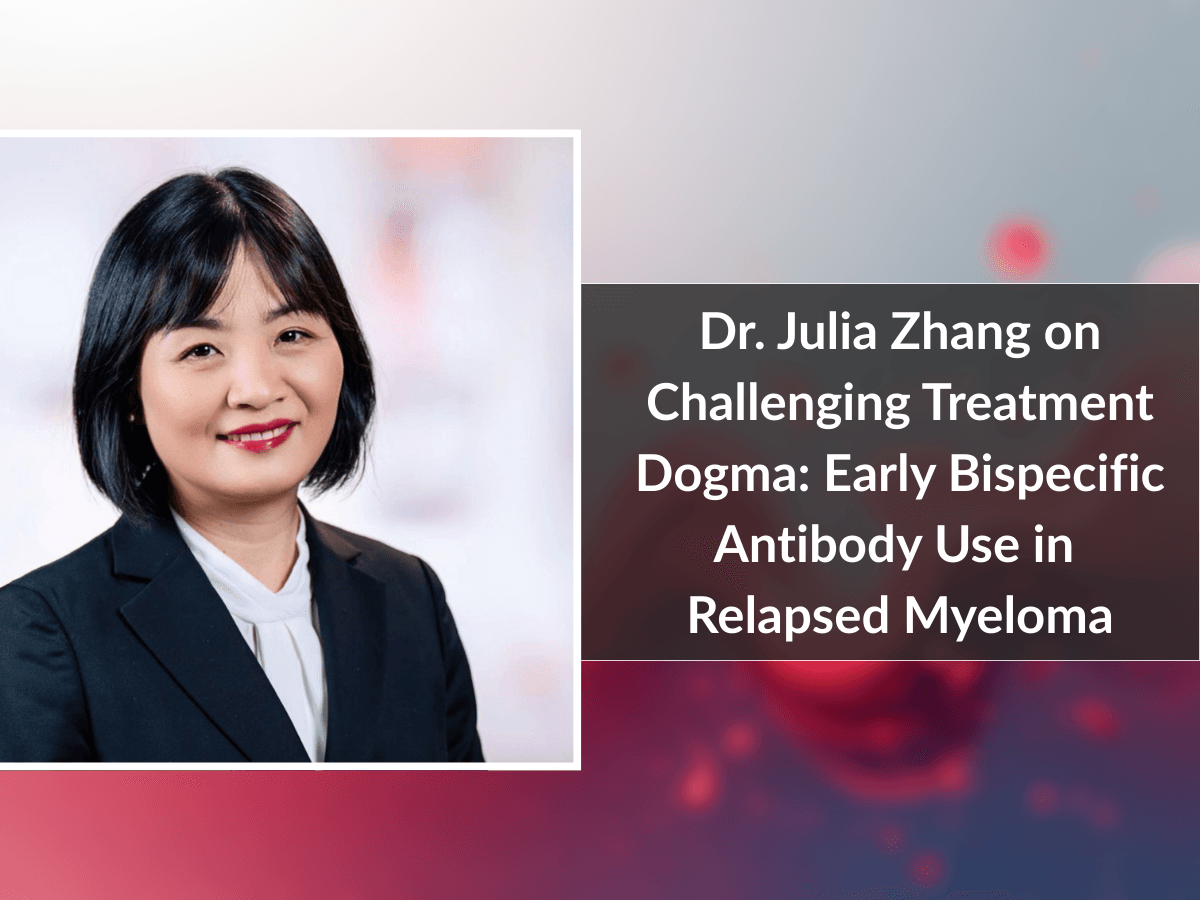
Should bispecific antibodies be used before CAR T-cell therapy in relapsed multiple myeloma—especially in older adults? At the Best of Hematology & Breast Cancer 2026 conference, Dr. Julia Zhang presented a compelling case of an 83-year-old woman with high-risk IgG kappa multiple myeloma, prompting a provocative panel discussion that challenged long-standing treatment sequencing dogma. Experts debated durability, toxicity, quality of life, and emerging phase 3 data supporting earlier use of teclistamab and other bispecific antibodies. The discussion reflects a shifting paradigm in multiple myeloma care, particularly for elderly patients where balancing efficacy and tolerability is critical.
Dr. Julia Zhang is a physician at Fred Hutchinson Cancer Center and Clinical Associate Professor in the Division of Hematology and Oncology at the University of Washington School of Medicine. At the Best of Hematology & Breast Cancer 2026 conference in Seattle, Dr. Zhang presented a complex case of relapsed/refractory multiple myeloma in an elderly patient, sparking discussion among experts about optimal treatment sequencing and the role of bispecific antibodies versus CAR T-cell therapy in older adults.
The transcript report below has not been reviewed by the speaker and may contain errors.
Case Presentation: 83-Year-Old Woman with Newly Diagnosed Multiple Myeloma
The case involved an 83-year-old woman who presented with an eGFR greater than 60, indicating normal kidney function. Creatinine was 0.89 and albumin was 3.4. A serum protein electrophoresis was performed, revealing 5.5 grams of M protein. Twenty-four-hour urine immunofixation was conducted because the patient had IgG kappa monoclonal protein. Free light chain analysis found elevated kappa at 163.8, lambda at 3.7, and an elevated kappa-to-lambda ratio of 44.27. Beta-2 microglobulin was 4.34 with slightly lower LDH at 159. There was elevated IgG at 6554 with lower IgA and IgM levels.
The patient subsequently underwent bone marrow biopsy, which revealed a hypercellular marrow of almost 70-80% cellularity with 80% involvement by kappa-restricted plasma cells and no amyloid. A myeloma FISH panel showed positive for gain 1q in 30% of cells and amplification of 1q in 66% of cells, positive for trisomy 9, 11, and 15, but no chromosome 14 abnormalities, no deletion 17p, and normal conventional cytogenetics. Imaging workup, including whole body CT and whole body MRI, was normal, as was an echocardiogram showing normal heart function.
Based on this workup, the patient was diagnosed with IgG kappa multiple myeloma, ISS stage 2, and Revised ISS stage 2. The patient had 80% plasma cells with amplification of 1q consistent with high-risk cytogenetics.
Treatment Course and Disease Progression
Despite the patient being aged 83, performance status was 0-1 and the patient did not have a significant past medical history. Treatment was initiated with daratumumab, bortezomib, lenalidomide, and dexamethasone (Dara-VRD) beginning in June 2023. The patient achieved a partial response based on M protein criteria, with M protein dropping from 5 to 0.9, and bone marrow showing 5-7% plasma cells. However, the patient developed grade 2 neuropathy and left eyelid ptosis, a concerning side effect from bortezomib. Bortezomib was discontinued and the patient moved to lenalidomide maintenance from October 2023 to February 2024.
The patient developed impending progressive disease with M protein rising to 2.76. At that time, discussion with the patient revealed she still wanted treatment to prolong life while also enjoying quality of life. Therefore, elotuzumab and pomalidomide were chosen as treatment starting in March 2024 for four months. Initially, the disease was stable, but then progressed with M protein rising to 1.7.
Discussion with the patient again confirmed she still wanted more aggressive treatment. At initial diagnosis, the patient had not been referred to a myeloma specialist, but for third-line treatment, consultation was obtained, and treatment was initiated with carfilzomib, cyclophosphamide, and dexamethasone (KCd-Cy) starting in August 2024. Initially, the patient responded very well, with M protein dropping to 0.6. However, the patient developed severe dyspnea in November 2024, prompting repeat echocardiogram.
New findings revealed diastolic dysfunction, severe pulmonary hypertension, and moderate mitral regurgitation. Treatment was held and a cardio-oncology consultation was obtained. Treatment for the cardiac complications was started while consultation regarding myeloma treatment such as CAR T was pursued.
One month later, after supportive treatment, fatigue and dyspnea significantly improved. After detailed discussion, the patient wanted to go back to treatment. From December 2024, treatment was resumed with modified KCd, including carfilzomib given as a 45-minute infusion with dose reduction, cyclophosphamide kept at 500 mg weekly, and dexamethasone reduced from 40 mg to 20 mg. The patient tolerated this well until developing impending biochemical progressive disease. Fortunately, repeat echocardiogram showed cardiac function had completely recovered. However, the patient significantly complained of grade 3 peripheral neuropathy from carfilzomib.
Panel Discussion: Treatment Options at Second Relapse
The case was presented to a panel for discussion regarding treatment options at second relapse. Several considerations were raised, including whether the patient should be considered for CAR T-cell therapy or clinical trials. The patient lived 40 miles away from the treatment center, and her daughter, who was very supportive, was a nurse and had concerns about quality of life issues.
Bispecific Antibody Recommendation
One panelist recommended bispecific antibody therapy for this patient based on patient preferences. While specific data were not presented, reference was made to the MAJESTIC-1 trial showing median duration of response of about 19 months with teclistamab. The panelist noted they typically space out bispecific dosing and have stopped treatment in some patients, even though data for this approach are not yet available. The drug was considered fairly well tolerated besides the initial risk of cytokine release syndrome and ICANS, which are manageable, and infections can be mitigated with appropriate IVIG prophylaxis.
CAR T Versus Bispecific Debate
A provocative statement was made that between ide-cel and teclistamab, teclistamab would be the choice, with puzzlement expressed about why someone over age 80 would automatically be directed toward ide-cel rather than a bispecific. Looking at durability measures, teclistamab appears to be favored with lower risk of acute toxicities.
Regarding other choices, ciltacabtagene autoleucel was noted as appealing and potentially coming to more hospitals as an outpatient option with only 20-30% risk of cytokine release syndrome. The safety profile may be better, though this is debatable. Clinical trials were acknowledged as an option to encourage the patient to consider.
Future of Bispecifics at First Relapse
Agreement was expressed that bispecific antibodies are the preferred approach. It was noted that hopefully later in 2026, bispecifics will be approved at first relapse. A press release was referenced from a randomized phase 3 study of teclistamab versus investigator's choice of daratumumab-lenalidomide-dexamethasone or carfilzomib-dexamethasone for patients who are both daratumumab and lenalidomide exposed at first relapse, which matched this patient's situation as she was lenalidomide-refractory after maintenance.
While full results were not available, the trial met its primary endpoint favoring teclistamab over control arms. The suggestion was made that much morbidity could have been averted if bispecifics were given at first relapse, as consolidation could have occurred earlier. Carfilzomib in particular was noted as being poorly tolerated in older adults, with data suggesting a steep gradient of increasing cardiac side effects with age.
It would be beneficial to have teclistamab, elranatamab, or linvoseltamab available to the community and available early, as patients like this would greatly benefit. In a few years, this will likely be standard practice. At many sites, patients no longer need hospitalization for the first week of bispecific therapy, and it can all be done outpatient, even in patients older than this case with acceptable outcomes.
Challenging the Dogma of CAR T Before Bispecifics
Discussion addressed whether clinical trials would be worthwhile for this patient, with consideration that trials might not offer something substantially better than what bispecifics would offer. It was stated that bispecifics should be the recommendation, with hope that for future patients, bispecifics can be given at first relapse.
A strong statement was made challenging the dogma that CAR T must be done before bispecifics, calling this based on "very flimsy data." The point was emphasized that in multiple myeloma, as far as is currently known, nobody is being cured yet. All treatment is essentially palliative, requiring discussion with patients about toxicities, time commitment of treatment, and benefits. The panel should not be dogmatic about treatment sequencing, especially in elderly patients.
Regarding the use of ide-cel now versus saving bispecifics for later, the counterargument was made that the patient is getting older, may develop other health issues, and can get significant benefit from bispecifics now. The potential for cytokine release syndrome, ICANS, and other side effects exists with CAR T as well, so why delay bispecific therapy?
Frontline Treatment Considerations
An additional point was raised about frontline treatment, suggesting discussion at the very beginning about daratumumab-VRD versus daratumumab-RD (without bortezomib). Data show that for older patients, the priority is maintaining functional independence. While adding bortezomib achieves better MRD negativity, it also causes more neuropathy and may not be worthwhile for an 83-year-old patient, as decent results can be achieved with triplets alone. While this particular patient's situation was different, quadruplet therapy is not routinely used for patients over age 80, as they were not included in quadruplet trials, and treatment may not align well with life preferences.
Case Outcome
The patient was ultimately started on bispecific antibody therapy with dosing every four weeks, and treatment was ongoing at the time of presentation.