

Tuesday, May 19, 2026
The Cancer News
AN AUTHORITATIVE RESOURCE FOR EVERYTHING ABOUT CANCER
AI in Breast Diagnostics: Why What We Do With the Tool Matters More Than the Tool Itself Drag

By Benjamin O. Anderson, MD, FACS
Professor Emeritus
May 18, 2026
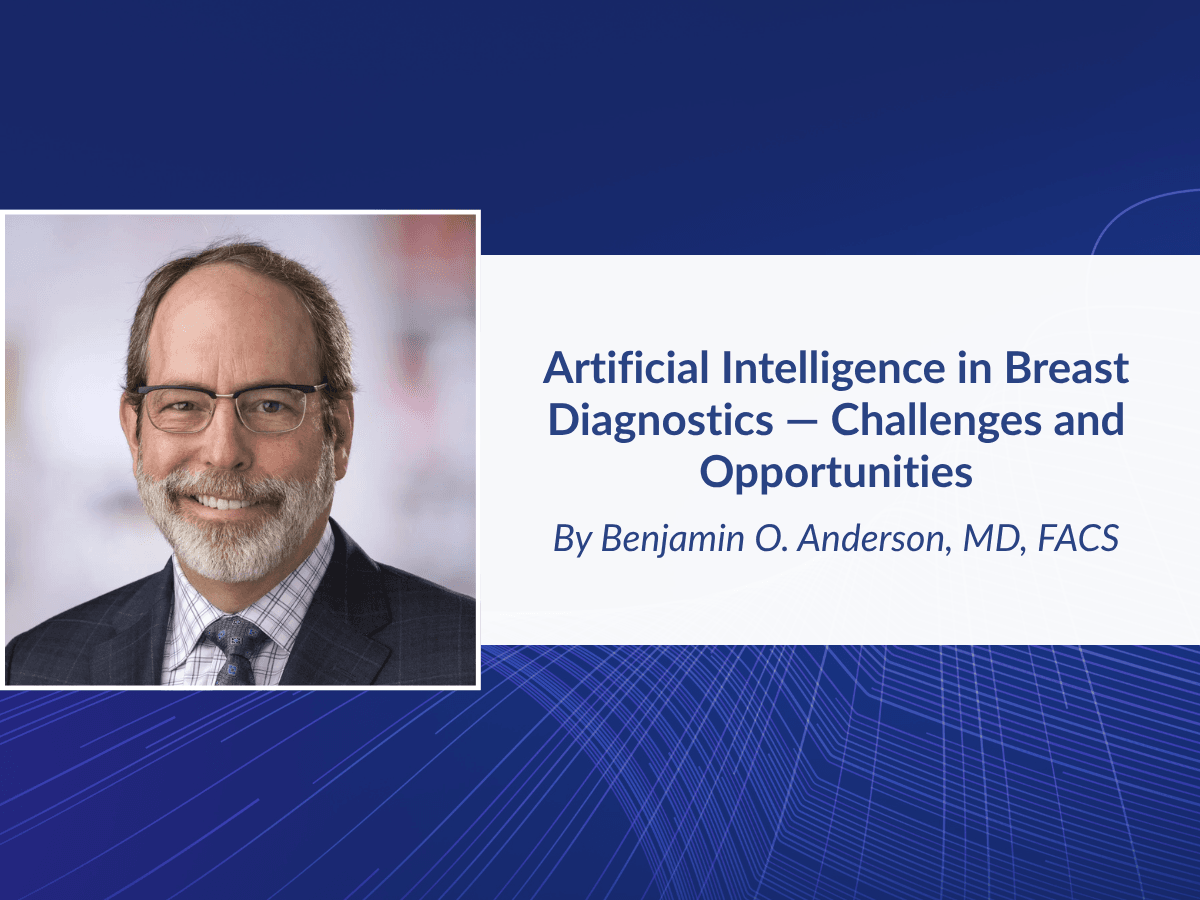
AI in Breast Diagnostics: Why What We Do With the Tool Matters More Than the Tool Itself
Artificial intelligence is reshaping breast cancer diagnostics, improving mammography accuracy and reducing radiologist workload in well-resourced settings. But as Dr. Benjamin O. Anderson explains, technology alone cannot solve global breast cancer disparities. The real challenge is ensuring timely access to diagnosis, pathology, treatment, and patient navigation—especially in low-resource regions where advanced disease remains common.
Introduction: The Promise of AI and the Lesson of CAD
Artificial intelligence is genuinely exciting in breast imaging. There is emerging evidence that modern AI tools can improve cancer detection, reduce radiologist workload, and enhance risk assessment. Before we embrace AI as the next transformative force in breast cancer diagnostics, we should recall what happened with the last generation of computer-assisted technology — and ask, for every new tool, the question that matters most: what problem are we actually trying to solve, and does this tool solve it in the clinical context where the need is greatest?
That question (about context, application, and purpose) is the thread that should run through every conversation about AI in cancer diagnostics. The most sophisticated diagnostic tools have little value if they fail to address the most pressing problems, or if the infrastructure requirements prevent them from properly functioning in the setting where the clinical need is greatest.
The CAD Cautionary Tale
Computer-aided detection (CAD) for mammography was introduced in the early 1990s with considerable optimism. The premise was compelling: use computer technology to help radiologists identify suspicious findings on mammograms that might be missed by the human eye. Early data looked promising. Regulatory approval came. CAD was widely adopted.
And then the outcome data came in, and it definitively failed.3 CAD did not improve cancer detection rates and in some settings it actually lowered sensitivity. The reason was instructive: CAD worked by placing markers on areas of concern for the radiologist to examine. The unintended consequence was that radiologists tended to focus on the marked areas — and spend less time examining the rest of the film. A tool intended to improve detection was inadvertently narrowing the radiologist's attention.
The fundamental difference between CAD and modern AI is in how they learn. CAD was rule-based: the computer was given explicit instructions about what to look for, much as a resident is taught specific signs to identify. Modern AI learns from data — it develops its own pattern recognition through exposure to large annotated datasets, often identifying features that human experts have not explicitly defined. This distinction matters enormously for what modern AI can and cannot do.
Modern AI in Mammography: What the Evidence Actually Shows
A landmark randomized trial published recently from Sweden provides the most rigorous evidence to date on modern AI-assisted mammographic screening.4 The study compared AI-assisted reading with single or double reading by radiologists, in a population with a median age above 50. The findings were meaningful:
- Higher cancer detection rates and sensitivity with AI assistance
- An increase in cancers with favorable biology detected — the screen-detectable cancers we most want to find
- Fewer interval cancers — cancers presenting between screening rounds, which often represent the more aggressive disease
- A reduction in radiologist workload of approximately 40%
This is genuinely promising. A 40% reduction in radiologist workload is not a trivial benefit, particularly as breast imaging capacity is constrained in many settings. And improved detection of biologically favorable cancers, with fewer interval cancers, suggests that AI may be finding the right cancers — not just more cancers.
But these findings come from a specific context: organized mammographic screening in a well-resourced setting with sufficient radiologist capacity, appropriate technology infrastructure, and a population within the recommended screening-age range. That context is not universal. It is not even the context in which most breast cancer deaths occur.
AI for Risk Assessment: Opportunity and Open Questions
Beyond detection, AI is increasingly being applied to mammographic risk assessment — using the imaging data to predict which women are most likely to develop breast cancer within the next five years.5 Studies comparing AI risk assessment with established models like the Tyrer-Cuzick model have shown that AI can improve risk stratification, better identifying patients who will develop cancer and placing them in the highest-risk group.
What exactly we do with that information is still being determined. Does refined risk stratification mean fewer mammograms for lower-risk women? Different screening intervals? Earlier prophylactic intervention for higher-risk women? These are open clinical questions with significant implications for how AI risk tools are deployed — and for the equity implications of differential access to those tools.
Context: Where the Greatest Need Actually Is
Here is the fundamental tension: the evidence for AI in mammographic screening is strongest in settings that have organized screening programs, abundant imaging infrastructure, and trained radiologist capacity. These are precisely the settings where breast cancer mortality has already been substantially reduced. High-income countries have seen 40% reductions in breast cancer mortality in the past three decades across ten countries. The problem we most need to solve — most urgently, most consequentially — is not in those settings.6
In sub-Saharan Africa, half of all breast cancer deaths occur in women under the age of 50.7 Women are presenting with large, open, ulcerated masses — disease so advanced it is visible from across the room. In that context, the question is not whether AI can help radiologists read mammograms more efficiently. The question is how to get women to care in the first place, how to ensure they can be imaged and biopsied when they present with a lump, and how to ensure that pathology is available and that treatment can be initiated within a clinically meaningful timeframe.
A study from the Trujillo Cancer Center in Peru — conducted by Anya Romanoff and colleagues — found that 93% of breast cancers presenting at that center were found by the patient herself.8 The delays in those patients' care were attributable primarily to the system, not to the patients. Patients who had been clinically evaluated previously came in earlier and at lower stage. Clinical evaluation — the physical breast exam — was the intervention that was making a difference, not imaging technology.
The lesson: diagnosis is not a test. Diagnosis is a process. It is mammography, ultrasound, tissue sampling, pathology, and navigation — a whole system working in sequence. And the constraint in most of the world is not the quality of any individual test. It is the system that connects them.
Patient Navigation: The Ho-Hum That Saves Lives
We get excited about technology. We should. But patient navigation — the organized process of ensuring that a patient moves through the diagnostic and treatment system without being lost, misrouted, or abandoned — is one of the most consistently effective interventions in cancer control, and it receives a fraction of the attention that new imaging or AI tools receive.
A study from Cali, Colombia showed that implementing a patient navigation program improved every measured criterion for getting patients through the diagnostic and treatment pathways.9 These are the metrics that matter. Navigation achieved them not through new technology, but through intentional, organized human support.
We must not forget the basics as we chase the cutting edge. And we must be honest that in most of the world, the cutting edge is not the constraint.
Clinical Implications and Practice Takeaways
- AI in mammographic screening shows genuine promise in well-resourced settings, with evidence of improved cancer detection, favorable biology cancers found more reliably, and substantial radiologist workload reduction. This warrants adoption in systems with the appropriate infrastructure.
- Context-specific assessment of AI utility is essential: the application — what clinical problem are we solving, in what setting, for what population — must precede technology deployment, not follow it.
- AI risk assessment tools show promise but require clear protocols for what to do with refined risk information before they can be equitably and responsibly deployed.
- Early AI-based CAD was not AI in the modern sense and should not be treated as evidence against current deep learning approaches; the mechanisms and evidence bases are entirely different.
- Patient navigation is evidence-based and underutilized: in almost every resource context, the bottleneck is system navigation, not the quality of individual diagnostic tests. Patient navigation programs deserve investment, advocacy, and clinical priority alongside new technology.
- Human resources and education are the first constraint in most global settings: before deploying new diagnostic technology, the more important questions are whether providers and patients have the knowledge to seek and receive care in a timely way.
Patient Perspective: What This Means for You
If you are receiving mammographic screening in a well-resourced setting, AI-assisted reading may already be part of how your images are interpreted, or may become so in coming years. This is a positive development: it may improve the detection of cancers with favorable biology and help radiologists use their time more effectively. If you live in a setting where mammographic screening is less accessible, know that clinical breast examination and awareness of breast changes remain important and effective tools. If you notice a change in your breast, seek care promptly: delays in diagnosis and treatment are the most preventable cause of poor outcomes, and many of those delays are system failures rather than patient failures.
Key Takeaways
- Early computer-aided detection (CAD) failed to improve outcomes and in some cases worsened sensitivity, because it was rule-based rather than learning-based; this history should inform — but not limit — how we evaluate modern AI.
- A landmark Swedish randomized trial of modern AI-assisted mammographic reading found higher detection rates, more biologically favorable cancers identified, fewer interval cancers, and a ~40% reduction in radiologist workload — promising findings in the appropriate context.
- In sub-Saharan Africa, half of breast cancer deaths occur in women under 50 presenting with advanced disease; in that context, the constraint is not imaging AI but access to care, clinical evaluation, pathology, and navigation.
- AI risk assessment tools show promise for refining 5-year cancer risk prediction using mammographic data, but how to act on that refined information is an open clinical and policy question.
- Patient navigation is the most undervalued intervention in breast cancer control: evidence from Peru and Colombia demonstrates that system-level navigation — ensuring patients move through diagnosis and treatment without being lost — improves every meaningful metric and requires investment comparable to new technology.
About the Author
Benjamin O. Anderson, MD, FACS, is Professor Emeritus of Surgery and Global Health Medicine at the University of Washington School of Medicine. He founded the Breast Health Global Initiative (BHGI) in 2002, which first conceptualized resource-stratified guidelines for breast cancer early detection, diagnosis, treatment, and supportive care in low- and middle-income countries.1 He led the development and publication of the World Health Organization's Global Breast Cancer Initiative Implementation Framework — a landmark document guiding breast cancer early detection and management globally.2 Disclosure: He has received consulting fees from AstraZeneca.
References and Resources
- Anderson BO, Yip CH, Smith RA, Shyyan R, Sener SF, Eniu A, et al. Guideline implementation for breast healthcare in low-income and middle-income countries: overview of the Breast Health Global Initiative Global Summit 2007. Cancer. 2008;113(8 Suppl):2221–43.
- World Health Organization. Global Breast Cancer Initiative Implementation Framework: assessing, strengthening and scaling-up of services for the early detection and management of breast cancer Geneva, Switzerland: World Health Organization; 2023. Available from: https://www.who.int/publications/i/item/9789240065987.
- Lehman CD, Wellman RD, Buist DS, Kerlikowske K, Tosteson AN, Miglioretti DL, et al. Diagnostic Accuracy of Digital Screening Mammography With and Without Computer-Aided Detection. JAMA internal medicine. 2015;175(11):1828–37.
- Lang K, Josefsson V, Larsson AM, Larsson S, Hogberg C, Sartor H, et al. Artificial intelligence-supported screen reading versus standard double reading in the Mammography Screening with Artificial Intelligence trial (MASAI): a clinical safety analysis of a randomised, controlled, non-inferiority, single-blinded, screening accuracy study. Lancet Oncol. 2023;24(8):936–44.
- Yala A, Lehman C, Schuster T, Portnoi T, Barzilay R. A Deep Learning Mammography-based Model for Improved Breast Cancer Risk Prediction. Radiology. 2019;292(1):60–6.
- Duggan C, Trapani D, Ilbawi AM, Fidarova E, Laversanne M, Curigliano G, et al. National health system characteristics, breast cancer stage at diagnosis, and breast cancer mortality: a population-based analysis. Lancet Oncol. 2021;22(11):1632–42.
- McCormack V, McKenzie F, Foerster M, Zietsman A, Galukande M, Adisa C, et al. Breast cancer survival and survival gap apportionment in sub-Saharan Africa (ABC-DO): a prospective cohort study. The Lancet Global health. 2020;8(9):e1203–e12.
- Romanoff A, Constant TH, Johnson KM, Guadiamos MC, Vega AMB, Zunt J, et al. Association of Previous Clinical Breast Examination With Reduced Delays and Earlier-Stage Breast Cancer Diagnosis Among Women in Peru. JAMA Oncol. 2017;3(11):1563–7.
- Sardi A, Orozco-Urdaneta M, Velez-Mejia C, Perez-Bustos AH, Munoz-Zuluaga C, El-Sharkawy F, et al. Overcoming Barriers in the Implementation of Programs for Breast and Cervical Cancers in Cali, Colombia: A Pilot Model. J Glob Oncol. 2019;5:1–9.
Author
Benjamin O. Anderson, MD, FACS
Surgery and Global Health Medicine at the University of Washington School of Medicine
Professor Emeritus
View ProfileCategories
More from Research


Share Article