

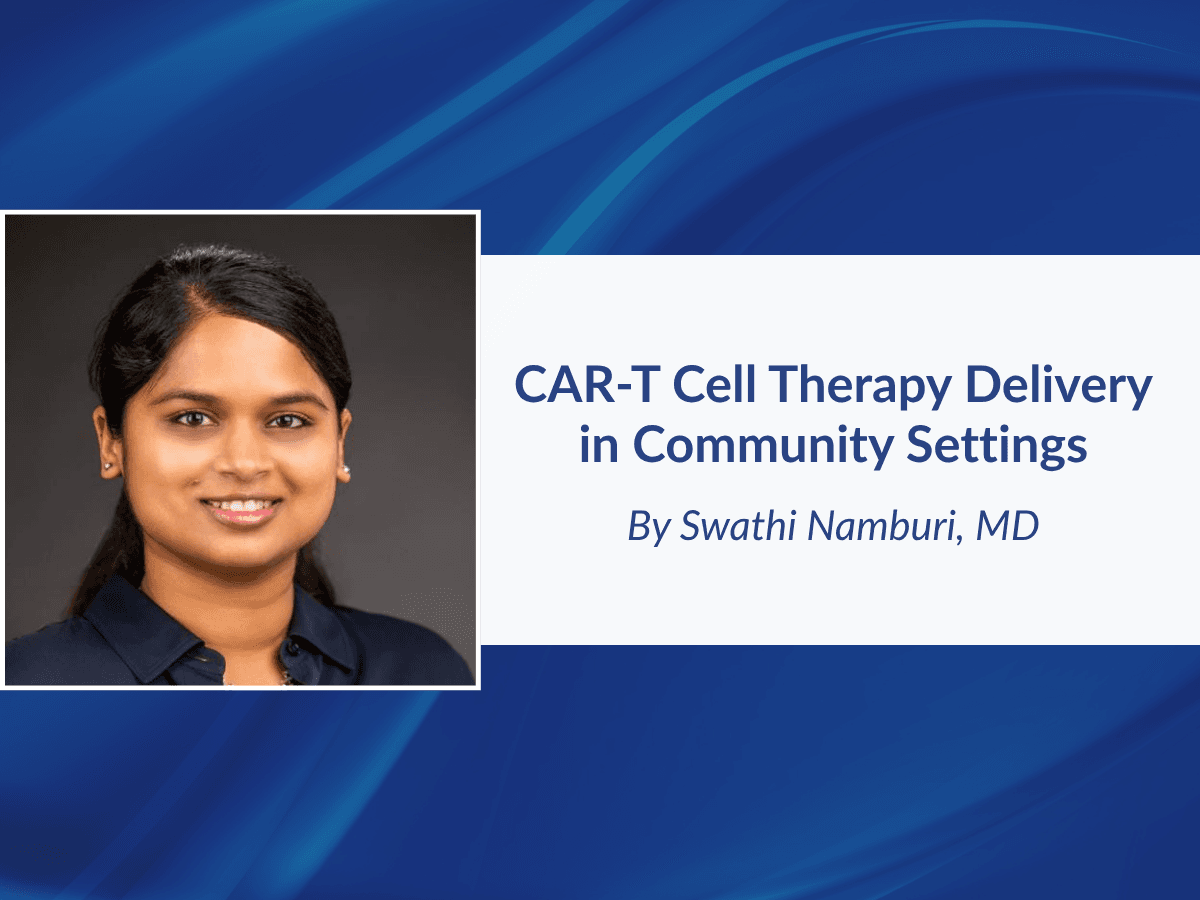
Building CAR-T Access Where Patients Live: Lessons from a Hybrid Community-Academic Cancer Center
CAR-T cell therapy has transformed outcomes for patients with blood cancers, but access remains concentrated in major academic medical centers. In this expert commentary, Dr. Swathi Namburi of Swedish Cancer Institute explains how hybrid community-academic cancer centers can safely expand CAR-T delivery closer to where patients live through clinical trials, telehealth, regional partnerships, and scalable hub-and-spoke models.
Introduction: Hybridity as the Path Forward
Swedish Cancer Institute sits in an interesting middle ground in the cellular therapy landscape. It is not a large academic medical center in the traditional sense: there are no medical students or fellows rotating through. But it is also not a standard community oncology practice. We offer autologous stem cell transplant, CAR-T cell therapy, bispecific antibodies, treatment for acute leukemias, and clinical trials, roughly half of which are Phase 1. Our infusion center runs seven days a week, and we are connected to the larger Providence health network, with sites across the Seattle region and broader reach into Alaska, Oregon, California, and Texas.
That hybrid identity — tertiary-level services delivered in a community-oriented setting — shapes how we think about access. Our experience building a CAR-T program from the ground up, and progressively extending it into the community, offers some practical lessons about what works, what is hard, and what policy changes would make the next phase of expansion more realistic.
How We Got Here: Building a CAR-T Program Step by Step
Swedish's journey toward cellular therapy did not begin with a fully built infrastructure. It began, as it does for many centers, through people and institutional history. When we launched our autologous stem cell transplant program in 2014, we had nurses who had been part of hematology care at this institution since the era when Fred Hutch was located at the adjacent First Hill hospital. That institutional memory and nursing expertise was a foundation we could build on.
Our first CAR-T experience came through an investigational cell therapy product — a clinical trial. This is a common and sensible starting point for centers without a pre-existing CAR-T track record. Clinical trials offer a critical advantage beyond the scientific question they are asking: they come with a research infrastructure that supports you when things go wrong. When an unfamiliar side effect emerges, you have a network to call. That scaffolding matters enormously for a smaller institution taking on a genuinely complex new therapeutic modality.
We recently celebrated infusing our 100th investigational cell therapy. Research has always been central to patient access to CAR-T at our center. That is not incidental — it reflects a broader truth about how the field works. Clinical trials are often how patients access the most promising CAR-T products, how centers build institutional expertise, and how the field generates the data needed to expand access safely. From our clinical trial foundation, we expanded to commercial CAR-T products, then to allogeneic CAR-T trials beginning in 2020. We now offer all of the commercially available CAR-T products across all indicated disease types and are poised to expand access to Obecabtagene autolucel for B-ALL later this year; this is the only FDA approved CAR-T we have not yet used at our center.
What a Smaller Center Does Differently — and Why That Can Be an Advantage
One thing I want to push back on gently is the assumption that large volume necessarily equals better access or better care. A smaller center has real advantages that are relevant to the access question.
At Swedish, our patients interact with a smaller group of people throughout their entire CAR-T journey. They get to know our team before their infusion, and they have a reliable nurse/physician team they can contact as needed. When a patient comes for evaluation, I am in a position to review not just whether CAR-T is the right choice, but whether a bispecific antibody, a clinical trial, or another approach might serve them better — because I am a specialist in the disease, not just a specialist in one treatment modality. That kind of comprehensive, longitudinal relationship is genuinely possible at smaller centers in a way that can be harder to sustain in high-volume programs. Sometimes the patient is able to do CAR-T but not for another few months because they maybe retiring from their job or their caregiver is not available; we plan out a therapeutic plan and a monitoring plan with the priority of safe and effective deployment of CAR-T when it is feasible instead of discouraging the patient or placing undue stress on their personal circumstances.
What this translates to practically is a philosophy of minimizing the ask of the patient. Pre-CAR-T evaluations — echocardiograms, staging scans, lab work — happen close to home whenever possible. If a patient is coming from hundreds of miles away, we arrange multiple evaluations to fit within a 24 to 36-hour window so that their initial trip can be completed efficiently. We offer virtual CAR-T education classes, which allow caregivers from out of state or out of country to learn about the process without making the trip themselves. We accommodate rotating caregivers — one person for the first two weeks of monitoring, a different person for the second — because that is often the practical reality for families without one available caregiver who can take a month away from life. The principle is simple: if it does not require a specialized facility, the patient should not have to come to us to do it.
Expanding the Hub: Bispecifics in the Network, CAR-T in Texas
Over time, we have extended the hub-and-spoke model beyond our own walls. Bispecific antibodies were the first modality we decentralized. Initially, we initiated all bispecific treatment at our tertiary First Hill campus and had patients receive subsequent cycles at their home network sites after the first month. We have since expanded to supporting network sites to both initiate and continue bispecific therapy with our physician and nurse coordinator backup — a person for the community team to call when unexpected adverse events occur.
CAR-T itself remains centralized at Swedish First Hill for our Providence system in the Pacific Northwest, with Portland as another regional site. In the summer 2025, we supported a center in Texas — a low-volume autologous transplant program — in launching their own CAR-T program. They have now delivered six CAR-T infusions successfully. We serve as their pharmacy and physician backup: available for guidance when questions arise, without needing to have the patient come to us. That mentorship model — sharing institutional knowledge, protocols, and on-call expertise — is, I believe, one of the most scalable ways to extend CAR-T access geographically.
When we work with new centers, one of the most consistent pieces of advice I give is: find your helpers early and keep them engaged. This means your infectious disease colleagues, pulmonologists, ICU team, neurologists, rheumatologists, and your nearby allogeneic transplant program. CAR-T will bring you clinical scenarios you have never faced before. Those relationships need to be established before you need them, not in the middle of a crisis.
The Financial Reality: Prior Authorization, Rescue Medications, and Institutional Survival
The financial reality of running a CAR-T program at a smaller institution is a definite barrier. There is a reason why only a select few high-income countries globally can use all the CAR-T products that we offer here at Swedish; aside from France and Germany, no other countries offer CAR-T as comprehensively as the United States.
CAR-T is expensive. The products themselves are expensive. The rescue medications — tocilizumab, anakinra, sutimlimab — are expensive and not all are accessible or reimbursable at every institution. Some medications that large academic centers can deploy — emapalumab, for example — are simply not financially viable options for a community or regional center. Knowing your plan B and plan C before you need them and ensuring those plans are both clinically effective and financially survivable for your institution, is not optional. It is essential operational planning.
A dedicated prior authorization specialist for CAR-T is a prerequisite. Before you commit to a CAR-T program, you need to understand what you will be reimbursed for. Many smaller hospitals are already operating in financially precarious circumstances. Taking on a high-cost new modality without that infrastructure can be destabilizing.
My guidance for starting out: begin with lymphoma, then myeloma, and then leukemia. Lymphoma CAR-T when utilized in an otherwise well patient with low tumor burden and good performance status generally have lower toxicity and faster recovery profiles. Myeloma CAR-T products can have higher rates of long-term cytopenia, and novel late toxicities including delayed neurotoxicity and inflammatory enterocolitis that your team may not yet have encountered. The leukemias, ALL and CLL, are perhaps the most challenging diseases and gathering expertise in lymphoma and myeloma first is recommended. Circulating tumor cells are problematic and unpredictable since the CAR-T cells encounter a lot of antigen all at once immediately upon infusion. Building expertise and institutional confidence in the more manageable disease area before expanding is not timidity — it is good implementation science.
What Needs to Change: Policy and the Future of Expanded Access
Looking ahead, several policy changes would meaningfully expand the reach of CAR-T and bispecific therapy without compromising safety.
Cross-state telehealth barriers need to come down. There is no clinical rationale for why a patient in Alaska or Montana cannot receive ongoing specialist care from their Seattle oncologist via video visit. Other specialties — including psychiatry — have successfully navigated this. Rare diseases and complex conditions like those requiring CAR-T are exactly the context where cross-state virtual care makes the most sense. The current restrictions are administrative artifacts, not safety measures.
Earlier discharge and expanded distance rules deserve formal evaluation. Regulatory changes in 2025 reduced the required post-CAR-T monitoring period from four weeks to two weeks near the treating center and relaxed driving restrictions. In practice, most centers have not yet fully implemented these allowances. We are actively evaluating whether specific patient populations — for example, lymphoma patients with low tumor burden receiving liso-cel — can safely return home at day 14 even when they live two hours away. If the answer is yes, and scientific rationale supports it, then we have an obligation to pursue it. That one change, for those patients, could be the difference between receiving CAR-T and not receiving it.
Allogeneic and in-vivo CAR-T products, when they mature sufficiently, will be transformative. Off-the-shelf products that do not require individual leukapheresis eliminate one of the most complex logistical steps in the current process and could meaningfully expand the number of centers able to administer CAR-T without the full infrastructure of a large transplant program.
Clinical Implications and Practice Takeaways
- Start your CAR-T journey through a clinical trial. The research infrastructure provides clinical and logistical support you cannot easily build alone, and it allows your team to gain experience with the modality before taking on commercial products independently.
- Begin with lymphoma before myeloma. Lymphoma bispecifics and CAR-T products have no REMS requirements, lower toxicity profiles, and faster recovery in responding patients. Build your institutional experience there first.
- Minimize the patient's geographic burden at every step. Pre-treatment evaluations, follow-up care, and bridging therapy can and should happen close to home whenever clinically safe to do so.
- Invest in a dedicated prior authorization specialist. Understanding your reimbursement landscape before you launch is not administrative detail — it is institutional survival.
- Build your multidisciplinary relationships before you need them. ID, pulmonology, ICU, neurology, rheumatology, and your regional transplant center should all know who you are and what you are doing before your first patient.
- Advocate for telehealth regulatory reform. Cross-state virtual care for patients with complex blood cancers is clinically rational and logistically transformative. The barriers are administrative, not medical, and are worth fighting at the state and federal level.
Patient Perspective: What This Means for You
CAR-T cell therapy is increasingly available not just at major cancer centers, but at specialized community-academic hybrid programs that may be closer to where you live. If your oncologist believes you might benefit from CAR-T or a bispecific antibody, ask whether a program in your region has experience with these treatments and whether your evaluations and follow-up care can be arranged close to home. Virtual education classes can help your caregivers learn about the process without traveling. If you are concerned about the financial or logistical burden of treatment, ask your care team early — resources exist, and planning ahead makes a meaningful difference in what is possible.
Key Takeaways
- A hybrid community-academic center can successfully deliver CAR-T while offering patients a more personal, relationship-centered experience than high-volume programs — and can serve as a hub for network expansion into surrounding communities.
- Clinical trial participation is the recommended starting point for centers building CAR-T programs, providing research infrastructure, safety monitoring, and institutional learning that commercial products alone cannot offer.
- The hub-and-spoke model is scalable: bispecific antibody initiation and continuation has been successfully decentralized to network sites, and Swedish's mentorship support enabled a Texas center to launch its own CAR-T program, with six successful infusions delivered in 2025.
- Financial sustainability requires proactive planning: dedicated prior authorization support, clear plan B and plan C for rescue medications, and reimbursement analysis before program launch are prerequisites for smaller institutions.
- Policy changes — particularly cross-state telehealth access, earlier discharge flexibility, and allogeneic CAR-T development — represent the most impactful near-term levers for expanding access to patients who currently cannot or will not travel to major academic centers.
References and Resources
- Swedish Cancer Institute — Center for Blood Disorders and Cellular Therapy. Available at: swedish.org
- Foundation for the Accreditation of Cellular Therapy (FACT). Community IEC Program Standards. Available at: factwebsite.org
- U.S. Food and Drug Administration. CAR-T REMS Programs. Available at: fda.gov
- National Comprehensive Cancer Network (NCCN). Hematologic Malignancies Guidelines. Available at: nccn.org
About the Author
Dr. Swathi Namburi, MD, is a hematologist-oncologist at the Center for Blood Disorders and Cellular Therapy at the Swedish Cancer Institute, part of the Providence Health network in Seattle. A graduate of Robert Wood Johnson Medical School at Rutgers University and fellowship-trained at the University of Pittsburgh Medical Center, her clinical focus spans multiple myeloma and novel immunotherapy approaches for blood cancers, including CAR-T cell therapy and bispecific antibodies. She is a board member of the Washington State Medical Oncology Society and an advocate for expanding access to advanced cellular therapies beyond major academic centers.