
Zero Oncologists for 173,000 People: Confronting the Precision Oncology Crisis in Tribal Communities
For many tribal communities in the American Southwest, precision oncology remains out of reach not because of technology gaps alone, but because cancer specialists are physically unavailable. On the Navajo Nation, home to approximately 173,000 people, there are zero oncologists. In this expert commentary, Dr. Monica Yellowhair of the University of Arizona Comprehensive Cancer Center examines the structural inequities, cultural realities, and policy failures shaping cancer care access for Indigenous communities — while highlighting how culturally grounded navigation programs and tribal partnerships can improve outcomes and rebuild trust in cancer care systems.
Introduction: A Disparity That Defies Easy Comparison
When people discuss health disparities in the United States, the framing is often comparative — this group fares worse than that group by this measure. The statistics about cancer care access in American Indian and Alaska Native communities resist that framing, not because the disparities are subtle, but because they are so profound as to require a different vocabulary entirely.
On the Navajo Nation — the largest federally recognized tribe in the United States, with a population of approximately 173,000 people — there are zero oncologists. Not few. Not underrepresented. Zero. That figure sits alongside data showing that in Flagstaff, one oncologist serves every 1,500 people; in Phoenix, one per 12,000; in Tucson, one per 7,000. And in the gaps between those cities, across thousands of square miles of tribal land with no cancer centers as of 2019, patients must travel up to 410 miles round trip to receive cancer care.
When we talk about precision oncology equity in this context, we are not primarily talking about whether patients have access to next-generation sequencing or molecular tumor boards. We are talking about something more fundamental: whether patients can reach an oncologist at all.
The Structural Landscape: Geography, Workforce, and Referral Without a System
The geography of cancer care in Arizona's tribal communities is not a natural phenomenon. It is the product of decades of policy decisions that built cancer infrastructure in urban centers and left tribal lands without it. The consequences are measurable. Arizona is home to 22 federally recognized tribes with a combined population of over 362,000 people. As of July 2019, none of those tribal lands had a cancer center.
The referral system that is supposed to connect patients to specialty care is not, in practice, a system at all. For federally recognized tribes, care typically begins at Indian Health Service facilities or tribally operated 638 healthcare facilities. Specialty referrals beyond those facilities — to oncology, in particular — follow no standardized operating procedure. Access depends on availability, on whoever is on call, on which doors happen to be open at a given moment.
When the Tuba City Regional Healthcare Corporation specialty care clinic — located between Flagstaff and the Four Corners area — lost both of its oncologists to retirement, the clinic shut down for nearly six months. There was no succession plan. There was no backup. And when the clinic eventually reopened, it did so through contract care: a hematologist oncology specialist from out of state who visits once a month. If appointments are full, patients who cannot be seen must seek care elsewhere — which means traveling further, waiting longer, and losing more time from the work and family obligations that are already under strain from a cancer diagnosis.
What Cancer Means in These Communities
Before any discussion of access or testing or treatment can be meaningful, it is necessary to understand how cancer is understood in the communities where these patients live.
Cancer was not a word in many Native languages until relatively recently. In Navajo, the first term that emerged for cancer translated roughly as "the sore that does not heal" — a name that communicated, accurately, that this was something grave, something with no good ending. That framing has real consequences for how patients engage with diagnosis and treatment. When cancer is understood as a death sentence, or as something contagious, or as a form of spiritual punishment, the decision to seek care — to be tested, to accept a diagnosis, to begin treatment — carries a weight that the biomedical model alone cannot address.
Over time, through education and community engagement, that Navajo term has evolved. It now translates more closely to "cells in the body that grow uncontrollably" — a shift that opens space for understanding cancer as something treatable, something that can be addressed. That shift matters. It illustrates that the cultural understanding of illness is not fixed, and that meaningful community education can change it. But it also illustrates how much that work requires — and how long it takes.
Traditional healing ceremonies and practitioners remain central to health and decision-making in many tribal communities. These are not alternatives to Western medicine that patients must be persuaded to abandon. They are part of a holistic framework that encompasses spiritual, emotional, physical, and communal dimensions of health and healing. In Arizona, Medicare is now piloting coverage of traditional practitioners as part of the care team — an acknowledgment, at the policy level, that culturally grounded care is not peripheral to good medicine. It is good medicine.
Navigation in Practice: What the Data Show
The work our team has done at the University of Arizona through the Cancer Moonshot initiative offers a direct data point on what changes when navigation is embedded within community infrastructure.
We implemented a community-based navigation program targeting colorectal cancer screening in tribal communities across Arizona, hiring navigators who live within the communities they serve. These are not outside professionals brought in to deliver a program. They are community members who know their neighbors, who understand the barriers, who speak the languages — and who are trusted in a way that no amount of clinical credential can substitute for.
The results were striking. Our navigators contacted over 1,200 patients across the state. They delivered more than 1,000 FIT kits. Of those kits, 52% were returned — and 15% of returned kits tested positive. Among those with positive results, 60% completed follow-up colonoscopy. Among patients who chose to go directly to colonoscopy, 70% completed the procedure. These numbers were generated during COVID-19.
For context: colorectal cancer screening rates through Indian Health Service have historically been below 30%. At the clinics where we worked, we saw increases of 46%, 155%, and 17% respectively. Navigation drove those numbers.
If that is what navigation achieves for colorectal cancer screening — a relatively accessible, non-invasive intervention — the implications for precision oncology access, genetic testing uptake, and clinical trial enrollment are significant. The model works. The question is whether there is institutional and policy will to resource it at the scale required.
Tribal IRBs, Data Sovereignty, and the Long Game
Researchers and clinicians who want to work with tribal communities on cancer — whether on screening, treatment, clinical trials, or precision oncology — need to understand a fundamental aspect of that work: it takes time, and the time it takes is not a bureaucratic obstacle. It is a reflection of what the work actually requires.
Tribal Institutional Review Boards are sovereign entities. They have their own standards, their own timelines, and their own accountability to the communities they protect. The Navajo Nation has one of the most rigorous tribal IRB processes in the country — for historically grounded reasons. My team has been working since 2021 on a community health assessment survey with one tribe, and we are only now nearing final approval. That is not unusual. It is the appropriate pace for work that involves communities that have been exploited by research institutions in the past.
Data sovereignty is equally important. In some of our collaborations, we have no access to the data we help collect. The tribe owns it. We serve as technical support — providing training, analytical assistance, and help with dissemination — while the community retains full control. That model is not a concession. It is the right structure for equitable research partnership.
The lesson for researchers and clinicians who want to engage with tribal communities is straightforward: show up with patience, stay for the long term, and accept that trust is earned across years, not meetings. Institutions that want the short-term benefit of community research without the investment of sustained partnership will not find it here — and should not.
Clinical Implications and Practice Takeaways
- Geographic access is the foundational barrier. For patients on tribal lands, reaching an oncologist at all — let alone accessing molecular testing or clinical trials — requires infrastructure that currently does not exist in most tribal communities. Advocacy for telehealth expansion, mobile oncology services, and sustainable specialist recruitment must be part of the equity agenda.
- Hire navigators from within communities. Community members who are trusted by their neighbors achieve outcomes that outside professionals cannot, regardless of credential or intent. Navigation programs should be designed with this principle from the outset.
- Allow time for traditional healing and community decision-making. Patients in tribal communities may need more time between diagnosis and treatment initiation — not because they are non-compliant, but because they are consulting family, elders, and traditional practitioners who are genuine participants in their healthcare decision-making. Build that time into care pathways.
- Understand tribal IRB processes before beginning research. Do not approach tribal IRB approval as a bureaucratic hurdle to be expedited. Approach it as a relationship process with appropriate timelines. Find out early whether a tribe has its own IRB or refers to an area Indian Health Service IRB, and plan accordingly.
- Return findings to communities. Research conducted in tribal communities generates knowledge that belongs to those communities. Disseminating findings back — in accessible formats, through community channels, and in the languages of the people who participated — is an ethical obligation and a trust-building practice.
Patient Perspective: What This Means for You
If you are a member of a tribal or Indigenous community who has received a cancer diagnosis or is concerned about cancer risk, know that you are not alone in facing barriers to care — and that those barriers are not your fault. They are the product of decades of underinvestment in tribal health infrastructure. Community health navigators, when available, can help connect you with screening, diagnosis, and treatment resources. If you are being asked to participate in research, know that you have the right to understand exactly what your participation involves, who will have access to your information, and whether you can withdraw at any time. And know that your community's traditions, values, and healing practices deserve to be respected as part of your care — not set aside as a condition of receiving it.
Key Takeaways
- The Navajo Nation — with 173,000 people — has zero oncologists, and as of 2019 no tribal lands in Arizona had a cancer center; patients travel up to 410 miles round trip for cancer care, with no standardized referral system and no continuity guarantee.
- Cultural understanding of cancer shapes engagement with care: in Navajo, the term for cancer has evolved from "the sore that does not heal" to "cells in the body that grow uncontrollably" — a shift driven by community education that illustrates both the importance and the possibility of culturally grounded cancer literacy.
- Community-based navigation produces dramatic results: during COVID-19, embedded tribal community navigators increased colorectal cancer screening rates by 46%, 155%, and 17% at three clinic sites — demonstrating the scalable impact of navigation programs grounded in community trust.
- Tribal IRBs are sovereign entities with rigorous, time-appropriate approval processes rooted in historical research exploitation; patient and long-term commitment — not expedited timelines — are the prerequisites for ethical and effective tribal research partnerships.
- Data sovereignty is a right, not a concession: equitable research with tribal communities may require researchers to serve as technical support while communities retain ownership of their own data — a model that reflects genuine partnership rather than extractive research practice.
References and Resources
- University of Arizona Cancer Center. Cancer Moonshot Community Navigation Program. Available at: cancercenter.arizona.edu
- Indian Health Service. Cancer Screening Data and Tribal Health Resources. Available at: ihs.gov
- National Cancer Institute. Community Outreach and Engagement Resources. Available at: cancer.gov
- Centers for Medicare & Medicaid Services. Traditional Healing Practitioner Coverage in Arizona. Available at: cms.gov
About the Author
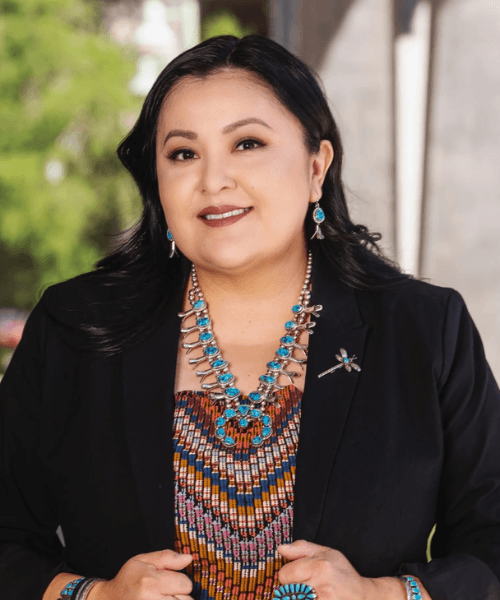
Dr. Monica Yellowhair, PhD, is the Assistant Director of Native American Partnerships at the University of Arizona Comprehensive Cancer Center whose work focuses on reducing cancer disparities in tribal communities across the American Southwest. A member of the Navajo Nation (is of the Towering House people (Kinyaa’áanii), born for the Red House people (Kinłichíi'nii) and she brings both professional expertise and lived community knowledge to her research on cancer prevention, screening access, and the intersection of Indigenous health values with biomedical cancer care.