

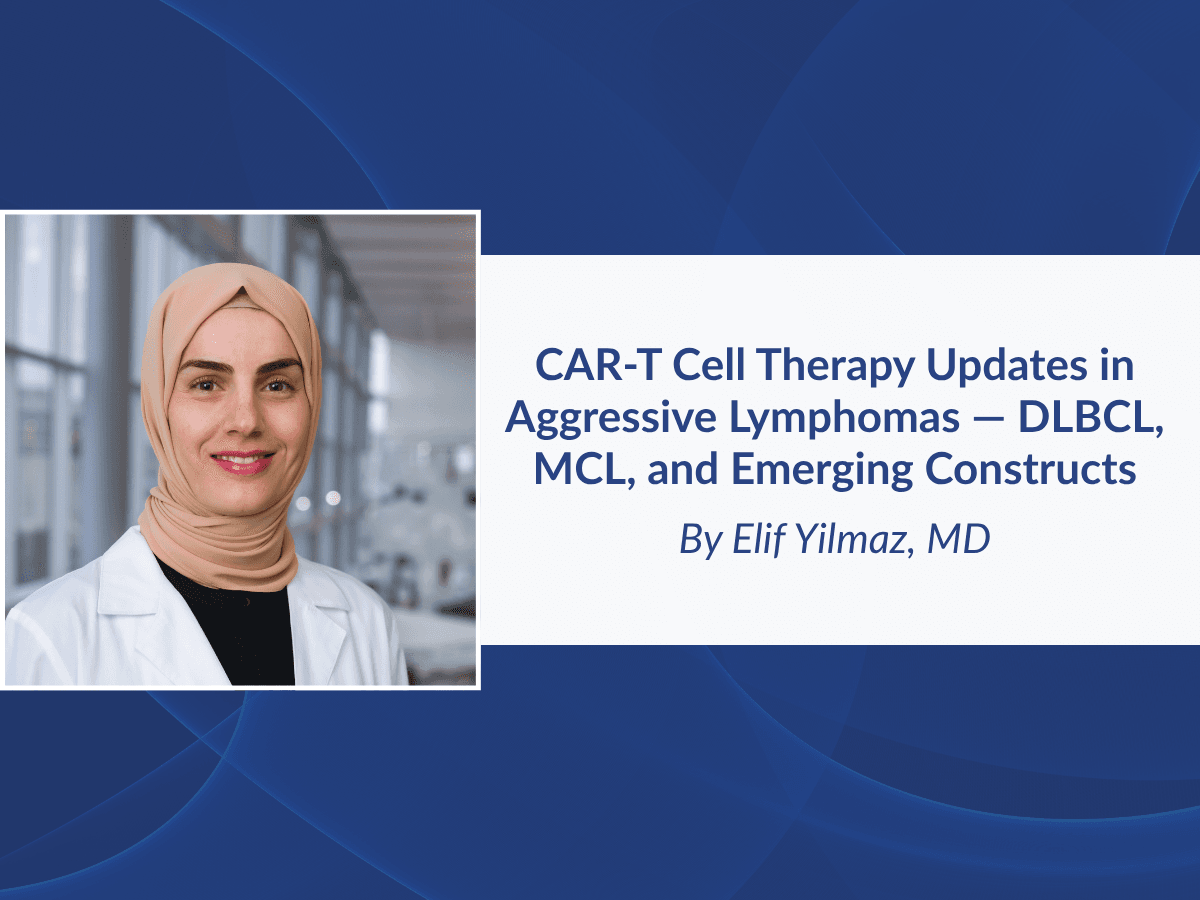
CAR-T Cell Therapy in Aggressive Lymphoma: Navigating Standard-of-Care Products, Sequencing Strategies, and the Road to Frontline Use
CAR-T cell therapy has rapidly transformed the treatment landscape for aggressive lymphomas such as diffuse large B-cell lymphoma (DLBCL) and mantle cell lymphoma (MCL). With four FDA-approved CD19-directed therapies now available, clinicians face increasingly complex decisions regarding product selection, toxicity management, sequencing with bispecific antibodies, and the role of CAR-T earlier in the disease course. In this expert commentary, Dr. Elif Yilmaz of UT Southwestern Medical Center reviews the latest evidence guiding second-line and frontline CAR-T strategies, compares key toxicity profiles among approved products, and discusses emerging approaches for patients who relapse after CAR-T therapy.
Introduction: Four Approved Products, One Fundamental Question
CAR-T cell therapy has transformed outcomes for patients with relapsed or refractory large B-cell lymphoma (LBCL) and mantle cell lymphoma (MCL). Four FDA-approved CD19-directed autologous CAR-T products are now available — axicabtagene ciloleucel (axi-cel), lisocabtagene maraleucel (liso-cel), tisagenlecleucel (tisa-cel), and brexucabtagene autoleucel (brexu-cel) — each with distinct construct features, toxicity profiles, and approved indications. The field has matured from a single third-line option to an established treatment modality now being evaluated in the second-line setting and, increasingly, in frontline combinations.
While CAR-T cell therapy has demonstrated substantial efficacy across multiple lymphoma subtypes, the challenge facing clinicians today is how to select the right product for the right patient, how to sequence it optimally with emerging therapies like bispecific antibodies, and how to manage patients who relapse after CAR-T.
Standard-of-Care CAR-T Constructs: Key Differences
Understanding the mechanistic differences between the four approved products informs clinical decision-making in ways that go beyond label indications.
Tisa-cel and liso-cel both use a 4-1BB costimulatory domain (in contrast to the CD28 domain used in axi-cel), which is generally associated with greater CAR-T cell persistence but slower in vivo expansion kinetics. Liso-cel and tisa-cel also differ in their hinge regions, which may influence antigen-binding dynamics and CAR signaling behavior. These distinctions contribute to differences in toxicity profiles that have become increasingly clinically meaningful.
DLBCL: From Third-Line Approval to Second-Line Standard of Care
Axi-cel was first approved in the third-line setting based on results from the ZUMA-1 trial, which enrolled patients with DLBCL NOS, primary mediastinal B-cell lymphoma, and high-grade B-cell lymphoma with at least two prior lines of therapy. Updated analysis with approximately six years of median follow-up showed a median progression-free survival (PFS) of 31% — a landmark result in this heavily pretreated population.
Approval was subsequently expanded to the second-line setting through the ZUMA-7 trial, a randomized phase 3 study comparing axi-cel to standard-of-care salvage chemotherapy followed by autologous stem cell transplantation (ASCT) in patients with primary refractory or early relapsed LBCL (defined as relapse within 12 months of frontline therapy). Importantly, crossover was not permitted, and bridging chemotherapy was not allowed beyond steroids. At four-year follow-up, the PFS rate in the axi-cel arm was 42% versus 24% in the ASCT arm.
Liso-cel was first approved in the third-line setting based on the Transcend NHL 001 study, which showed a median two-year PFS of 41% at. Second-line approval came through the TRANSFORM trial — a randomized phase 3 study with a similar design to ZUMA-7 — which demonstrated a three-year PFS of 51% with liso-cel versus approximately 21% with ASCT.
Tisa-cel was approved in the third-line setting based on the JULIET study, which demonstrated an overall response rate of 52% and a complete response rate of 40% in patients with relapsed or refractory LBCL. Efforts to move tisa-cel into the second-line setting through the BELINDA trial were unsuccessful, as the study did not demonstrate an event-free survival benefit over standard salvage chemotherapy followed by autologous transplant. Several factors may have contributed to the negative result, including longer manufacturing times and the allowance for multiple cycles of bridging chemotherapy, which likely selected for patients with more aggressive or refractory disease by the time of infusion.
Whether tisa-cel is intrinsically less effective than axi-cel or liso-cel remains uncertain, particularly given the limitations of cross-trial comparisons. However, across studies, tisa-cel has generally shown lower efficacy signals.
The Toxicity Question: Why I Favor Liso-cel in Practice
Among patients for whom both axi-cel and liso-cel appear to offer comparable efficacy, the toxicity profile becomes the decisive clinical factor. Liso-cel consistently demonstrates lower rates of high-grade CRS (cytokine release syndrome) and ICANS (immune effector cell-associated neurotoxicity syndrome) than axi-cel across both aggressive and indolent lymphoma studies.
Following resolution of some of the manufacturing and product-release challenges that initially affected liso-cel availability, utilization of liso-cel increased substantially over the last year. This shift was not unexpected, given its favorable safety profile — particularly lower rates of severe CRS and ICANS — while maintaining efficacy that appears broadly comparable to other approved CD19-directed CAR-T therapies in LBCL. In my practice, I favor liso-cel for most DLBCL patients eligible for commercial CAR-T, precisely because the tolerability advantage translates into meaningful quality-of-life differences for patients navigating what is already an intensive treatment course.
Frontline CAR-T for High-Risk DLBCL: The Evolving Evidence
The field is actively evaluating whether CAR-T can move into the frontline setting for selected high-risk patients.
The ZUMA-12 study was the first to explore this. In this phase 2 single-arm study, patients with high-risk LBCL and an IPI score of 3 or higher — and a Deauville score of 4 or 5 on interim PET after two cycles of chemoimmunotherapy — received axi-cel. The three-year PFS rate was 75%, which is notably impressive in a population defined as high-risk.
The ongoing ZUMA-23 study is building on this by enrolling patients with IPI scores of 4 or 5, randomizing them after one cycle of chemoimmunotherapy to axi-cel versus continuation of chemotherapy. This study is nearing completion of enrollment and could be practice-changing within the next two years.
An exciting emerging product in this space is rapcabtagene autoleucel, a CAR-T construct featuring ultrafast two-day manufacturing. The shorter ex vivo expansion is designed to preserve T-cell fitness by reducing exhaustion. Phase 2 interim data presented at ASH showed an overall response rate of 89% and a complete response rate of 74% in frontline high-risk LBCL patients, with notable observations suggesting that some partial responses on end-of-treatment PET may represent false-positive findings rather than true residual disease.
The allogeneic CAR-T space is also advancing. The ALPHA-3 trial is enrolling patients with ctDNA-positive disease after six cycles of frontline chemoimmunotherapy — offering consolidation with an allogeneic CD19 product for patients who have not achieved a molecular complete response. This represents an innovative application of MRD-guided decision-making to the frontline setting.
CAR-T in Mantle Cell Lymphoma
Brexu-cel was approved for relapsed or refractory MCL in July 2020, with full approval granted in April 2026 following publication of Cohort 3 results from the ZUMA-2 trial. The approval initially covered BTKI-exposed patients (Cohorts 1 and 2), and efficacy appeared stronger in BTKI-naive Cohort 3.
Liso-cel received FDA approval for relapsed/refractory mantle cell lymphoma in May 2024 based on results from the TRANSCEND NHL MCL cohort. The reported median PFS was approximately 15 months, numerically shorter than the nearly 25-month median PFS reported with brexu-cel in the ZUMA-2 trial. However, cross-trial comparisons should be interpreted cautiously because of important differences between the study populations and treatment eras. The liso-cel study was conducted during the COVID-19 pandemic, and COVID-related deaths had a meaningful impact on the PFS curve; a sensitivity analysis excluding COVID-related events increased the median PFS to approximately 18 months. In addition, the TRANSCEND MCL cohort included a higher proportion of patients with TP53 mutations compared with ZUMA-2, suggesting a potentially higher-risk population.
In my practice, I generally favor liso-cel for many patients with MCL because of its more favorable safety profile, particularly the substantially lower rates of severe CRS and ICANS. At the same time, the currently available data does not allow for a definitive conclusion regarding comparative efficacy between liso-cel and brexu-cel.
What to Do After CAR-T Failure
Managing patients who relapse after CAR-T remains one of the most challenging scenarios in lymphoma care. For early relapses within the first three to six months, disease tempo is often high, T-cell function may be compromised, and re-collection for another autologous product may yield a suboptimal product. Allogeneic stem cell transplantation is a curative option for some, but only a minority of post-CAR-T relapse patients are candidates.
CAR-after-CAR strategies — sequential CAR-T products targeting different antigens — have produced durable remissions in selected patients. This is among the most promising salvage approaches for patients with intact performance status and accessible disease. Bispecific antibodies offer meaningful disease control in the post-CAR-T setting but are unlikely to be curative; they should be considered a bridge to another potentially curative strategy rather than a destination.
CAR-T in Real-World Practice: Bridging and Logistics
A practical reality of commercial CAR-T delivery that is rarely discussed in clinical trial literature: most insurance companies require two to three weeks to approve CAR-T, and T-cell collection cannot proceed before approval. As a result, most patients require at least a cycle of salvage therapy between initial consultation and leukapheresis. Additional bridging therapy is then often required during the manufacturing period.
Over the past two years, bispecific antibodies have increasingly been used as bridging agents prior to second-line CD19 CAR-T, with multiple ongoing trials exploring this strategy. Radiation therapy also plays an important and sometimes underappreciated role as a bridging option, particularly in patients with bulky disease who would benefit from cytoreduction and disease control prior to infusion.
One important consideration in the bridging setting is prior exposure to bendamustine. Multiple retrospective studies have shown that recent bendamustine exposure — particularly within the preceding several months before leukapheresis — is associated with inferior CAR-T outcomes, including lower response rates and shorter survival. This is thought to be related, at least in part, to the prolonged lymphotoxic and T-cell suppressive effects of bendamustine, which may impair T-cell fitness and the quality of the manufactured CAR-T product.
Clinical Implications and Practice Takeaways
- Liso-cel is the preferred product for most DLBCL patients eligible for commercial CAR-T based on comparable efficacy to axi-cel and a consistently more favorable CRS and ICANS profile.
- Refer high-risk patients to a CAR-T center early. Patients with high-IPI disease at diagnosis should be concurrently evaluated by a transplant and cellular therapy specialist, because moving toward CAR-T before disease accelerates is consistently associated with better outcomes.
- Bispecific antibody bridging is growing but requires careful patient selection. Trials exploring bispecifics as consolidation after CAR-T or as sandwich strategies are maturing; avoid extrapolating these approaches outside of protocol without supporting data.
- Avoid recent bendamustine exposure before CAR-T. Patients who are being considered for CAR-T should not receive bendamustine containing regimens as salvage/bridging therapy.
- CAR-after-CAR is viable in selected patients. For fit patients relapsing after anti-CD19 CAR-T, sequential CAR-T targeting a different antigen (e.g., CD20 or CD22) is legitimate in clinical trial setting.
- Bispecific-plus-CAR-T combination and sequencing strategies are under active investigation in multiple trial designs (including bispecifics as bridging before CAR-T, as consolidation after CAR-T, and in sandwich designs) but should not be applied outside of protocol settings until efficacy and safety data mature.
Patient Perspective: What This Means for You
If you have been diagnosed with diffuse large B-cell lymphoma or mantle cell lymphoma that has not responded to standard chemotherapy or has come back after treatment, CAR-T cell therapy may be an option worth discussing with your specialist. CAR-T involves collecting your own immune cells, engineering them in a laboratory to recognize and attack your cancer, and infusing them back into your body. It is not a simple treatment: it requires a specialized center, a monitoring period after infusion, and careful management of potential side effects. But for patients who are eligible, it offers the potential for durable, long-term remission. Ask your oncologist whether you might benefit from a referral to a CAR-T center, ideally before your disease has progressed through multiple additional lines of therapy.
Key Takeaways
- Four FDA-approved CD19 CAR-T products are available for aggressive B-cell lymphoma, with axi-cel and liso-cel demonstrating comparable efficacy in DLBCL but liso-cel offering a significantly more favorable toxicity profile, making it the preferred choice in most clinical scenarios.
- Second-line CAR-T is now an established standard of care for primary refractory and early-relapsed DLBCL, based on ZUMA-7 (axi-cel, 42% four-year PFS) and TRANSFORM (liso-cel, 51% three-year PFS) versus ASCT.
- Frontline CAR-T for high-risk DLBCL is under active investigation, with ZUMA-12 showing 75% three-year PFS in Deauville 4/5 patients after two cycles of chemoimmunotherapy, and ZUMA-23 potentially delivering practice-changing results within two years.
- Liso-cel remains an effective and well tolerated option in MCL. Although cross-trial comparisons have suggested longer PFS with brexu-cel, these analyses are confounded by differences in patient populations and the impact of COVID-19–related events in the liso-cel study. Given its substantially lower rates of severe CRS and ICANS, liso-cel is an attractive choice for many patients in clinical practice.
- Management of relapse after CAR-T therapy remains a major unmet need. In fit patients, repeat cellular therapy approaches, including CAR-T strategies targeting alternative antigens, are actively explored in clinical trials and may offer additional curative potential. For selected patients who achieve a meaningful remission with post–CAR-T salvage therapy, allogeneic stem cell transplantation may also provide a potential path toward durable disease control or cure.
References and Resources
- Locke FL, et al. (ZUMA-1). Long-term safety and activity of axicabtagene ciloleucel in refractory large B-cell lymphoma. Nature Medicine, 2019.
- Westin JR, et al. (ZUMA-7). Axicabtagene ciloleucel versus standard of care in relapsed/refractory large B-cell lymphoma. New England Journal of Medicine, 2022.
- Kamdar M, et al. (TRANSFORM). Lisocabtagene maraleucel versus standard of care with salvage chemotherapy followed by autologous SCT in relapsed/refractory large B-cell lymphoma. The Lancet, 2022.
- Jacobson CA, et al. (ZUMA-12). Axicabtagene ciloleucel in high-risk large B-cell lymphoma. Journal of Clinical Oncology, 2022.
- Wang M, et al. (ZUMA-2). KTE-X19 CAR T-cell therapy in relapsed or refractory mantle cell lymphoma. New England Journal of Medicine, 2020.
- National Comprehensive Cancer Network (NCCN). B-Cell Lymphomas Guidelines. Available at: nccn.org
About the Author
Dr. Elif Yilmaz, MD, is an Assistant Professor in the Division of Hematology and Oncology in the Department of Internal Medicine at UT Southwestern Medical Center in Dallas, Texas. Originally from Turkey, she earned her medical degree at Istanbul University and completed her internal medicine residency at Sinai Hospital of Baltimore, followed by hematology and oncology fellowships at George Washington University and Georgetown University School of Medicine. Board-certified by the American Board of Internal Medicine, Dr. Yilmaz joined the UT Southwestern faculty in 2022. Her clinical expertise encompasses indolent and aggressive lymphomas, cellular therapies, and bone marrow transplantation, with research interest in immunosuppression-derived lymphomas and cancer disparities.