

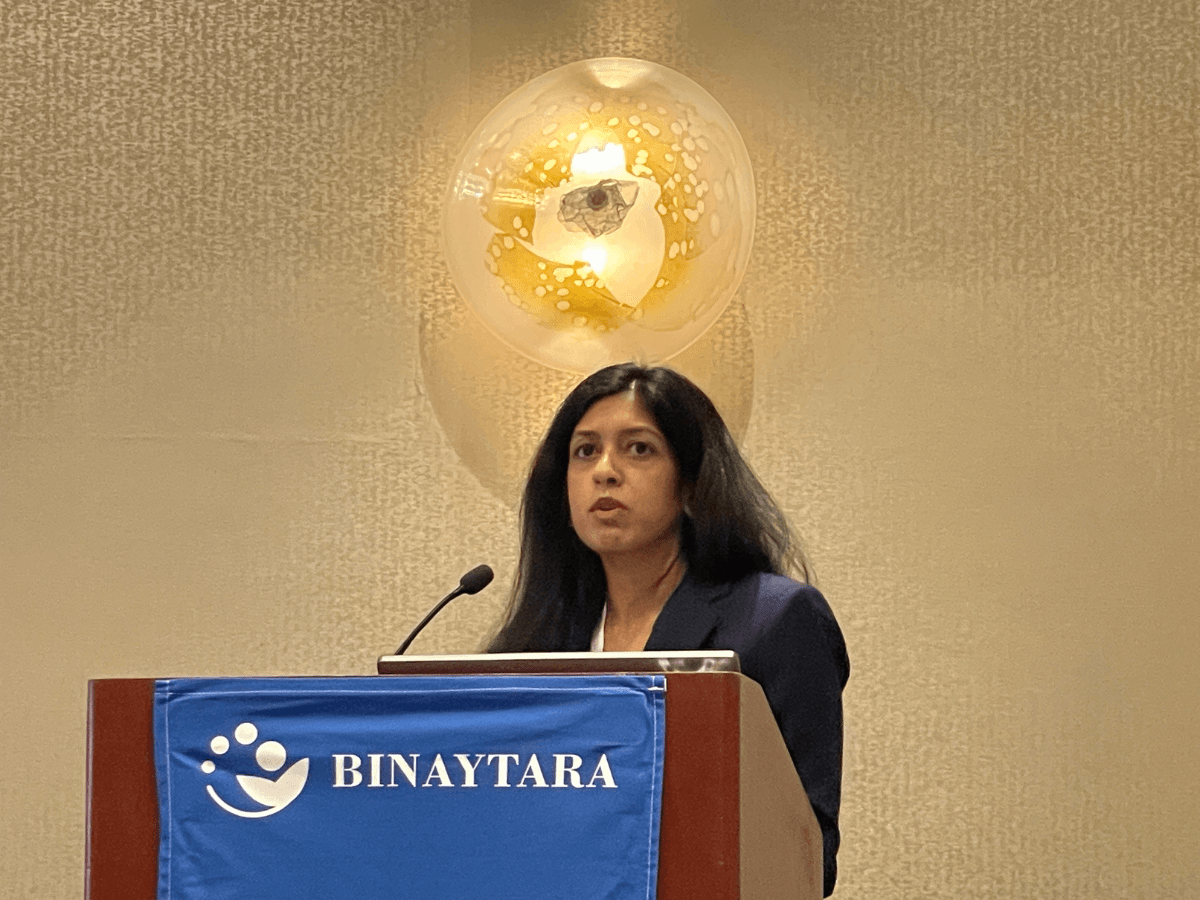
Bispecific antibodies and CAR T-cell therapies are rapidly reshaping the treatment landscape for B-cell lymphomas. At the Best of Hematology and Breast Cancer conference, Dr. Chaitra S. Ujjani shared critical updates from the 2025 ASH annual meeting, highlighting long-term efficacy data, emerging combination strategies, and practical considerations for integrating these immunotherapies into clinical practice across follicular, large cell, and mantle cell lymphomas.
Dr. Chaitra S. Ujjani is a hematologist-oncologist at Fred Hutchinson Cancer Center specializing in B-cell lymphomas. At the Best of Hematology and Breast Cancer conference, Dr. Ujjani presented critical updates on bispecific T-cell engagers and CAR T-cell therapy for B-cell lymphomas, highlighting key findings from the 2025 American Society of Hematology (ASH) annual meeting.
Her presentation focused on the evolving treatment landscape for follicular lymphoma, large cell lymphoma, and mantle cell lymphoma, with emphasis on novel therapeutic approaches and their clinical implications.
The transcript below has not been reviewed by the speaker and may contain errors.
Updates in B-Cell Lymphoma Treatment
The presentation covers two major areas of advancement in B-cell lymphoma treatment: updates on bispecific T-cell engagers and updates on CAR T-cell therapy. These developments, primarily presented at the 2025 ASH annual meeting, represent significant progress in treatment options for patients with relapsed or refractory B-cell lymphomas.
CD20-Targeted Bispecific T-Cell Engagers: Current FDA-Approved Options
Mosunetuzumab: Intravenous CD20 Bispecific Therapy
Mosunetuzumab is FDA-approved for third-line and beyond follicular lymphoma. The route of administration is intravenous, and authorization was recently granted in December. The duration of therapy is fixed at 8 to 17 cycles. At ASH this year, five-year progression-free survival data showed approximately 36% for the treatment group. The median duration of response was almost four years, and retreatment was demonstrated as feasible, with over five patients successfully being retreated.
Epcoritamab: Subcutaneous Administration with Continuous Therapy
Epcoritamab is approved in the third line and beyond for follicular lymphoma and large cell lymphoma. The route of administration is subcutaneous, and treatment continues until progression. Updates in follicular lymphoma data showed that the median duration of complete response was not reached, ranging from more than 31 months. In large cell lymphoma, the data update revealed median duration of complete response was over three years.
Glofitamab: Fixed-Duration CD20 Bispecific
Glofitamab is approved for large cell lymphoma and is an intravenous medication given up to 12 cycles. The median duration of response was 30 months. Updated data showed that two-year progression-free survival for patients in complete response was 57%. Retreatment is also feasible with this agent.
Mosunetuzumab Studies in Follicular Lymphoma: Expanding Treatment Contexts
At ASH this year, several mosunetuzumab studies in follicular lymphoma were presented. Mosunetuzumab monotherapy in high tumor burden, treatment-naive follicular lymphoma demonstrated impressive results. The complete response rate was 64%, with an overall response rate of 87% at one year. The progression-free survival for this high tumor burden population was encouraging.
Combination Therapy Approaches with Mosunetuzumab
Mosunetuzumab in combination with lenalidomide in relapsed/refractory follicular lymphoma included 20 heavily pretreated patients. Forty percent of patients had received prior CAR T-cell therapy. The overall response rate was 96% with a complete response rate of 87%. Cytokine release syndrome (CRS) rates were minimal, occurring in about a quarter of patients, and this was primarily low-grade.
Mosunetuzumab plus polatuzumab demonstrated a complete response rate of 83%. More CRS was observed with this combination, but all cases were low-grade.
Epcoritamab Plus Lenalidomide Plus Rituximab: The EPCORE NHL-1 Study
Data were presented for epcoritamab in the EPCORE NHL-1 study, examining epcoritamab plus lenalidomide plus rituximab in previously treated patients with follicular lymphoma. Patients with an indication for therapy were randomized to either epcoritamab combination (EPCORE R²) or lenalidomide plus rituximab (R²). Almost 500 patients were randomized in the study, with median age of approximately 60 years old. About a quarter of patients had bulky disease, everyone had seen a prior CD20 antibody, and a third of patients were refractory to their frontline therapy. The median number of prior lines of therapy was one.
Safety Profile of Epcoritamab Combination Therapy
Safety data examined two different step-up dosing schedules for epcoritamab. Focusing on the subcutaneous step-up dosing, 133 patients were treated in this fashion. For EPCORE R², the CRS rate was 26%, mostly all low-grade and consistent with the class. About 17% of patients experienced hypotension. Time to onset of CRS was a day and a half, and time to CRS resolution was quite quick at one day. A quarter of patients received tocilizumab for supportive care.
The adverse event profile showed slightly more toxicity with EPCORE R² compared to R² alone, including more serious adverse events, more infections (including more grade 3 or higher infections at 33% versus 16%), and more neutropenia.
Efficacy Data: Superior Response Rates with Triple Therapy
Efficacy data demonstrated an overall response rate for the triplet therapy of 95% compared to 79% with R². Complete response rate was 83% compared to just 50% with R². Progression-free survival curves were quite wide, with median PFS not reached with the triplet versus less than a year with R² alone.
Bispecific Antibodies in Older Patients with Large Cell Lymphoma
Data was presented examining bispecific antibodies in older patients with treatment-naive large cell lymphoma. Three different abstracts displayed data for mosunetuzumab, odronextamab monotherapy, and epcoritamab monotherapy. The median age for all these studies in treatment-naive large cell lymphoma patients was 80 years old.
With mosunetuzumab, the complete response rate was 81%, and one-year progression-free survival was 85%. Odronextamab and glofitamab showed complete response rates of around 60%. Median progression-free survival data are still early, but these options may be valuable for some patients. CRS, for the most part, was low-grade.
Glofitamab in Mantle Cell Lymphoma: Prior BTK Inhibitor Experience
An important paper published last year (not presented at ASH) examined glofitamab in mantle cell lymphoma patients, comparing those who had prior BTK inhibitor therapy versus those who did not. For the prior BTK inhibitor population—the majority of patients—the complete response rate was 71%. Progression-free survival and duration of complete response data showed durable responses for some patients.
CD19-Targeted Bispecific: Odronextamab in Relapsed/Refractory Indolent Lymphoma
Shifting from CD20 bispecifics, odronextamab is a CD19 bispecific T-cell engager. This year, data was presented for relapsed/refractory indolent lymphoma patients who were CD19-positive and had received at least two prior lines of therapy. Several different dose levels were investigated.
Patient characteristics showed that about 15% of patients were CD20-negative. Response rates were observed at all dose levels, including high complete response rates. In terms of adverse event profile, the therapy was well-tolerated with low-grade CRS. Grade 3 or higher immune effector cell-associated neurotoxicity syndrome (ICANS) occurred in approximately 20% of patients.
CAR T-Cell Therapy Updates: Long-Term Follow-Up Data
CAR T-cell therapy has FDA indications for three different agents in various settings, including primary refractory disease, early relapse, and after two prior lines of therapy. Axicabtagene ciloleucel (axi-cel), lisocabtagene maraleucel (liso-cel), and tisagenlecleucel (tisa-cel) demonstrate high complete response rates, though durability appears to be approximately 40%.
Long-Term Follow-Up in Follicular Lymphoma
At ASH this year, long-term follow-up data were presented for axi-cel, tisa-cel, and liso-cel in relapsed/refractory follicular lymphoma. High complete response rates were observed with all these agents, showing durable responses. With axi-cel, progression-free survival is almost five years. With tisa-cel, it's about four and a half years. With liso-cel at three years, progression-free survival is 68%.
CAR T-Cell Therapy in Marginal Zone Lymphoma
One additional abstract examined liso-cel in relapsed marginal zone lymphoma. The complete response rate was 62%. Median progression-free survival for patients achieving a complete response or partial response had not been reached. The 24-month progression-free survival rate was 90%.
Novel CAR T-Cell Products: Dual-Targeted and Faster Manufacturing
Numerous new CAR T-cell products were presented at ASH this year, many representing dual-targeted CAR T-cell products targeting both CD19 and CD20. Research is examining faster manufacturing times, with one presentation demonstrating a product with a two-day manufacturing time. These developments represent an important trend in the field.
Changes in Clinical Practice: Practical Implications
Current practice changes include being more proactive about obtaining biopsies when considering bispecifics and CAR T-cell therapy for patients with recurrent disease, aiming to determine which therapeutic targets are available. Confirming CD20 expression before initiating bispecific therapy is essential. Referring patients to CAR T-cell therapy as soon as possible is important, even within institutions that offer these therapies, and making referrals early in the treatment course.
Bridging strategies remain imperfect, necessitating continuous exploration of new options through clinical studies.
Future Directions in B-Cell Lymphoma Treatment
The field appears to be moving toward bispecifics in earlier lines of therapy, either as monotherapy or in combination with other novel agents. For indolent disease, possible combinations include bispecific therapy as a frontline treatment. Several studies are pending or ongoing, including institutional trials examining bispecific plus R-EPOCH combinations.
For CAR T-cell therapy, the hope is increased accessibility through better bridging strategies, more effective products, and quicker production times. A better understanding of resistance mechanisms and optimal sequencing strategies will be critical for maximizing patient outcomes.
Summary: Evolving Treatment Landscape for B-Cell Lymphomas
The treatment landscape for B-cell lymphomas continues to evolve rapidly, with bispecific T-cell engagers and CAR T-cell therapies demonstrating impressive efficacy across multiple disease settings. From treatment-naive elderly patients to heavily pretreated relapsed/refractory disease, these novel immunotherapies are expanding options and improving outcomes. Ongoing research into combination strategies, dual-targeted products, and manufacturing improvements promises to further enhance the therapeutic armamentarium for patients with B-cell lymphomas.