

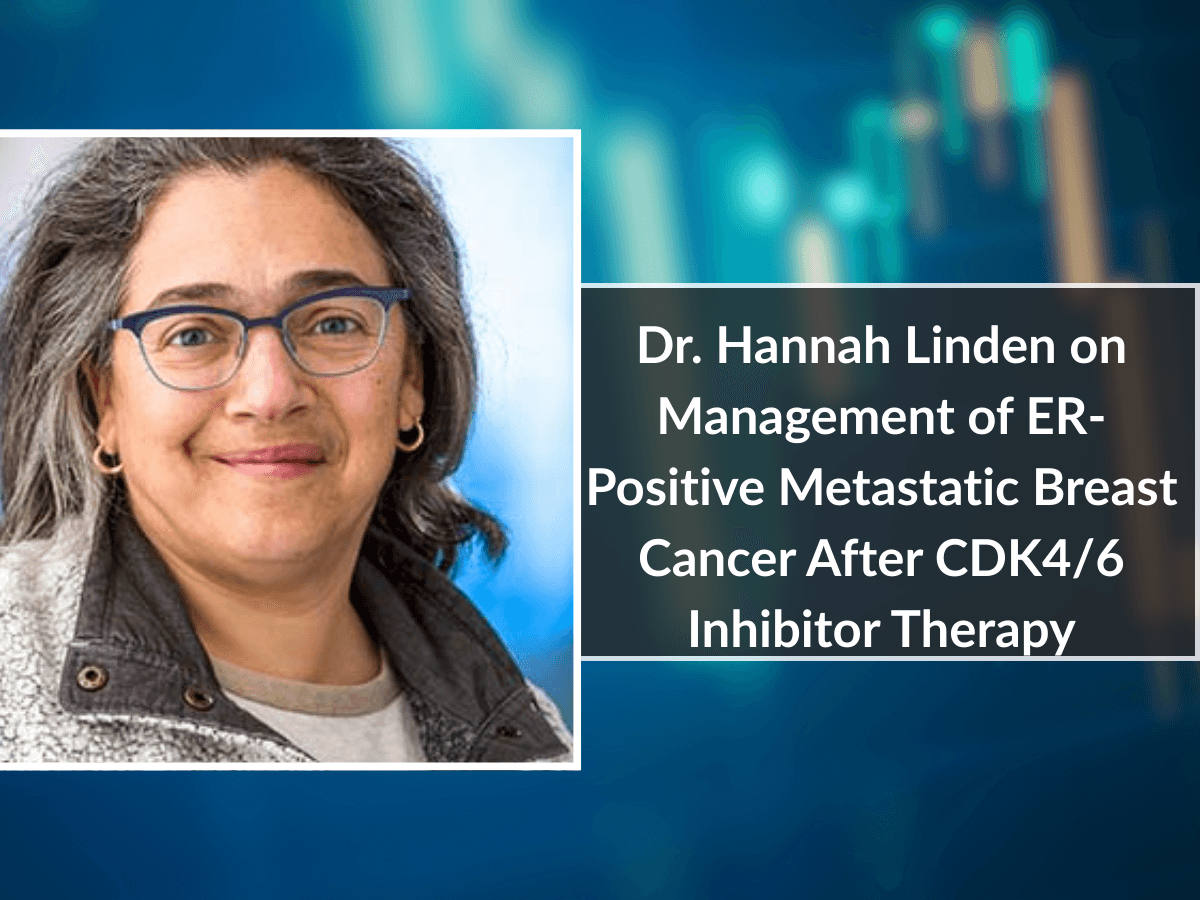
What is the best treatment strategy for ER-positive metastatic breast cancer after progression on a CDK4/6 inhibitor? At the Best of Hematology & Breast Cancer 2026 conference, Dr. Hannah Linden of Fred Hutchinson Cancer Center outlined the rapidly evolving landscape of endocrine therapies, oral SERDs, targeted combinations, and precision imaging tools that are reshaping care for patients with hormone receptor–positive metastatic disease.
Dr. Hannah Linden is associate program director of the Medical Oncology and Hematology Fellowship Program at Fred Hutch and UW Medicine. She is a breast cancer specialist who treats patients at Fred Hutchinson Cancer Center and Harborview Medical Center. At the Best of Hematology & Breast Cancer 2026 conference in Seattle, Dr. Linden presented on the evolving landscape of treatment options for ER-positive metastatic breast cancer, with particular focus on therapeutic strategies following CDK4/6 inhibitor therapy.
The transcript report below has not been reviewed by the speaker and may contain errors.
The Evolving Landscape of ER-Positive Breast Cancer Treatment
The landscape of breast cancer treatment has been fundamentally transformed by newer drugs that have prolonged lives. However, this progress has created complex clinical questions about optimal sequencing and combination strategies. The challenge centers on determining the best approach after patients have received CDK4/6 inhibitor therapy, a scenario that has become increasingly common in clinical practice.
Current Endocrine Therapy Options
Multiple strategies exist for targeting the estrogen receptor pathway. The depleting strategy uses aromatase inhibitors, while the blocking strategy employs SERMs. Endoxifen and elacestrant are emerging options, with endoxifen showing promise as potentially the active metabolite of tamoxifen, possibly without the associated side effects. This has led to the opening of a premenopausal study that has generated exciting results.
FDA approval now exists for elacestrant and imlunestrant, though currently only for the ESR1 mutation subset. Additional SERDs, including giredestrant, are in development and expected to generate significant interest. The PROTAC and oral degrader class is anticipated to receive FDA approval in the near future, providing clinicians with expanded choices among very promising drugs.
Combination Therapies and Regulatory Considerations
An interesting aspect of current SERD approvals is that, despite working for other tumor types, they have only been approved for patients with ESR1 mutations. This suggests that tumors without this mutation may be circumventing cancer growth through alternative pathways, though this interpretation remains debatable. Combinations with molecular targeted agents appear safe overall, though some drug interactions have been documented.
The transition from a CDK4/6 inhibitor combined with an aromatase inhibitor to a single agent seems counterintuitive. Camizestrant and elacestrant are expected to receive approval soon, and the modest side effects across these drugs may become the determining factor in clinical selection. Fulvestrant will remain relevant due to its cost-effectiveness and proven activity, despite the inconvenience of injection. Many patients tolerate it well and prefer to continue therapy. It remains the only SERD approved for premenopausal status.
The LADERا Adjuvant Study
Imlunestrant was highlighted in the LADERA study presented at San Antonio. This remarkable but not yet published trial randomized 4,200 patients with stage 1 to 3 ER-positive breast cancer to standard therapy with an AI or tamoxifen versus the novel SERD. At 32 months follow-up, which is considered early, results favor the SERD with notably low discontinuation rates compared to the standard of care. Adherence and tolerability represent fundamental challenges in endocrine therapy management.
Grade one bradycardia was observed, but overall, the trial appears quite promising. An important unanswered question is whether having access to SERDs in the adjuvant setting could limit the need for CDK4/6 inhibitors, though this has not been formally studied. The drug is not yet approved despite patient interest and requests.
Treatment Decisions After CDK4/6 Inhibitor Progression
After patients respond to CDK4/6 inhibitor therapy, often for years, determining the next step remains challenging. This may occur after single-agent endocrine therapy followed by adding a CDK4/6 inhibitor, perhaps with a change in background therapy. Multiple reasonable approaches exist, and clinical judgment should guide decision-making.
Estrogen receptor imaging could provide valuable information about whether ER-positive disease persists. Generally, patients either retain or lose ER expression, though some patients lose it at select sites. This likely predicts non-response to further endocrine therapy, though randomized data are lacking. At San Antonio, results from AI 1183 Typhoon demonstrated the promise of FDG PET to measure response in bone, specifically for lytic lesions, which are very common in breast cancer. This impressively positive study could potentially lead to FDA liberalization of FDG PET labeling, allowing routine disease monitoring. This development represents a potential game-changer.
Targeting the Estrogen Receptor: Key Considerations
The fundamental question is whether continued ER targeting remains appropriate, and the optimal level of ER expression needed for PI3K inhibitor efficacy remains unknown. For drug-sensitive tumors, single-agent SERD might be sufficient, though mutation testing would likely guide this decision. While combination therapy approval is pending, it likely represents a sound strategy.
Currently approved options include abemaciclib plus elacestrant or exemestane. PI3K inhibitors represent highly active options, though associated toxicity requires consideration. Future options, including CDK2/4/6 inhibitors and CAT6 inhibitors, offer exciting potential by targeting resistance mechanisms.
Real-World Outcomes and Prognostic Factors
A concerning pattern across studies shows a steep shoulder on survival curves, indicating many patients progress rapidly to chemotherapy. A recent Italian real-world experience publication demonstrates poor outcomes regardless of treatment approach. Patients without visceral disease perform somewhat better, but a significant proportion of non-responders remains. Overall survival analysis shows similar patterns, with capecitabine potentially offering slight advantages for patients with visceral disease.
The study included patients treated with third-line or later therapy, with 27% [tumultuous no medicine patient], predominantly postmenopausal with visceral involvement. This reflects typical clinic populations. Significant prognostic variables included duration of CDK4/6 inhibition and presence of visceral metastases. These factors should inform decisions about continuing on the endocrine pathway versus switching to more toxic but potentially more effective therapy.
The EMBER-3 Study and Combination Therapy Benefits
Updated results from EMBER-3 presented at San Antonio and simultaneously published in Annals of Oncology demonstrated imlunestrant superiority over standard of care, defined as exemestant or fulvestrant. Overall survival showed promising trends though not yet statistically significant. Without crossover, these results appear encouraging despite the survival curve shoulder remaining steeper than desired. This combination appears superior to single agent approaches and the MAINTAIN study using ribociclib plus fulvestrant from that era.
The combination of imlunestrant plus abemaciclib presents GI tract tolerability challenges. Subgroup analysis in EMBER-3 identified favorable prognostic groups: low tumor burden, absence of visceral involvement, and ESR1 mutation status. PI3K mutation-positive patients showed somewhat reduced benefit. Improved progression-free survival and trending overall survival improvement are exciting because combination SERD data are needed to achieve response rates exceeding 50%.
Discussing treatment with only 30% efficacy prospects feels difficult with patients. Even in bone-dominant disease, progression poses significant risks including spinal compression fractures or hip fractures. Therefore, aggressive efforts to improve response rates are warranted.
ESR1 Mutation Status and Treatment Benefit
Adding imlunestrant provides significant benefit, following a consistent pattern across SERDs: the addition of molecular targeted agents like venetoclax shows more significant benefit in ESR1 mutation-positive patients compared to those without the mutation. However, efficacy is not absent in mutation-negative patients. The challenge lies in securing FDA approval for broader indications, which limits optimal patient care when clinicians believe patients would benefit but lack approved access.
The LADERA data generated significant excitement, and ultimately ESR1 mutation requirements may become less restrictive. ESR1 status fluctuates in individual patients over time, yet approval could theoretically be obtained based on a mutation detected five years previously but no longer present.
Clinical Principles for Managing ER-Positive Metastatic Disease
ER-causing breast cancer remains quite manageable with an evolving therapeutic landscape, potentially approaching an era where chemotherapy becomes infrequent for these patients. The setting and patient's clinical scenario are critically important. Duration of response to initial therapy, disease sites, and pace of disease progression represent key considerations. Ki-67 might be relevant but proves frustrating to use in practice, and genomic profiles are not employed in metastatic disease management.
Multiple valid treatment paths exist, including de-escalation strategies with single agent endocrine therapy. CDK4/6 inhibitors may not be necessary upfront or may not be required in the palliative setting. Patients can lose ER expression but may also regain it, making serial assessment important. Molecular imaging can assist particularly in bone-dominant patients where sampling poses challenges.
Future Directions and Research
Ongoing trials are testing combination therapies, which is crucial for determining optimal treatment partnerships. Elevated is open at the center examining [cam]. Obtaining epsilon requires proper processing, and liquid assays are also available. The clinical significance of detecting 0.2% of something in a liquid assay remains questionable. More trials comparing tumor biopsy from the leading edge with liquid assays are needed.
FES imaging has received provisional approval for use as an integral biomarker in phase two studies, allowing treatment decisions based on imaging results. This involves testing whether patients should remain on the endocrine pathway or transition to immunotherapy or other approaches. This parallels standard clinical practice, where sampling one ER-positive bone metastasis among twenty leads to the assumption that all tumor sites are ER-positive. Homogeneous ER expression confirms that endocrine-based therapy will be effective. The threshold is considered 30% based on a small European study showing that patients with heterogeneity below 80% do not benefit from endocrine therapy.
A progesterone receptor imaging trial is open through TBCRC and Lilly. The work presented reflects contributions from many colleagues, and it is a privilege to work at the Hutch and University where outstanding collaboration enables this research.