

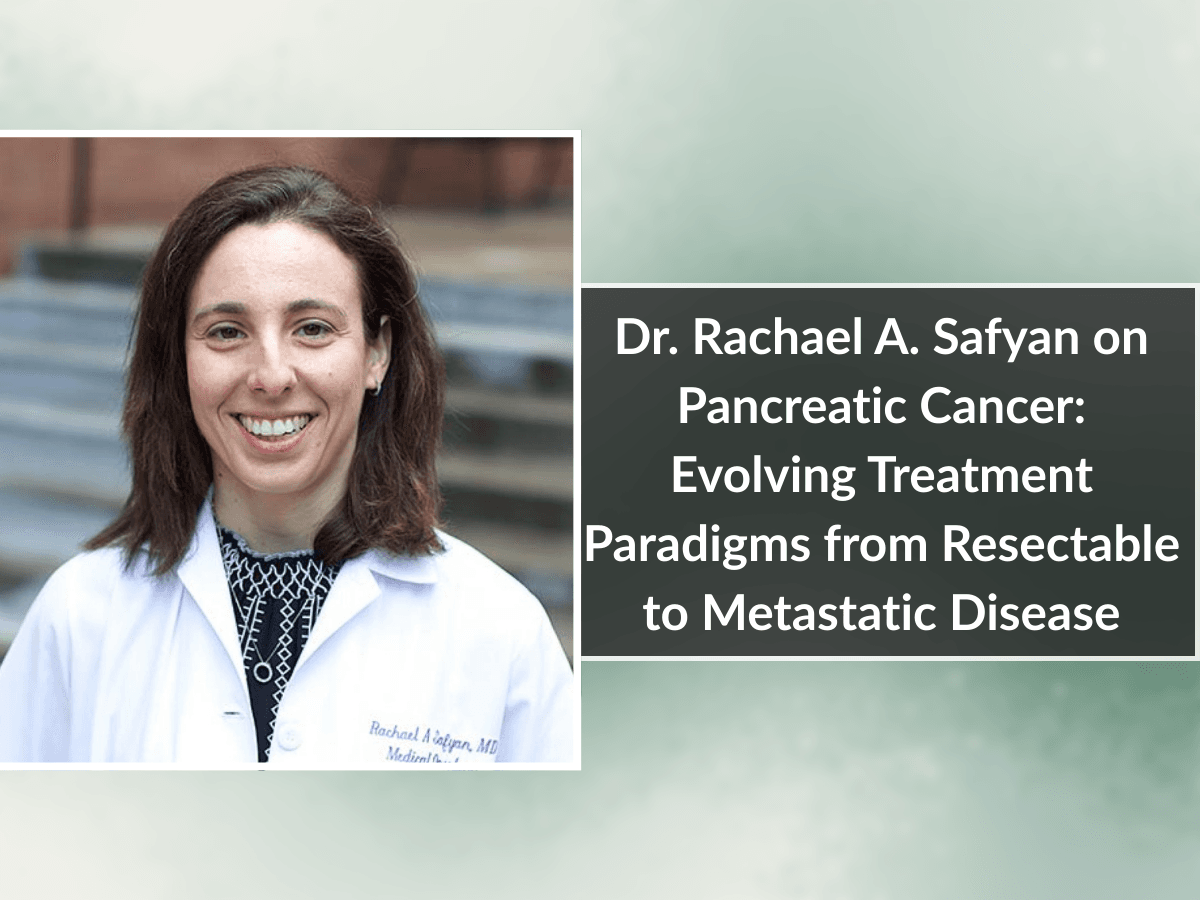
Pancreatic cancer is rapidly becoming one of the leading causes of cancer-related death in the United States. At the 2026 Hawaii Gastrointestinal Cancers Summit, Dr. Rachael A. Safyan delivered a comprehensive update on evolving treatment paradigms across all stages of disease—from neoadjuvant and adjuvant strategies in resectable pancreatic cancer to FDA-approved tumor-treating fields in locally advanced disease and the emerging revolution of RAS-targeted therapies in metastatic pancreatic cancer.
Dr. Rachael A. Safyan is a medical oncologist with both a clinical and research focus on gastrointestinal malignancies, seeing patients at the Sloan Clinic and Fred Hutch at UW Medical Center. At the 2026 Hawaii Gastrointestinal Cancers Summit, Dr. Safyan presented a comprehensive stage-by-stage update on pancreatic cancer, covering advances in neoadjuvant and adjuvant therapy, the landmark FDA approval of tumor-treating fields for locally advanced disease, and a rapidly evolving landscape of RAS-targeted therapies in metastatic disease.
The transcript report below has not been reviewed by the speaker and may contain errors.
Pancreatic Cancer Epidemiology and Disease Overview
Over 67,000 people were diagnosed with pancreatic cancer in the United States in 2025, and nearly 52,000 died of the disease. By 2030, pancreatic cancer is projected to become the second most common cause of cancer-related death. Although the overall incidence remains relatively low, it has been slowly increasing by approximately 1% per year since the 1990s. These trends underscore the urgency of continued progress across all stages of disease.
Resectable and Borderline Resectable Disease: Neoadjuvant Strategies
The current 2025 NCCN guidelines recommend upfront surgery for patients with resectable disease in the absence of high-risk features, while patients with borderline resectable disease are advised to receive neoadjuvant chemotherapy first. The rationale for neoadjuvant therapy is multifaceted: it is generally better tolerated by patients prior to major surgery, it is associated with improved R0 resection rates and nodal downstaging, and perhaps most importantly, it provides earlier systemic treatment for micrometastatic disease. Pancreatic cancer is fundamentally a systemic disease, and data consistently show that systemic recurrence within the first 6 to 12 months after surgery is the primary driver of mortality, while local recurrence tends to occur later.
Two major perioperative trials completed accrual in 2025 and are expected to provide important data in the coming years. The Alliance trial is a phase 3 study comparing perioperative modified FOLFIRINOX to adjuvant FOLFIRINOX. The Pre-OPTIC 3 study, conducted in Europe, follows a similar design. Results from both are eagerly anticipated.
The CASSANDRA Trial: Quadruplet Neoadjuvant Therapy
Among the most notable recent presentations is the CASSANDRA trial, a phase 3 study using a two-by-two factorial design that evaluated PaxG versus modified FOLFIRINOX in patients with resectable and borderline resectable pancreatic cancer. A total of 260 patients were randomized to four months of either capecitabine, nab-paclitaxel, cisplatin, and gemcitabine (PaxG) or modified FOLFIRINOX. A second randomization then allocated patients to either two additional months of therapy before surgery or surgery followed by adjuvant chemotherapy.
The initial readout on the first randomization showed that neoadjuvant PaxG significantly improved event-free survival, with a median of 16 months compared to 10.2 months with modified FOLFIRINOX. PaxG was also associated with improved CA19-9 response, improved pathologic stage, R0 resection rates, and reduced early metastatic recurrence. Overall survival data are still pending, and the regimen has not yet been incorporated into NCCN guidelines, but these results have generated considerable interest in the neoadjuvant setting.
Emerging Adjuvant Strategies: mRNA Vaccines and RAS Inhibitors
Two additional trials in the early-stage setting deserve attention. A phase 3 study currently underway is evaluating a personalized mRNA vaccine, autogene cevumeran, in the adjuvant setting. Patients with resectable disease undergo surgery and are then randomized to modified FOLFIRINOX alone or modified FOLFIRINOX with atezolizumab plus the mRNA vaccine.
A second adjuvant trial, RASOLU-304, has opened at a limited number of sites and will expand to include Fred Hutch in the coming months. This is a phase 3 multicenter randomized study evaluating adjuvant diraxonrasib (RMC-6236), a pan-RAS inhibitor, versus standard-of-care observation in patients who have completed neoadjuvant and/or adjuvant chemotherapy following resection. Both trials reflect a broader shift toward biomarker-driven and molecularly targeted strategies in the curative-intent setting.
Locally Advanced Pancreatic Cancer: Tumor Treating Fields and the PANOVA-3 Trial
In locally advanced pancreatic cancer, current NCCN guidelines recommend systemic chemotherapy as induction therapy for four to six months, followed by chemoradiation. However, the LAP07 trial established that the addition of chemoradiation to chemotherapy did not improve overall survival, leaving the field in need of new approaches.
A significant development arrived with the recent FDA approval of Optune Pancreas by Novocure, a tumor-treating fields device for use in locally advanced pancreatic cancer. Tumor treating fields is a portable, non-invasive device that delivers low-intensity alternating electrical fields to the abdomen. These fields disrupt critical cellular processes, including DNA repair and microtubule formation, ultimately leading to apoptosis. Preclinical and translational data also suggest a potential role in modulating the tumor immune microenvironment.
The approval was based on the PANOVA-3 trial, a phase 3 study presented and published in 2025, which evaluated gemcitabine and nab-paclitaxel with or without tumor-treating fields in patients with locally advanced disease. This was the first phase 3 study in locally advanced pancreatic cancer to demonstrate an improvement in overall survival. The addition of tumor-treating fields yielded a median overall survival of 16.2 months compared to 14.2 months with chemotherapy alone, along with an improvement in pain-free survival.
An ongoing phase 3 trial through NRG is examining whether dose-escalated radiation can improve upon the standard approach. Following four to six months of induction chemotherapy, patients are randomized to dose-escalated radiation targeting a biologically effective dose of 100 gray versus standard-of-care chemotherapy, observation, or standard chemoradiation. Radiation oncologists have two fractionation options, a 5-fraction and a 25-fraction arm, with the 5-fraction schedule considered preferable when feasible. Overall survival is the primary endpoint.
Metastatic Disease: The RAS Targeting Revolution
Pancreatic cancer is a RAS-driven disease, with KRAS mutations present in over 90% of cases. The vast majority occur at codon 12, and these mutations are initiating events in pancreatic tumorigenesis. RAS cycles between a GTP-bound active state and a GDP-bound inactive state, and mutations in RAS lead to decreased GTP hydrolysis, resulting in the accumulation of mutated RAS in its active conformation. Retrospective studies confirm that patients with mutant KRAS have worse overall survival compared to the approximately 5 to 10% of patients whose tumors are KRAS wild-type. Among the most common mutant alleles, G12D accounts for roughly 40% of cases, G12V and G12R account for most of the remainder, and the specific allele carries prognostic significance. Patients with G12D have the worst overall survival of the three most common variants, while G12R is associated with a more favorable prognosis. KRAS allele copy number also influences overall survival.
The past several years have seen an explosion of RAS-targeting therapies moving from preclinical studies through phase 1, 2, and 3 trials. Several are FDA-approved, specifically the G12C inhibitors, though the G12C mutation is far less common in pancreatic cancer than in lung cancer. The current pipeline includes mutant-specific inhibitors targeting individual alleles such as G12C and G12D, as well as pan-RAS or pan-KRAS inhibitors designed to block multiple alleles simultaneously.
IRAS-G12D Inhibition: Insight-B16734
Preliminary phase 1 results of IBI-3734 (also referred to as 734), a novel oral KRAS G12D inhibitor, were presented at GI ASCO. Because G12D mutations account for approximately 40% of KRAS-mutant pancreatic cancers, a selective inhibitor for this allele represents a particularly relevant therapeutic target. IBI-3734 is a selective on/off KRAS G12D inhibitor, meaning it targets both the active and inactive conformations of the protein.
The trial included both a monotherapy cohort and combination therapy cohorts pairing IBI-3734 with gemcitabine/nab-paclitaxel or modified FOLFIRINOX. Patients in the monotherapy arm were heavily pretreated, with approximately a quarter having received at least three prior lines of therapy. In combination therapy cohorts, patients were predominantly first- or second-line.
The monotherapy waterfall plot demonstrated encouraging antitumor activity, with an overall response rate of 37% in this heavily pretreated population. For context, the standard second-line regimen of liposomal irinotecan (NAPOLI-1) yields a response rate of approximately 17%. In the combination cohorts, though patient numbers remain small and data are early, response rates at the 1,200 mg recommended phase 2 dose reached 50% regardless of which chemotherapy backbone was used.
The safety profile was characterized primarily by GI and constitutional adverse events. Notably absent were the rash, stomatitis, and cytopenias frequently observed with pan-RAS inhibitors, likely reflecting the high selectivity of IBI-3734. Combination with chemotherapy also appeared feasible. The global phase 3 study, DAWN-303, is planned in the first-line metastatic setting, randomizing patients to modified FOLFIRINOX or gemcitabine/nab-paclitaxel with or without IBI-3734, with overall survival as the primary endpoint.
Pan-RAS Inhibition: Diraxonrasib (RMC-6236)
Diraxonrasib (RMC-6236) is a RAS-on multi-selective non-covalent tricomplex inhibitor. It binds to the active GTP-bound form of KRAS and acts as a molecular glue, forming a complex with the chaperone protein cyclophilin A. In the second-line setting, diraxonrasib at the recommended phase 2 monotherapy dose of 300 mg demonstrated substantial clinical activity in patients with RAS-mutant tumors. Across G12X mutations and all RAS-mutant tumor analyses, response rates ranged from 29 to 35%, median progression-free survival was 8 to 8.5 months, and median overall survival was 13 to 15 months. These figures compare very favorably to the current standard second-line chemotherapy benchmark of approximately six months median overall survival.
The pivotal phase 3 study, RASOLU-302, compared diraxonrasib to standard-of-care second-line chemotherapy, has completed accrual, and results are anticipated in early to mid-2026. A positive outcome would position this agent for FDA approval in the second-line setting.
In the first-line setting, diraxonrasib in combination with gemcitabine/nab-paclitaxel has shown encouraging early antitumor activity with response rates of 55%. Looking further ahead, RASOLU-303 will examine diraxonrasib alone versus diraxonrasib with gemcitabine/nab-paclitaxel, and diraxonrasib maintenance versus chemotherapy, with co-primary endpoints of progression-free survival and overall survival. This study raises the possibility of a future first-line regimen that does not require chemotherapy as a backbone.
Important caveats accompany the enthusiasm for pan-RAS inhibitors. Toxicity in combination with chemotherapy is not trivial; rash, fatigue, diarrhea, stomatitis, and cytopenias, including anemia, neutropenia, and thrombocytopenia, are all clinically significant. Drug costs remain unknown. As allele-specific inhibitors move into frontline treatment paradigms, earlier and more comprehensive genomic profiling will become increasingly critical. And as with all targeted therapies, resistance inevitably develops, with current evidence pointing toward RAS pathway reactivation as a primary mechanism, though research into resistance is ongoing.
KRAS Wild-Type Pancreatic Cancer
The 5 to 10% of patients whose tumors are KRAS wild-type tend to be younger and have better overall survival. These tumors are enriched in other molecular alterations, and retrospective as well as prospective data from the NOTABLE trial suggest potential benefit with anti-EGFR therapy. A recently activated SWOG trial, S2433, is a randomized phase 3 study evaluating second-line chemotherapy with or without amivantamab for locally advanced or metastatic KRAS wild-type pancreatic cancer, with a goal of accrual of 84 patients.
DNA Damage Repair Alterations: Durvalumab Plus Olaparib
A phase 2 study evaluated durvalumab in combination with olaparib in patients with metastatic pancreatic cancer harboring DNA damage repair (DDR) gene alterations. This open-label, single-arm, multicenter trial enrolled 40 patients, 80% of whom had BRCA2 mutations. Sixty-five percent of patients had germline mutations, with the remainder being somatic. Eighty percent had received one prior line of chemotherapy, predominantly oxaliplatin-containing frontline regimens. The scientific rationale draws on preclinical data showing that PARP inhibitors modulate the tumor immune microenvironment, providing a basis for synergy with checkpoint inhibition.
The results were favorable: an objective response rate of 35%, a disease control rate at 6 months of 57%, and a median duration of response of 14.5 months. For context, the POLO trial reported a response rate of 23% for olaparib maintenance, and median overall survival in this study of approximately 22.2 months compares reasonably to olaparib maintenance data, though cross-trial comparisons across different patient populations must be interpreted cautiously.
Metastasis-Directed Therapy in Oligometastatic Pancreatic Cancer
Interest in metastasis-directed therapy (MDT) for carefully selected patients with oligometastatic pancreatic cancer has been growing. The EXTEND trial, published in 2024, demonstrated in 41 patients that MDT was associated with an improvement in median progression-free survival of 10.3 months compared to 2.5 months with chemotherapy alone.
A retrospective study presented at GI ASCO examined local ablative therapies in oligometastatic pancreatic cancer across 22 centers in France and Belgium. Eligible patients had fewer than five metastases involving fewer than two organs, and the modalities studied included surgery, radiation, and radiofrequency ablation. Event-free survival and overall survival were compared across the three MDT approaches. The majority of patients in this cohort had only one to two metastatic sites, 43% had received prior systemic therapy, and the radiofrequency ablation arm had a higher proportion of patients with lung metastases compared to the other groups.
The study found improved event-free survival and overall survival with radiofrequency ablation compared to surgery and radiation. The investigators proposed a scoring system that assigns one point each to three clinical variables as a way to stratify patients most likely to benefit from MDT. However, the study did not include tumor sequencing or other molecular characterization, leaving the question of optimal patient selection incompletely answered.
Summary and Looking Ahead
Several themes emerge from this overview of the current pancreatic cancer landscape. Earlier, next-generation sequencing is increasingly important as more biomarker-driven trials move into the neoadjuvant and adjuvant space. Select patients with oligometastatic disease may benefit from metastasis-directed therapy, and multidisciplinary tumor board discussions are essential for identifying those individuals. The RAS inhibitor field is poised to be transformative, with agents moving progressively earlier into lines of therapy and the possibility that future frontline regimens may not require chemotherapy as part of the backbone. The emergence of biomarker-driven treatment strategies makes upfront comprehensive genomic profiling not just useful but critical for all patients with pancreatic cancer.