

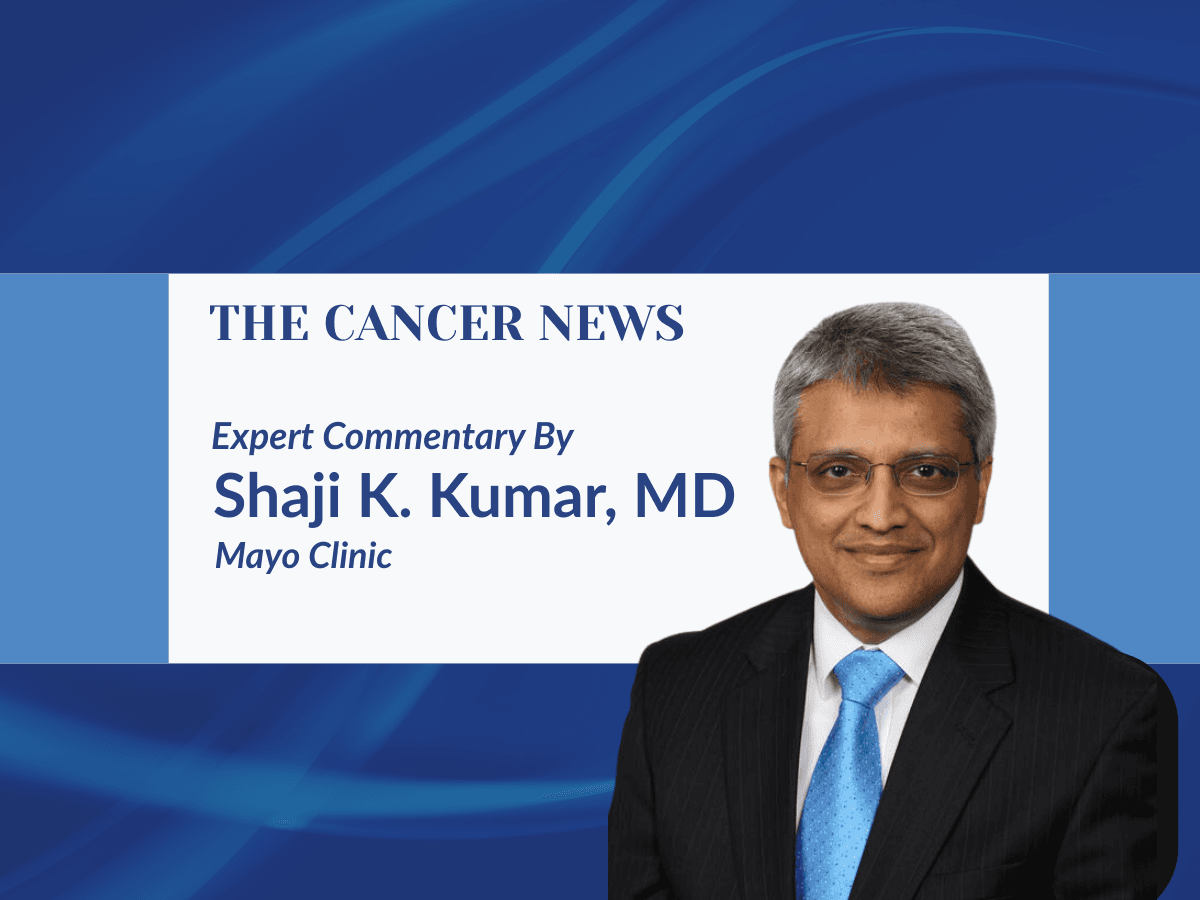
Multiple Myeloma in 2026: Redefining the Possible — From Three-Year Median Survival to the Threshold of Cure
Introduction: Twenty Years of Transformation
Twenty years ago, the median overall survival for multiple myeloma was approximately three years. We used to tell patients that as a fact of their disease. But today, we are looking at survival that may exceed 15 years. The treatment landscape has been transformed by proteasome inhibitors, immunomodulatory drugs, anti-CD38 monoclonal antibodies, CAR-T cells, bispecific antibodies, and ADCs. We now have approximately twenty approved drugs across multiple drug classes. The duration of first responses has become so long that I genuinely believe five years from now, we will be talking about a significant proportion of patients who have received nothing more than their initial therapy. The paradigm is shifting from a chronic relapsing disease toward, for some patients, a curative intent approach.
Let me walk through how we think about this in 2026.
Framing the Treatment Decision: Risk, Frailty, and Response Depth
Every myeloma treatment decision boils down to two fundamental variables: how aggressive is the disease biology (risk stratification), and how aggressive can we be in delivering therapy (patient frailty and organ function). A third, more dynamic variable — depth of response — then guides how we think about ongoing therapy.
High-risk disease definition has evolved. The International Myeloma Society and IMWG updated the consensus definition, reflecting the fact that treatments have improved so much that single high-risk features no longer carry the same weight they once did. The current definition requires at least two concurrent high-risk cytogenetic abnormalities, or a single alteration like del(17p) that confers high risk on its own, or an elevated beta-2 microglobulin in the presence of a normal creatinine level. This revision acknowledges that our treatments have gotten better at overcoming individual high-risk features, while presence of multiple abnormalities remain a challenge.
Newly Diagnosed Transplant-Eligible Myeloma: Quadruplet Induction Is the Standard
For patients with newly diagnosed myeloma who are eligible for autologous stem cell transplant, the standard induction regimen in 2026 is a quadruplet: an anti-CD38 monoclonal antibody (daratumumab or isatuximab) plus a proteasome inhibitor (bortezomib or carfilzomib) plus an immunomodulatory drug (lenalidomide) plus dexamethasone.
Multiple trials have now confirmed that quadruplet regimens produce significantly deeper responses than triplets: higher overall response rates, higher MRD-negativity rates, and improved progression-free survival. The most illustrative data show a four-year PFS of approximately 85% with quadruplet induction followed by transplant and two-drug maintenance. Twenty years ago, we quoted three-year median overall survival. Now we have 85% four-year progression free survival.
Does Transplant Still Matter?
This is the question that every generation of new induction therapy raises. The most relevant data come from phase 3 trials like the DETERMINATION trial, which randomized patients to VRd with or without transplant. The benefit of transplant was much more pronounced in patients with high-risk disease. While there was no difference in overall survival with an early or delayed transplant, an early transplant was associated with better PFS.
My current practice: I still consider autologous stem cell transplant an integral part of first-line therapy, particularly for high-risk patients. For standard-risk patients with a very deep response to induction, a discussion about delaying or omitting transplant is reasonable — but collecting and storing cells remains important so the option is preserved.
Post-Transplant Maintenance
The minimum standard for all transplant-eligible patients is lenalidomide maintenance. Multiple trials and a meta-analysis confirm this is beneficial in improving PFS and OS compared to observation. For high-risk patients, lenalidomide alone is probably insufficient and we tend to use bortezomib and lenalidomide combination. Data from the Cassiopeia trial and others suggest daratumumab maintenance adds benefit in terms of PFS — whether daratumumab should be added when it was already part of induction is an ongoing question that current trials are addressing.
Newly Diagnosed Transplant-Ineligible Myeloma: Quadruplets Here Too
The standard for transplant-ineligible patients has been daratumumab-lenalidomide-dexamethasone (DRd) based on the MAIA trial, which showed improvement in PFS and OS versus Rd alone.
Three recent randomized trials have now evaluated quadruplet versus triplet in transplant-ineligible patients:
- IMROZ (isatuximab plus VRd): Significantly improved PFS.
-
CEPHEUS (daratumumab plus VRd): Very similar results to IMROZ.
-
BENEFIT: DRd with or without bortezomib – improved outcomes with 4 drugs
They all support quadruplet therapy as the preferred approach in transplant-ineligible patients who can tolerate it. These studies were conducted in patients up to age 80. In real-world practice, I use the concept of "when in doubt start with three, add the fourth": begin with three drugs, and as tolerability is established, add the fourth. This is particularly relevant for frailer patients.
Relapsed Myeloma: The Immunotherapy Revolution
The first relapse is where the treatment landscape has changed most dramatically, and I want to be direct: the outcomes we are seeing with immunotherapy in first relapse are unlike anything we have seen before in myeloma and is even better than what we saw in the newly diagnosed myeloma a decade ago.
Bispecific Antibodies in First Relapse
The TEC-3 trial evaluated teclistamab (a BCMA-targeted bispecific antibody) in combination with daratumumab in patients with first relapse. The three-year progression-free survival was 83%. Compare this to the median PFS of approximately three years with the best daratumumab-based triplet regimens from before— and this is PFS at three years, not median. This is a substantial improvement, and there is also an overall survival benefit.
Multiple bispecific antibodies are now available or in development. What is striking is the consistency across agents: whether the target is BCMA (teclistamab, elranatamab), GPRC5D (talquetamab), or other antigens, response rates are consistently around 60-70% in heavily pretreated patients — with median PFS of approximately 12-18 months even in fourth-plus line settings. This consistency tells us the platform is powerful, and that the specific target may matter less than the mechanism.
CAR-T Cells in First and Second Relapse
Ciltacabtagene autoleucel (cilta-cel, Carvykti) is now approved in the first relapse setting based on the CARTITUDE-4 trial, which showed superior PFS versus standard of care. Idecabtagene vicleucel (ide-cel, Abecma) is approved for second relapse onwards. Both demonstrated improvement in PFS and trends toward OS benefit.
My general approach: I try to use CAR-T before bispecific antibodies when feasible, because there is emerging data that prior bispecific exposure may impair subsequent CAR-T cell function (though the reverse — CAR-T before bispecifics — seems more permissive). The practical caveat is that bispecifics are substantially easier to deliver in the community setting than CAR-T, which requires referral to a transplant center, and this logistics gap is real. Bispecifics — with CRS becoming predominantly grade 1, manageable in outpatient settings — are increasingly accessible even in community oncology practices.
Other Relapse Options
Anti-CD38 combinations (daratumumab-carfilzomib or daratumumab-pomalidomide) remain highly effective in first relapse for patients who were not anti-CD38 exposed upfront — though this group is shrinking as daratumumab moves earlier.
Belantamab mafodotin (anti-BCMA ADC) combinations — particularly belantamab with pomalidomide or bortezomib (DREAMM-7/8) — show improved outcomes over doublet therapies. Selinexor with bortezomib-dexamethasone is also available.
For patients with t(11;14) translocation, venetoclax combinations produce very high response rates and should be strongly considered. IHC for BCL-2 expression is not a reliable selection tool — use the translocation status based on FISH testing. Patients with concurrent 17p deletion or 1q amplification alongside t(11;14) tend to have lower durability of venetoclax responses.
The Future: Toward Cure and Fixed-Duration Therapy
I believe we are at the threshold of formally defining cure in myeloma. At a recent international meeting, a working definition was agreed upon: patients who are MRD-negative at the 10^-6 threshold and who sustain that MRD negativity for five years without intervening therapy are considered potentially cured.
The directions that make me most optimistic:
Trispecific antibodies: Constructs engaging three targets simultaneously — approaching the depth and durability of CAR-T in a more accessible format. Several are in early development.
Next-generation CAR-T cells: Dual-targeted CAR-Ts (e.g., BCMA plus GPRC5D), armored CAR-Ts that secrete additional cytokines, and next-generation products with improved persistence. Both bispecific and CAR-T approaches will be substantially more potent in the next generation.
Fixed-duration therapy: The goal is to move from continuous maintenance (which we use today) to limited-duration combination therapy that achieves durable MRD-negative remissions. The combination of potent frontline quadruplets with potent immunotherapy consolidation may produce MRD-negativity rates high enough to allow us to stop therapy entirely in a meaningful proportion of patients.
Supportive care improvements — particularly infection prevention with IVIG, vaccination guidance, and antiviral prophylaxis — will become even more important as immunosuppressive therapies deepen.
Clinical Implications and Practice Takeaways
- Quadruplet induction (Dara-VRd or isa-VRd) is the standard for transplant-eligible and transplant-ineligible newly diagnosed myeloma; produces 4-year PFS of ~85% in transplant-eligible patients.
- Autologous SCT remains important, especially for high-risk disease; collection and storage is essential even when transplant is delayed.
- Lenalidomide maintenance is the minimum post-transplant standard; dual maintenance adds benefit for high-risk disease.
- DRd (MAIA) is the established standard for transplant-ineligible patients; IMROZ and CEPHEUS data support quadruplet escalation in fit patients.
- Teclistamab+daratumumab (TEC-3): 3-year PFS 83% in first relapse — a landmark result.
- CAR-T (cilta-cel in 1st relapse, ide-cel in 2nd+) is preferred before bispecific antibodies when logistics allow.
- Bispecifics have consistent ~60-70% ORR across BCMA and GPRC5D targets; increasingly manageable in community settings.
- t(11;14): venetoclax combinations highly effective; do not use IHC to select — use translocation status.
- MRD-negativity at 10^-6 sustained for 5 years without therapy is the emerging definition of cure; achievable in a growing proportion of patients.
For Patients: What This Means for Your Care
Multiple myeloma treatment has been transformed over the last two decades. Patients today have access to a breadth of effective therapies — targeted antibodies, CAR-T cells, bispecific engagers, and more — that simply did not exist when the disease was first described. The goal of treatment is shifting toward deeper and more durable remissions, and for some patients, toward cure. Ask your oncologist about MRD testing — knowing whether your disease is detectable at the molecular level is increasingly important for treatment decisions. And if you are considering or being recommended CAR-T therapy, ask about referral to a specialized center — the sooner the referral, the more options are available.
Key Takeaways
- Quadruplet induction (Dara-VRd) produces 4-year PFS of ~85% in transplant-eligible newly diagnosed myeloma.
- Autologous SCT remains integral, especially for high-risk disease; delay is an option for standard-risk deep responders.
- Quadruplet therapy is now also the standard for transplant-ineligible patients (IMROZ, CEPHEUS); start with 3 drugs and add the 4th as tolerated.
- Teclistamab+daratumumab in first relapse: 3-year PFS of 83% — a landmark immunotherapy result.
- CAR-T (cilta-cel, ide-cel) preferred before bispecific antibodies; bispecifics (BCMA, GPRC5D targets, ~60-70% ORR) are increasingly accessible in community.
- Venetoclax highly effective in t(11;14); select by translocation, not BCL-2 IHC.
- MRD-negativity at 10^-6 sustained 5 years without therapy is the working definition of cure in myeloma.
References
- Sonneveld P, et al. (PERSEUS). Daratumumab-VRd plus transplant in transplant-eligible myeloma. New England Journal of Medicine, 2024.
- Facon T, et al. (MAIA). Daratumumab-lenalidomide-dexamethasone in transplant-ineligible myeloma. New England Journal of Medicine, 2019; OS update 2023.
- IMROZ trial. Isatuximab plus VRd in transplant-ineligible myeloma. New England Journal of Medicine, 2024.
- CEPHEUS trial. Daratumumab-VRd in transplant-ineligible myeloma. Journal of Clinical Oncology, 2024.
- TEC-3 trial. Teclistamab plus daratumumab in first relapse myeloma. Presented at ASCO, 2025.
- CARTITUDE-4. Cilta-cel in first relapse myeloma. New England Journal of Medicine, 2023.
- DREAMM-8. Belantamab mafodotin with pomalidomide-bortezomib in relapsed myeloma. New England Journal of Medicine, 2024.
About the Author
Dr. Shaji K. Kumar, MD, is a Professor of Medicine at Mayo Clinic in Rochester, Minnesota, where he has been a faculty member for over 20 years. He is Chair of the NCCN Multiple Myeloma Guidelines Panel. He received his medical degree from the All India Institute of Medical Sciences, New Delhi, India, and completed his fellowship training in hematology/oncology at Mayo Clinic. Dr. Kumar has authored over 500 peer-reviewed publications and is internationally recognized as one of the leading experts in myeloma, amyloidosis, and related plasma cell disorders. He is a recipient of the 2024 International Myeloma Working Group (IMWG) Robert A. Kyle Lifetime Achievement Award. His research encompasses the development of novel drug combinations, cellular therapies, and biomarker-guided approaches to myeloma treatment.