

This article has been medically reviewed by Fengting Yan, MD, PhD, FACP
Tofu and Breast Cancer: Is It Safe to Eat Soy?
At a Glance: Does Soy or Tofu Increase Breast Cancer Risk?
Current evidence does not show that eating tofu or other soy foods increases breast cancer risk or worsens outcomes for most breast cancer patients, including many with hormone receptor-positive (HR+) disease. Although soy contains isoflavones—plant compounds sometimes called phytoestrogens—these compounds do not behave the same way as human estrogen in the body. In fact, research suggests that moderate soy consumption is generally safe for breast cancer patients, and some studies have even linked soy intake to improved outcomes. Concerns about soy and breast cancer stem largely from older animal studies that have not been replicated in humans consuming soy as part of a normal diet.
Who Needs to be Worried About Estrogen?
Accounting for 70-80% of breast cancer diagnoses, hormone receptor-positive (HR+) breast cancer is the most common subset of the disease. HR positivity means that cancer cells have proteins, or receptors, that seek out and bind to certain hormones in the body in order to grow. The most common hormone receptor type is estrogen: over two-thirds of breast cancer incidences are estrogen receptor-positive (ER+). In other cases, HR+ breast cancer may also react to the hormone progesterone in addition to estrogen (ER+/PR+), or in much rarer cases progesterone alone (PR+/ER-).
The good news is that the extra step of hormone binding means that HR+ breast cancer cells grow and spread more slowly than their hormone receptor-negative counterparts. Plus, HR+ cancer is eligible for treatment with an additional therapy that improves prognoses: endocrine therapy, a treatment that blocks those hormones the cancer needs in order to grow. If the majority of HR+ breast cancer cases thrive in an estrogen-rich environment, blocking estrogen is an effective course of treatment—and measures need to be taken to ensure that the body is not an estrogen-rich environment. There are various estrogen-inhibiting medications breast cancer patients can take. Still, patients in this stage of treatment are, naturally, wary about substances that might increase their hormone levels. Enter: tofu.
Does Soy Contain Estrogen?
Soy food, the unappetizing moniker given to soy-based foods like tofu in clinical contexts, has garnered a bad rap. In the early aughts, words of warning began to issue from the nutrition community: tofu and other soy foods contain estrogen. It’s true that soy foods contain compounds called isoflavones—also known as phytoestrogens, which are similar in chemical structure to human estrogen, or 17-β estradiol hormone. On a very basic level, then, yes: tofu contains estrogen. A since-scrubbed 2009 Men’s Health article asked, to great effect, “Is This [soy] the Most Dangerous Food For Men?” Worried about their testosterone levels dropping, men steered clear of soy foods, a wary distance that hasn’t closed much in the decades since, despite findings to the contrary. (“Our bad,” the publication said in a 2019 revisitation.)
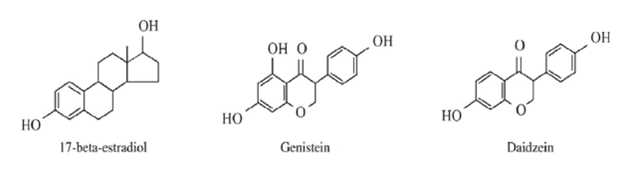
Figure 1: Chemical structure of 17-β estradiol hormone (left), and the phytoestrogens Genistein and Daidzein, found in soy food. (Source: http://pubchem.ncbi.nlm.nih.gov)
HR+ breast cancer patients were also turned off; and in this case, clinical activity seemed to lend credence to the wariness. The foundational literature was a 1998 in vivo (tested on animals) study, which reported that the isoflavones in tofu stimulated growth of estrogen-dependent breast tumors in mice. Several studies between 2000 and 2004 followed, with findings in a similar vein. Is the fear well-founded, then?
A Key Difference: Estrogen vs. Isoflavones
The short answer is no. Importantly, the mice in the initial study had higher isoflavone blood levels than humans would have from consuming soy foods as part of a normal diet; and, on the physiological level, rodents break down isoflavones differently than humans. Ensuing studies have found that the tumor-stimulating effect of the rodent in vivo studies doesn’t replicate in humans. More important than estrogen-like chemical structure, it turns out, is estrogenic effect—and it’s here that 17-β estradiol hormone and soy’s isoflavones diverge.
To understand why isoflavones behave differently than estrogen does in the body, Fengting Yan, MD, PhD, FACP, Fred Hutchinson Cancer Center oncologist and women’s cancer specialist, weighed in for The Cancer News. To start, there are two distinct estrogen receptors (ERs) in the body: ERα and ERβ. ERα is associated with cell proliferation, or multiplication, in breast and uterine tissue—so, naturally, it’s the receptor that estrogen-driven breast cancer (a disease characterized by cell proliferation) depends on.
ERβ works more like a brake, inhibiting cell proliferation. "ERβ may play a protective role in breast cancer development by inhibiting mammary cell growth, as well as inhibiting the stimulatory effects of ERα," Yan explained. “Phytoestrogens appear to preferentially bind to the ERβ.” That is, isoflavones boost the estrogen receptor that curbs cell multiplication. This marks a key differentiator between isoflavones and human estrogen: the latter binds to ERα and ERβ indiscriminately, boosting the cancer-friendly activity of ERα.
The potential protective effects of soy’s isoflavones go beyond estrogen receptor selectivity: “Phytoestrogens have also been shown to inhibit aromatase,” Yan said. Aromatase converts other hormones into estrogen, and is a key suppression target in some endocrine therapies. In this, isoflavones act more like the estrogen inhibitors used in HR+ breast cancer treatment than estrogen itself.
The Takeaway: Moderate Soy Consumption is Clinician-Approved
“Overall, the data are not impressive that the adult consumption of soy affects the risk of developing breast cancer or that soy consumption affects the survival of breast cancer patients,” Yan said. “Consequently, if breast cancer patients enjoy soy products, it seems reasonable for them to continue to use them.” She added: “I do not limit soy intake to myself or my patients.”
The oncologist’s takeaway is consistent with scientific literature. A study analyzing data from the China Kadoorie Biobank study—including data on 300,000 Chinese women, aged 30-79—found no association between moderate soy consumption and breast cancer risk. A 2022 statistical analysis actually observed a “significant” inverse correlation between the amount of isoflavones pre- and post-menopausal women consumed and breast cancer occurrence. But do keep in mind: as with the 1998 rodent study, it’s important to not extrapolate these results. There’s a lot of evidence investigators need to gather before isoflavones become an oncologist-approved tool in the breast cancer treatment toolkit.
Yan left us with one last piece of (soy) food for thought. Tamoxifen is a selective estrogen receptor modulator (SERM), one of the key types of medications used in HR+ breast cancer hormone therapy. “Interesting enough,” Yan said, “tamoxifen's chemical structure is similar to estrogen, too. It belongs to the family of SERMs.” If everything that looked like estrogen on the chemical level behaved like it, too, we wouldn’t have an important line of defense against HR+ breast cancer. So go ahead: if it calls to you, eat that tofu scramble. We’ve been afraid of it for long enough.
About the Medical Reviewer: Fengting Yan, MD, PhD, FACP

Fengting Yan, MD, PhD, FACP, is a Physician and Clinical Associate Professor in the Clinical Research Division at Fred Hutchinson Cancer Center. She completed her fellowship in hematology/oncology at Fred Hutchinson Cancer Research Center and the University of Washington. Dr. Fengting Yan brings a rich background in translational research, women’s health education, and global clinical training. Her work focuses on identifying molecular targets and advancing therapies in women’s cancers.
References
- Kim N, Lukong KE. Treating ER-positive breast cancer: a review of the current FDA-approved SERMs and SERDs and their mechanisms of action. Oncol Rev. 2025;19:1564642. doi:10.3389/or.2025.1564642.
- Cleveland Clinic. Hormone receptor-positive breast cancer. Cleveland Clinic. https://my.clevelandclinic.org/health/diseases/hormone-receptor-positive-breast-cancer. Accessed May 7, 2026.
- Boutas I, Kontogeorgi A, Dimitrakakis C, Kalantaridou SN. Soy isoflavones and breast cancer risk: a meta-analysis. In Vivo. 2022;36(2):556-562. doi:10.21873/invivo.12737.
- Hsieh CY, Santell RC, Haslam SZ, Helferich WG. Estrogenic effects of genistein on the growth of estrogen receptor-positive human breast cancer (MCF-7) cells in vitro and in vivo. Cancer Res. 1998;58(17):3833-3838.
- Allred CD, Allred KF, Ju YH, Virant SM, Helferich WG. Soy diets containing varying amounts of genistein stimulate growth of estrogen-dependent (MCF-7) tumors in a dose-dependent manner. Cancer Res. 2001;61(13):5045-5050.
- Allred CD, Ju YH, Allred KF, Chang J, Helferich WG. Dietary genistin stimulates growth of estrogen-dependent breast cancer tumors similar to that observed with genistein. Carcinogenesis. 2001;22(10):1667-1673. doi:10.1093/carcin/22.10.1667
- Allred CD, Allred KF, Ju YH, Goeppinger TS, Doerge DR, Helferich WG. Soy processing influences growth of estrogen-dependent breast cancer tumors. Carcinogenesis. 2004;25(9):1649-1657. doi:10.1093/carcin/bgh178
- Ju YH, Allred CD, Allred KF, Karko KL, Doerge DR, Helferich WG. Physiological concentrations of dietary genistein dose-dependently stimulate growth of estrogen-dependent human breast cancer (MCF-7) tumors implanted in athymic nude mice. J Nutr. 2001;131(11):2957-2962. doi:10.1093/jn/131.11.2957
- American Institute for Cancer Research. Soy and cancer: myths and misconceptions. AICR. https://www.aicr.org/resources/blog/soy-and-cancer-myths-and-misconceptions/. Accessed May 7, 2026.
- Wei Y, Lv J, Guo Y, et al. Soy intake and breast cancer risk: a prospective study of 300,000 Chinese women and a dose-response meta-analysis. Eur J Epidemiol. 2020;35(6):567-578. doi:10.1007/s10654-019-00585-4.