


Metastatic cancer—also known as stage 4 cancer—occurs when cancer cells spread from the primary tumor to other parts of the body through the bloodstream or lymphatic system. Understanding how metastasis happens, where cancer commonly spreads, and how it is diagnosed and treated can help patients and families better navigate advanced cancer care.
What is metastasis?
The words “stage 4” or “metastatic” are often heard in conjunction with cancer. The term “metastasis” originates from Greek, roughly translating to a change of place. Similarly, metastatic cancer refers to cancer that spreads from where it originated to other nearby and/or distant parts of the body. The process of this spreading is called metastasis. Because metastatic cancer cells behave like primary tumors, breast cancer that spreads to the bone is still called metastatic breast cancer and not primary bone cancer.
Sometimes, the metastatic site of a cancer is the first presentation that identifies the primary cancer, and sometimes a primary cancer is not found. This is called cancer of unknown primary origin.
How Does Cancer Spread?
Cancer can spread through the body in a multitude of ways, including:
- Direct invasion of nearby normal tissue (Such as breast cancer invading the fatty and connective tissue it is adjacent to)
- To local lymph nodes or regional metastasis (Such as breast cancer invading the lymph nodes of the axilla, causing lumps in the armpits)
- To other organs or distant metastasis (Such as breast cancer travelling through the bloodstream to reach the lungs)
When cancer begins to occupy the lymph nodes and distant organs, it is classified as metastatic.
What is the sentinel lymph node (SLN)?
The sentinel lymph node is a commonly used term in breast cancer and melanoma. Lymph nodes are a collection of lymphatic tissue, and often exist in groups around different organs. As the name suggests, the sentinel lymph node is the initial lymph node in that draining group that could receive cancer cells from the primary site. This lymph node can be removed and examined under the microscope. If this does not show any signs of cancer, it suggests a significantly lower rate of distant metastasis, as this is a major gateway for cancer spread.
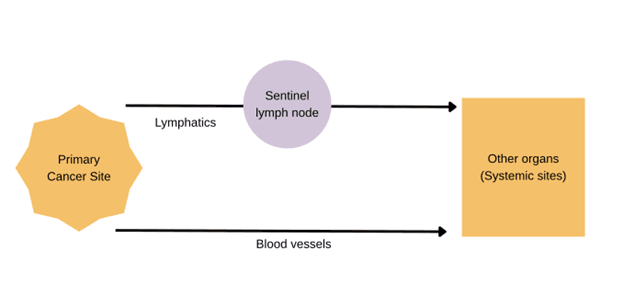
Schematic of how cancer spreads or metastasizes through blood stream and lymphatics
What Are the Risk Factors for Cancer Metastasis?
As metastasis is one of the most dreaded complications of cancer, many studies have investigated the factors that can cause a primary cancer to be more likely to spread. Almost all cancers have the potential to metastasize, but some cancers are inherently more aggressive, such as pancreatic, lung, melanoma, triple-negative breast cancer, and ovarian cancer.
Also, certain genetic factors or molecular changes can predispose individuals to early metastasis. Primary cancers that do not respond well to initial treatment can be more likely to spread. Other risk factors include delayed diagnosis and incomplete surgical removal of the primary cancer.
What Are the Common Locations of Metastasis?
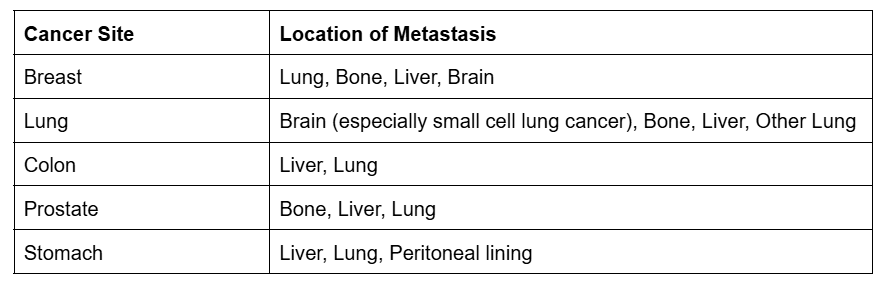
The location of metastasis or cancer spread depends on the location of the primary tumor. Cancer can spread to almost all parts of the body. But the most common sites include bone, liver, and lung, and local lymph nodes.
What are the symptoms of metastatic cancer?
Metastasis may not always have symptoms. General symptoms of metastasis may include:
- Fatigue
- Weight loss
- Night sweats
Other symptoms depend on the location of the metastasis. For example:
- Metastasis to the lungs: Chest pain, shortness of breath, cough (with sometimes bloody sputum)
- Metastasis to the spine: Bony pain, fractures
- Metastasis to the liver: Abdominal pain, decreased appetite, jaundiced or yellowed skin
- Metastasis to the brain: Headaches, altered behaviour, seizures, vomiting, gait imbalance, weakness
How is Metastatic Cancer Detected?
Metastasis is diagnosed by imaging studies, such as computed tomography (CT) scans, magnetic resonance imaging (MRI) scans, and positron emission tomography (PET) scans, which detect abnormalities in the whole body.
It can also be diagnosed by biopsy, a procedure that involves examining tissue under a microscope, such as a lymph node biopsy.
Recently, oncologists have been working to detect metastasis before symptoms appear or imaging studies can identify it by using blood tests that detect circulating tumor DNA.
Is Metastatic Cancer Treatable?
Metastasis can be treated similarly to the primary tumor, with chemotherapy, immunotherapy, hormone therapy, radiation therapy, and local targeted therapy to stop or slow the tumor growth and spread. Sometimes, certain locations of metastasis respond better to specific forms of treatment.
While stage 4 cancer or metastatic cancer has historically been associated with poor rates of survival, advances in therapy over the years have made it possible for survival rates to increase even with metastatic cancer. Palliative care or palliative intent treatment, which refers to therapy aimed at improving the quality of life by relieving symptoms, is also used in some cases. Clinical trials are also ongoing for certain types of metastatic cancer.
About Author

Chandra Kakarala, MBBS, is an internal medicine resident interested in hematology/oncology, global health, and medical education. She is passionate about improving cancer detection rates and preventive care.
Works Discussed
- National Cancer Institute. (n.d.). Metastatic cancer: When cancer spreads. https://www.cancer.gov/types/metastatic-cancer
- Leong, S. P., Naxerova, K., Keller, L., Pantel, K., & Witte, M. (2022). Molecular mechanisms of cancer metastasis via the lymphatic versus the blood vessels. Clinical and Experimental Metastasis, 39(1), 159-179. https://doi.org/10.1007/s10585-021-10120-z
- Cleveland Clinic. (n.d.). Metastasis (metastatic cancer). https://my.clevelandclinic.org/health/diseases/22213-metastasis-metastatic-cancer