

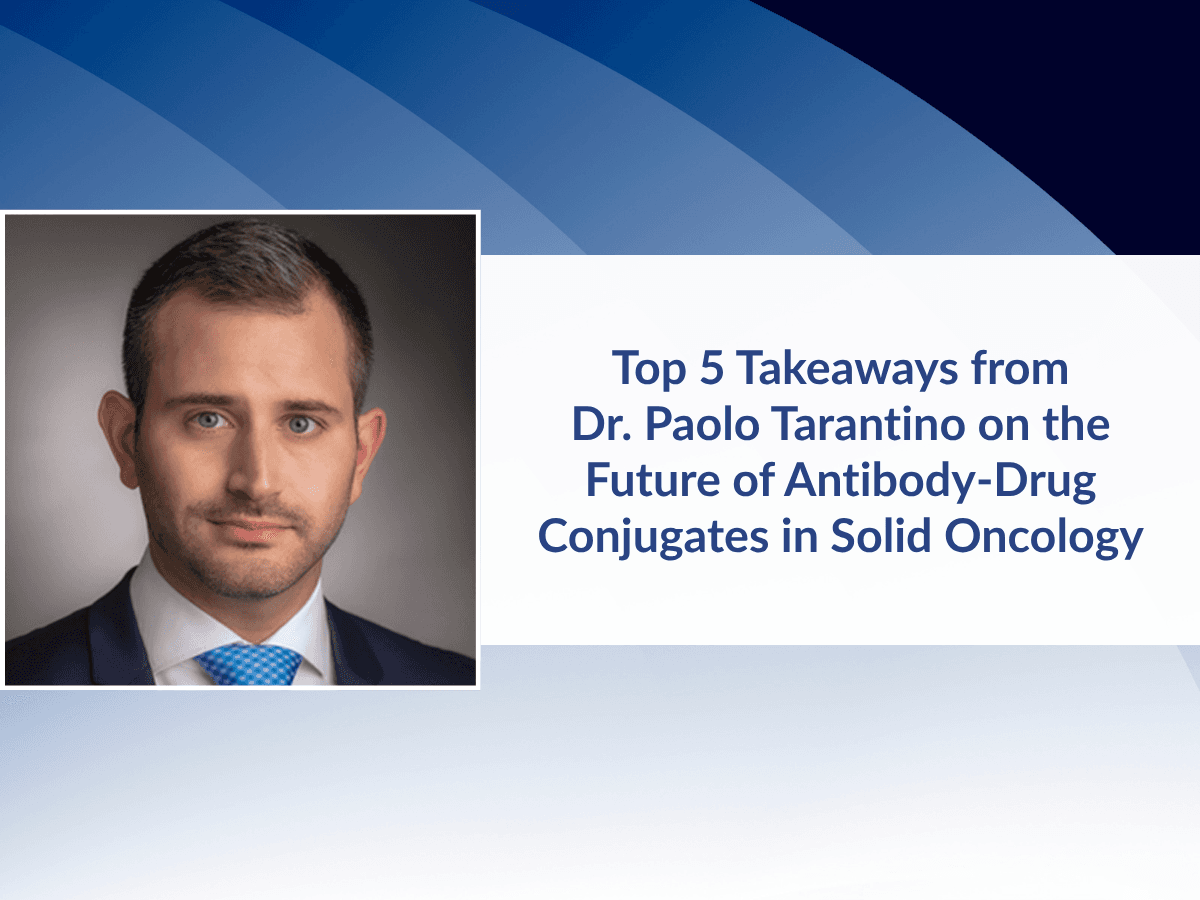
Top 5 Takeaways from Dr. Paolo Tarantino on the Future of Antibody-Drug Conjugates in Solid Oncology
Antibody-drug conjugates (ADCs) are rapidly reshaping the treatment landscape in solid oncology. Once considered niche therapies, they are now emerging as frontline and even curative-intent options. In a keynote at the Binaytara Detroit 2026 Hematology and Oncology Practice Symposium, Dr. Paolo Tarantino outlined the key clinical and scientific shifts driving this transformation.
Insights from the keynote address at the Binaytara Detroit 2026 Hematology and Oncology Practice Symposium
The antibody-drug conjugate (ADC) class has moved from a niche late-line option to one of the most active areas of solid tumor drug development in a remarkably short window. At the Binaytara Detroit 2026 Hematology and Oncology Practice Symposium, Dr. Paolo Tarantino, advanced fellow at Dana-Farber Cancer Institute and a leading voice in ADC research, delivered a keynote tracing where the field has been, where it is now, and what the next several years are likely to bring.
His talk, The Current and Future Landscape of Antibody-Drug Conjugates in Solid Oncology, covered everything from the mechanistic reasons ADCs work to the open questions about sequencing, biomarkers, and toxicity that the community has yet to resolve. Five takeaways stood out as particularly relevant for practicing hematologists and oncologists.
1. The case for ADCs starts with respecting what chemotherapy has already accomplished
"No other treatment in the history of oncology has saved as many lives as chemotherapy. If you put together all the lives, all the cancers cured by immunotherapy, targeted therapy, novel bispecifics, all of them together, they cannot really reach the number of lives saved by chemotherapy."
Dr. Tarantino opened by reframing how the field should think about ADCs. The innovation, he argued, is not that ADCs replace chemotherapy — it is that they make chemotherapy work better.
The core limitations of conventional cytotoxic therapy are well known: resistance develops quickly across sequential lines, and cumulative toxicities like taxane-induced neuropathy and anthracycline-related cardiotoxicity restrict how long any given regimen can be used. ADCs were designed to address both problems at once. By tethering a cytotoxic payload to a monoclonal antibody, they extend the effective half-life of the chemotherapy in circulation — turning what would otherwise be a short pharmacokinetic burst into a more sustained low-dose exposure. Dr. Tarantino noted that the half-life of free exatecan is roughly five to six hours, but when delivered as part of T-DXd or Dato-DXd, exposure stretches to five to seven days.
The implication for clinicians is worth internalizing: ADCs are not a departure from cytotoxic therapy but a more sophisticated way to deliver it. Patient counseling should reflect that.
2. The "magic bullet" framing oversells what ADCs can currently do
"We like to think of ADCs as magic bullets that spare patients side effects. But they don't. They still cause nausea, fatigue, alopecia, neutropenia."
One of the more candid moments of the keynote was Dr. Tarantino's pushback against the narrative that ADCs are uniformly better tolerated than the chemotherapies they are derived from. The reality is more nuanced.
T-DM1 is genuinely well tolerated for most patients — minimal alopecia, limited fatigue, modest neuropathy. But T-DM1 is the exception, not the rule. T-DXd carries a meaningful risk of interstitial lung disease that requires active monitoring. Enfortumab vedotin causes skin toxicity, peripheral neuropathy, and dysgeusia. Sacituzumab govitecan causes neutropenia at clinically relevant rates. Delayed nausea, driven by the prolonged low-dose chemotherapy effect Dr. Tarantino described, is common across the class.
This matters more now than it did three years ago. As ADCs move into first-line and adjuvant indications, patients are receiving them earlier in their disease course, often with longer expected duration on therapy and higher baseline expectations for quality of life. The tolerability conversation needs to evolve accordingly. "Better tolerated than sequential chemotherapy" is a defensible claim. "Magic bullet" is not.
3. ADCs are moving from rescue therapy to curative-intent backbone
"Instead of being a late-line option as a rescue for patients, ADCs will become a curative option to get rid of cancer, not to see it anymore, to prevent recurrences. It's going to be the standard chemotherapy in the future."
The most significant practice-level shift Dr. Tarantino described is the migration of ADCs into earlier lines. In HER2-positive metastatic breast cancer, DESTINY-Breast09 reported a first-line PFS in the range of 40 months with T-DXd — a benchmark that would have been considered implausible at the time of the original DESTINY-Breast01 readout. DESTINY-Breast05 has shown activity in the adjuvant setting, with substantial improvements in pathological complete response rates compared with T-DM1 in the neoadjuvant context.
The pattern is not limited to breast cancer. EV-302 demonstrated a doubling of overall survival in first-line metastatic urothelial cancer with enfortumab vedotin plus pembrolizumab. Neoadjuvant data for the same combination in cisplatin-ineligible urothelial cancer has shown event-free survival favoring the ADC-IO regimen over standard care at two years. Comparable first-line trials are underway in gastric, lung, and other solid tumors.
For practicing oncologists, the operational implication is straightforward: treatment algorithms that currently reserve ADCs for second or third line will need to be revisited regularly over the next few years.
4. The trial that defined a generation of breast oncology research
"These were patients with HER2 metastatic breast cancer and a median of six prior lines of treatment. We saw every patient responding, many with complete responses. The PFS in this trial was 20 months. It made me passionate about ADCs. I saw a revolution in this trial."
Dr. Tarantino spoke personally about DESTINY-Breast01 — the trial that first demonstrated what T-DXd could do and, in his telling, the dataset that convinced him to commit his career to ADC research.
The clinical context is worth remembering. Patients in DESTINY-Breast01 had a median of six prior lines of therapy for HER2-positive metastatic breast cancer. By that point in the disease course, the realistic conversation with most patients is about goals of care, not response rates. The expected PFS from another line of single-agent chemotherapy was two to three months. T-DXd produced near-universal response, including complete responses, and a median PFS of approximately 20 months.
That kind of result reshapes a field, but it also reshapes individual clinicians. Behind most major drug approvals there is a moment when a respected investigator looks at a waterfall plot and concludes that something fundamental has changed. For ADCs in solid oncology, DESTINY-Breast01 was that moment.
5. The conjugate concept is bigger than oncology
"ADCs started from oncology, but now they're getting everywhere else. The idea can be utilized for anything. There are trials ongoing in neurology, rare diseases, immunology, infectious diseases — across medicine."
Dr. Tarantino closed with the broadest point of the keynote: the underlying logic of ADCs — using an antibody to deliver a payload to a specific tissue — is not inherently an oncology tool. It is a general drug-development strategy.
He highlighted several directions the field is exploring. Immune-stimulating antibody conjugates (ISACs) deliver TLR or STING agonists rather than cytotoxic payloads, with the goal of synergizing with checkpoint inhibitors. Radio-immunoconjugates are advancing in parallel. Bispecific ADCs, which engage two epitopes for more efficient internalization, are entering clinical trials. Dual-payload ADCs — pairing two cytotoxics with complementary mechanisms on a single antibody — are showing early preclinical promise. Pro-body drug conjugates, which use a peptide mask cleaved only in the tumor microenvironment, represent one of the more credible paths to genuinely tumor-selective delivery.
Outside oncology, early-phase work is exploring ADC-style delivery for antibiotics in localized infections such as osteomyelitis, with additional programs in neurology, immunology, and rare diseases.
The vast majority of these programs will not reach approval. But Dr. Tarantino's broader point holds: targeted delivery is becoming a general modality, and the discipline that has done the most to validate it — solid oncology — is now exporting that knowledge across medicine.
Looking forward
Dr. Tarantino's keynote captured a field at an inflection point. The first generation of ADCs validated the concept. The second generation — with higher drug-to-antibody ratios, cleavable linkers, and topoisomerase I inhibitor payloads — established that ADCs can produce practice-changing efficacy across HER2-positive, HER2-low, triple-negative, urothelial, gastric, and selected lung cancers. The next generation will need to address the questions that remain: how to sequence ADCs that share payloads, which biomarkers reliably predict benefit beyond IHC, how to combine ADCs with immunotherapy in a clinically meaningful way, and how to make these agents genuinely safer rather than incrementally so.
For the oncology community, the practical task is staying current as that work matures. Dr. Tarantino's research at Dana-Farber, including the trastuzumab deruxtecan sequencing trial and biomarker collaborations with Yale and other centers, is one of several efforts aimed at answering those questions over the next few years.
The Binaytara Detroit 2026 Hematology and Oncology Practice Symposium convenes practicing clinicians and researchers for updates on the evolving standard of care across hematologic and solid malignancies.
Frequently Asked Questions (FAQs)
1. What are antibody-drug conjugates (ADCs)?
Antibody-drug conjugates are targeted cancer therapies that link a monoclonal antibody to a cytotoxic drug. This allows chemotherapy to be delivered directly to cancer cells, improving precision while maintaining potency.
2. How are ADCs different from traditional chemotherapy?
ADCs do not replace chemotherapy—they refine it. By attaching chemotherapy to an antibody, ADCs prolong drug exposure and target tumor cells more selectively, potentially improving efficacy and reducing systemic toxicity.
3. Are ADCs safer than standard chemotherapy?
Not necessarily. While some ADCs are better tolerated, many still cause side effects such as nausea, fatigue, neutropenia, and organ-specific toxicities like interstitial lung disease. The idea that ADCs are “magic bullets” is an oversimplification.
4. In which cancers are ADCs currently used?
ADCs are активно used in several solid tumors, including:
- Breast cancer (HER2-positive and HER2-low)
- Urothelial cancer
- Gastric cancer
- Lung cancer
Their use is expanding rapidly across additional tumor types.
5. Are ADCs used only in advanced-stage cancer?
No. ADCs were initially used in late-line settings, but they are increasingly being used in earlier lines of treatment, including first-line and even curative-intent settings such as neoadjuvant and adjuvant therapy.
6. What was the significance of the DESTINY-Breast01 trial?
DESTINY-Breast01 demonstrated remarkable responses in heavily pretreated HER2-positive metastatic breast cancer patients, with progression-free survival around 20 months—far exceeding expectations. It marked a turning point in ADC development.
7. What are the main challenges with ADCs today?
Key challenges include:
- Managing overlapping toxicities
- Determining optimal sequencing of ADCs
- Identifying reliable biomarkers
- Improving safety while maintaining efficacy
These are active areas of research.
8. What is the future of ADCs in oncology?
ADCs are expected to become a backbone of cancer treatment, potentially replacing conventional chemotherapy in some settings and playing a role in curative strategies.
9. Can ADC technology be used outside of cancer?
Yes. The ADC concept—targeted delivery of a therapeutic payload—is being explored in fields such as infectious diseases, neurology, immunology, and rare diseases, expanding its impact beyond oncology.
10. What should clinicians focus on as ADCs evolve?
Clinicians should stay updated on:
- Emerging clinical trial data
- New indications and earlier-line use
- Toxicity management strategies
- Combination therapies with immunotherapy
Continuous learning will be essential as ADCs reshape standard care.