

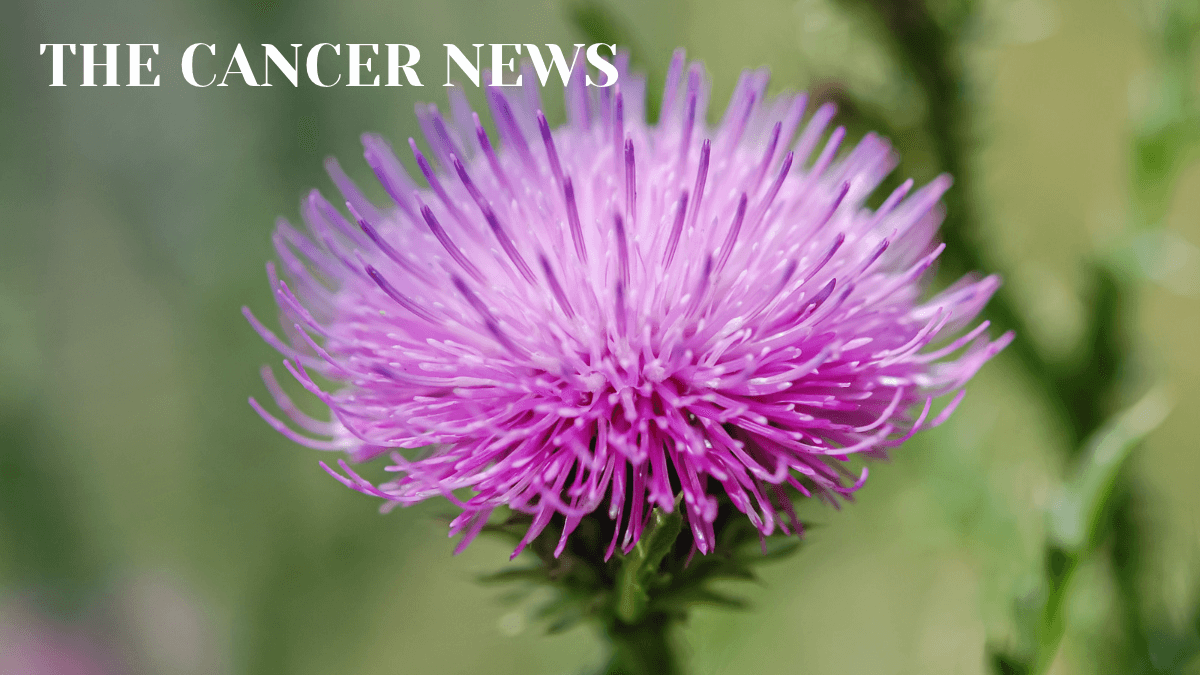
Milk Thistle and Cancer: Why the Warning Label Exists
This article has been medically reviewed by Yu Cao, MD.
Key Takeaways
-
The cancer warning on milk thistle supplements is usually a California Proposition 65 label, triggered by trace heavy metals from soil, not by the herb itself.
-
A separate medical caution exists: milk thistle can mimic estrogen and may affect hormone-sensitive cancers such as breast, ovarian, and uterine cancer.
-
Milk thistle does not cure, treat, or prevent cancer. Talk to your oncologist before using it during or after cancer treatment.
The milk thistle cancer warning on supplement packages does not mean the herb causes cancer. Two separate issues are behind the label: one is a legal disclosure requirement, the other is a medical caution for people with specific types of cancer. The sections below explain each one and when they apply to you.
Milk thistle (Silybum marianum) is a flowering plant whose seeds contain silymarin, an antioxidant compound commonly sold as a dietary supplement for liver support, fatty liver disease, and gallbladder health. It is generally well-tolerated by healthy adults. The FDA has not approved it to treat any medical condition, including cancer. [3]
Why the Cancer Warning Label Exists
Two distinct issues drive the warnings on milk thistle products, and they are often confused.
i. The Proposition 65 Label
California's Proposition 65 (the Safe Drinking Water and Toxic Enforcement Act of 1986) requires businesses to warn consumers about products containing any of roughly 900 listed chemicals above trace thresholds. [1] For herbal supplements like milk thistle, the trigger is typically trace heavy metals, including lead, cadmium, and arsenic, that the plant absorbs naturally from soil during cultivation. The thresholds are extremely conservative. A Prop 65 warning is required at exposure levels calculated to produce no more than one excess cancer case per million people over a 70-year lifetime. [1] Because the law applies to anything sold in California, many companies put the label on all packaging nationwide. The label does not mean the product has been found to be unsafe.
ii. The FDA Supplement Disclaimer
Milk thistle supplements also carry the standard FDA disclaimer: "This product is not intended to diagnose, treat, cure, or prevent any disease." This is required by federal law for all dietary supplements. The FDA has not approved the use of milk thistle as a treatment for cancer or any other medical condition. [3]
The Real Medical Concern: Estrogen and Hormone-Sensitive Cancers
Beyond the packaging labels, there is a genuine clinical reason oncologists flag milk thistle for certain patients.
i. Silymarin as a Phytoestrogen
Silymarin and its primary active compound, silybin, can bind to estrogen receptors in the body. This means they act as phytoestrogens, plant-derived compounds that mimic the hormone estrogen. For cancers that grow in response to estrogen, such as estrogen receptor-positive (ER+) breast cancer, this hormonal activity could theoretically stimulate cancer cell growth. [2] This is the same biological concern that surrounds soy and breast cancer, where soy isoflavones interact with estrogen receptors through a similar mechanism.
ii. Which Conditions Are Affected
Doctors advise people with the following conditions to avoid milk thistle unless their oncologist specifically approves it. For prostate cancer specifically, the concern applies to hormone-sensitive forms. [2] [4]
| Condition | Why Caution Is Needed |
| Breast cancer (ER+) | Silymarin may stimulate estrogen receptor-positive cancer cell growth |
| Ovarian cancer | Estrogen-like activity may promote hormone-driven tumor growth |
| Uterine cancer | Same phytoestrogen mechanism applies |
| Endometriosis | Estrogen-dependent condition that milk thistle may worsen |
| Uterine fibroids | Growth can be stimulated by estrogenic compounds |
| Prostate cancer (hormone-sensitive) | Some oncologists advise avoidance for hormone-driven forms |
Sources: Mayo Clinic [2], NCI [3], Cancer Research UK [4].
Can Milk Thistle Interfere with Cancer Treatment?
Even for patients whose cancer is not hormone-sensitive, milk thistle raises separate concerns during active treatment.
i. Antioxidant Interference with Chemotherapy and Radiation
Milk thistle is a potent antioxidant. While this is normally considered beneficial, high doses of antioxidant supplements can reduce the cancer-killing effects of chemotherapy and radiation therapy. These treatments work in part by generating oxidative stress that destroys cancer cells. Antioxidants can counteract that mechanism. This is a general caution for all high-dose antioxidant supplements during cancer treatment, not specific to milk thistle alone. [4]
ii. Drug Metabolism and Interactions
Milk thistle affects liver enzymes in the cytochrome P450 family, particularly CYP2C9 and CYP3A4, that process prescription medications. This can alter the absorption levels of drugs used in cancer care and beyond, including warfarin (a blood thinner), raloxifene (an osteoporosis and breast cancer drug), sirolimus (an immunosuppressant), and simeprevir (a hepatitis C medication). [2]
iii. Limited Data on Anticancer Drug Interactions
The NCI states directly that "little information about interactions with anticancer medications, radiation therapy, or other drugs is available." [6] This uncertainty is itself a reason for caution. The absence of evidence that milk thistle is harmful during cancer treatment is not the same as evidence that it is safe.
What the Research Actually Shows
The relationship between milk thistle and cancer is more nuanced than either "it causes cancer" or "it cures cancer."
i. Laboratory Findings
Cell culture and animal studies have found that silymarin can slow the growth of breast, prostate, colorectal, and lung cancer cells in controlled laboratory settings. These findings have not translated into proven clinical benefit in humans. [7]
Milk thistle is most commonly taken for liver health, and lab research does show hepatoprotective effects, meaning the compound appears to shield liver cells from certain toxins. However, no human trial has demonstrated that milk thistle prevents or treats liver cancer. The NCI notes that clinical trials have primarily studied milk thistle for hepatitis and cirrhosis, not for cancer outcomes. [3] [4]
ii. Small Clinical Trials
A randomized trial found that silymarin gel applied to the chest wall reduced the onset and severity of radiodermatitis (skin inflammation from radiation) in breast cancer patients after mastectomy. Separate small trials tested oral silymarin for cisplatin-related kidney toxicity, with mixed results. [4] No human trial has demonstrated that milk thistle prevents, treats, or cures any cancer. [3]
iii. Supplement Quality Concerns
The National Center for Complementary and Integrative Health (NCCIH) reports that some milk thistle products have contained substantially different amounts of silymarin than their labels claimed, or have been contaminated. [5] This variability adds another layer of uncertainty for patients considering the supplement. As The Cancer News has reported in similar contexts, dietary supplements marketed alongside cancer claims, like the question of whether sugar feeds cancer, often carry more myth than evidence.
Milk Thistle Safety and Side Effects
When it comes to milk thistle safety and interactions, most healthy adults without hormone-sensitive conditions can tolerate the supplement at standard doses. Common side effects include nausea, diarrhea, abdominal bloating, headache, and itching. [2] [5]
High doses can elevate liver enzymes and bilirubin levels, which is notable because milk thistle is often taken specifically for liver support. [4] People with diabetes should use caution, as milk thistle may lower blood sugar. [2]
Allergic reactions are a risk for people allergic to plants in the Asteraceae family, which includes ragweed, daisies, marigolds, chrysanthemums, artichokes, and kiwi. [2]
The Bottom Line
The milk thistle cancer warning exists for two distinct reasons: a Proposition 65 legal disclosure about trace heavy metals from soil, and a genuine medical caution about estrogen-like effects in hormone-sensitive cancers. Neither means milk thistle has been proven to cause cancer in healthy people. What it does mean is that the safety profile is not fully understood, especially for cancer patients on active treatment. The NCI's position is clear: milk thistle cannot be recommended as a cancer treatment outside the context of well-designed clinical trials. [3] The right course of action is straightforward. Talk to your oncologist before taking any supplement during or after cancer treatment, especially if you are managing a condition that requires ongoing cancer prevention insights.
For more evidence-based cancer reporting, explore more cancer news from The Cancer News.
Frequently Asked Questions
Does milk thistle cause cancer?
No. Milk thistle has not been shown to cause cancer. The warning on supplement packages is typically a California Proposition 65 disclosure about trace heavy metals absorbed from soil, not a finding that the herb is carcinogenic. Long-term animal studies found no cancer-causing activity from silymarin.
Can I take milk thistle if I have breast cancer?
Talk to your oncologist first. Milk thistle contains compounds that can mimic estrogen, which may stimulate the growth of hormone receptor-positive (ER+) breast cancer cells. Most oncologists advise avoiding it for patients with ER+ breast cancer, endometriosis, or uterine fibroids.
Is milk thistle safe during chemotherapy?
There is not enough data to confirm safety. High-dose antioxidant supplements may reduce the effectiveness of chemotherapy and radiation. Milk thistle also affects liver enzymes that process medications. Do not take it during cancer treatment without your oncologist's explicit approval.
What is the Prop 65 warning on milk thistle?
California's Proposition 65 requires warnings on products containing trace amounts of listed chemicals above very conservative thresholds. For milk thistle and other herbal supplements, the trigger is typically heavy metals (lead, cadmium, arsenic) absorbed from soil during cultivation, not the herb itself. The label is a legal disclosure requirement, not a finding that the product is unsafe. For questions about milk thistle safety and interactions specific to your health situation, talk to your doctor.
References
- American Cancer Society. Cancer Warning Labels Based on California's Proposition 65. https://www.cancer.org/cancer/risk-prevention/understanding-cancer-risk/cancer-warning-labels-based-on-californias-proposition-65.html
- Mayo Clinic. Milk Thistle. https://www.mayoclinic.org/drugs-supplements-milk-thistle/art-20362885
- National Cancer Institute. Milk Thistle (PDQ) Patient Version. https://www.cancer.gov/about-cancer/treatment/cam/patient/milk-thistle-pdq
- Cancer Research UK. Milk Thistle and Liver Cancer. https://www.cancerresearchuk.org/about-cancer/treatment/complementary-alternative-therapies/individual-therapies/milk-thistle-and-liver-cancer
- National Center for Complementary and Integrative Health (NCCIH). Milk Thistle. https://www.nccih.nih.gov/health/milk-thistle
- National Cancer Institute. Milk Thistle (PDQ): Integrative, alternative, and complementary therapies - Health Professional Information [NCI]. https://www.healthwise.net/mercymychart/Content/StdDocument.aspx?DOCHWID=ncicdr0000347008
- Milk Thistle (PDQ) Health Professional Version. https://www.cancer.gov/about-cancer/treatment/cam/hp/milk-thistle-pdq#_19