

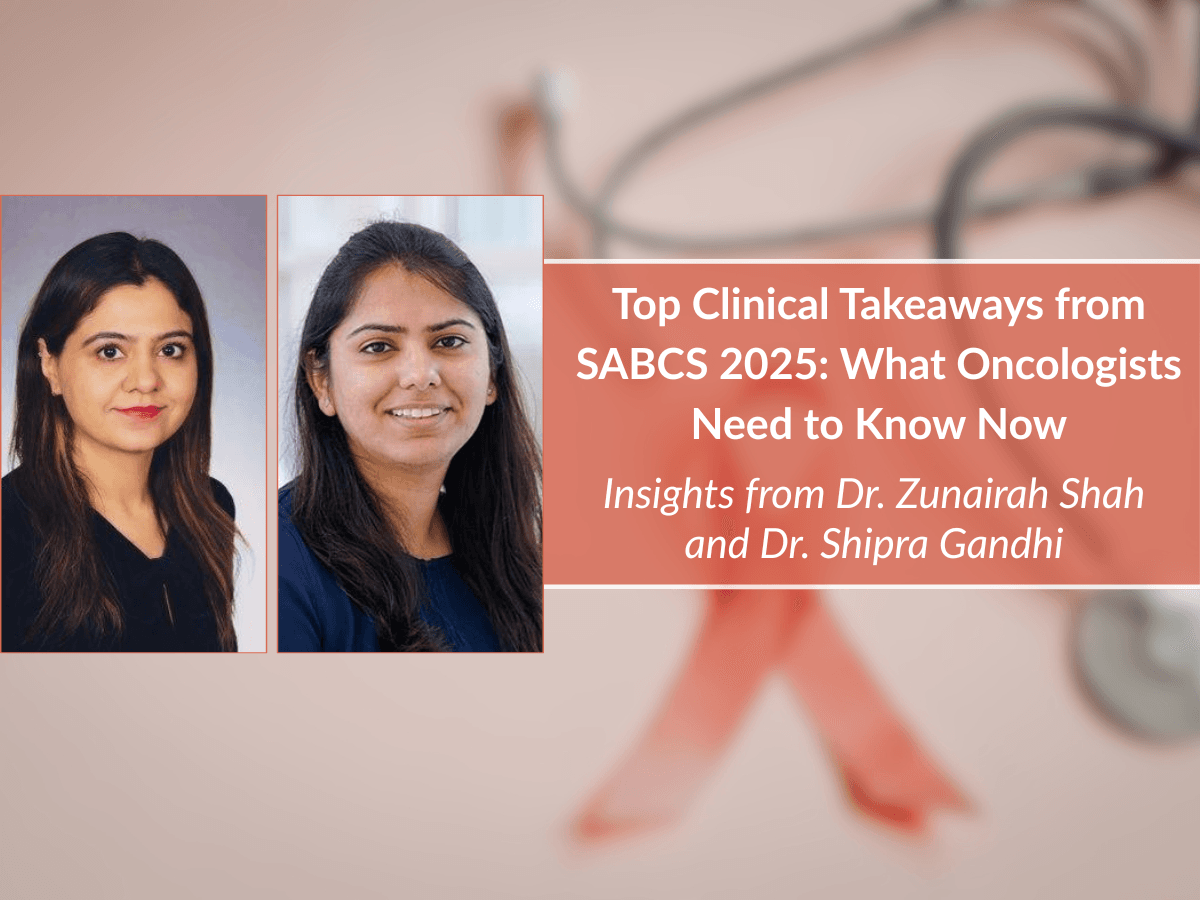
Top Clinical Takeaways from SABCS 2025: Practice-Changing Updates in Breast Cancer
The 2025 San Antonio Breast Cancer Symposium (SABCS) delivered several practice-changing updates that are already influencing breast cancer treatment in 2026. Major themes included the earlier use of antibody–drug conjugates (ADCs), the emergence of oral selective estrogen receptor degraders (SERDs) for endocrine-resistant disease, and the growing role of molecular monitoring such as circulating tumor DNA (ctDNA) to guide treatment decisions. Together, these advances signal a shift toward more personalized treatment sequencing across HER2-positive, triple-negative, and hormone receptor–positive breast cancer.
Introduction: SABCS 2025 Signals a Turning Point in Breast Cancer Care
The 2025 San Antonio Breast Cancer Symposium (SABCS) marked a decisive inflection point in oncology, reshaping treatment landscapes for all major breast cancer subtypes. As we move through 2026, the data presented at this symposium have transitioned from clinical trial results into real-world practice standards. Three overarching themes emerged: the migration of Antibody–Drug Conjugates (ADCs) into earlier curative-intent settings, the arrival of a "precision era" for endocrine therapy in Hormone Receptor–Positive (HR+) disease, and a shift toward individualized sequencing based on molecular evolution.
This year’s meeting signaled that breast cancer care is no longer defined by fixed lines of therapy but by adaptive strategies. From replacing long-standing chemotherapy standards in HER2-positive disease to redefining endocrine resistance through oral Selective Estrogen Receptor Degraders (SERDs), the 2025 updates provide oncologists with a biological roadmap to improve patient outcomes while navigating increasingly complex toxicity profiles.
Emerging Therapies Transforming Breast Cancer Treatment
The therapeutic landscape is being redefined by two primary classes of agents: Antibody-Drug Conjugates (ADCs) and oral Selective Estrogen Receptor Degraders (SERDs).
Antibody-Drug Conjugates (ADCs)
T-DXd, sacituzumab govitecan, and datopotamab deruxtecan (Dato-DXd) are moving into earlier lines of care. These "smart bombs" deliver potent chemotherapy directly to cancer cells via targeted antibodies, improving efficacy while altering the toxicity profile.
Oral SERDs
These agents, including giredestrant, camizestrant, and imlunestrant, represent the first major endocrine advance in decades. They offer more effective estrogen receptor blockade and are showing promise in overcoming resistance mutations like ESR1.
PI3K-Pathway Inhibitors
Inavolisib is establishing itself as a key agent for PIK3CA-mutant, endocrine-resistant disease.
Clinical Practice Updates: How SABCS 2025 Is Changing Treatment Algorithms
These therapeutic advances are fundamentally altering treatment algorithms and patient monitoring protocols.
These emerging therapies are significantly altering treatment algorithms, sequencing, and patient selection.
Treatment Sequencing
In HER2-positive metastatic disease, therapy is evolving from a single default frontline regimen to tailored induction-plus-maintenance sequencing based on hormone receptor status, CNS risk, and tolerability.
Mutation-Guided Switching
The use of circulating tumor DNA (ctDNA) to detect emergent ESR1 mutations allows for early endocrine switching, significantly improving progression-free survival (PFS) by moving from an aromatase inhibitor to a SERD while continuing CDK4/6 inhibition.
Safety Monitoring
As ADCs move into curative-intent settings, clinicians must implement robust protocols for monitoring interstitial lung disease (ILD), gastrointestinal toxicity, and neuropathy.
Key Clinical Trial Highlights from SABCS 2025
Recent studies presented at SABCS 2025 are the primary drivers of these changes:
HER2-Positive Breast Cancer: ADCs Move into Curative-Intent Settings
Neoadjuvant and Adjuvant Disease
One of the most closely watched questions in HER2-positive breast cancer has been whether trastuzumab deruxtecan (T-DXd) should move into early-stage therapy. In the phase III DESTINY-Breast11 trial, patients with high-risk HER2-positive disease received neoadjuvant T-DXd alone or T-DXd followed by trastuzumab-pertuzumab (T-DXd→THP) versus standard anthracycline-taxane-based chemotherapy plus HER2-targeted therapy(ddAC-THP). Pathologic complete response (pCR) rates were significantly higher with T-DXd-based strategies (T-DXd→THP: 67.3% vs ddAC-THP: 56.3%), with consistent benefit across hormone receptor subgroups. Importantly, T-DXd→THP reduced neutropenia and cardiac dysfunction compared with standard therapy but increased gastrointestinal toxicity and neuropathy. Interstitial lung disease (ILD) rates remained low (~4–5%).
Interpretation remains cautious because the comparator (ddAC→THP) is less commonly used in contemporary U.S. practice than TCHP. Nonetheless, the trial reinforces a growing consensus: ADC-based neoadjuvant therapy can achieve deeper responses with potentially less long-term toxicity.
If DESTINY-Breast11 raised the possibility of earlier T-DXd, DESTINY-Breast05 made a more definitive statement in the adjuvant setting. Among patients with residual invasive HER2-positive disease after neoadjuvant therapy, adjuvant T-DXd improved 3-year invasive disease-free survival compared with ado-trastuzumab emtansine (T-DM1) (92.4% vs 83.7%), challenging the decade-long KATHERINE paradigm. Updated safety data showed ILD in 9.6% of T-DXd-treated patients, predominantly grade 1–2, with rare fatal events (0.2%).
Taken together, these trials support T-DXd as the preferred adjuvant therapy for high-risk residual HER2-positive disease, while highlighting the need for ILD monitoring protocols and early pulmonary evaluation pathways as ADCs move into curative-intent treatment.
Metastatic HER2-Positive Disease: A New Frontline Treatment Strategy
The metastatic HER2-positive landscape experienced a major frontline shift at SABCS 2025. DESTINY-Breast09 demonstrated that first-line T-DXd plus pertuzumab significantly improved progression-free survival compared with standard docetaxel-trastuzumab-pertuzumab (40.7 vs 26.9 months; HR 0.56). Based on these data, the U.S. Food and Drug Administration approved the combination in December 2025 as first-line therapy for unresectable or metastatic HER2-positive breast cancer.
Patient-reported outcomes indicated higher gastrointestinal toxicity but similar overall treatment burden, suggesting patients perceive ADC-based therapy as manageable despite distinct side effects.
As T-DXd moves upfront, the therapeutic question shifts from “which frontline regimen?” to “what induction and maintenance sequence?”
HER2CLIMB-05 evaluated tucatinib added to trastuzumab-pertuzumab maintenance after induction THP and demonstrated significantly improved progression-free survival (24.9 vs 16.3 months) regardless of hormone receptor status or brain metastases, with particularly strong benefit in HR-negative disease.
PATINA trial further refined maintenance strategies for HR-positive/HER2-positive metastatic disease. Updated 5-year data confirmed that adding a CDK4/6 inhibitor, palbociclib, to anti-HER2 plus endocrine therapy prolonged progression-free survival (44.3 vs 29.1 months) and reduced cumulative central nervous system progression, suggesting a potential protective effect.
Collectively, these studies signal a paradigm shift: metastatic HER2-positive therapy is evolving from a single default frontline regimen to tailored induction-plus-maintenance sequencing based on hormone receptor status, CNS risk, and tolerability..
Triple-Negative Breast Cancer: ADC Expansion and Chemotherapy De-Escalation
Metastatic TNBC: ADCs Move Frontline
Perhaps the most striking shift in TNBC at SABCS 2025 was the transition from chemotherapy-first to ADC-first metastatic therapy.
ASCENT-04 (PD-L1–positive) and ASCENT-03 (PD-L1–negative) support moving sacituzumab govitecan into first-line metastatic TNBC, improving progression-free survival versus chemotherapy, although overall survival data is immature. The team is additionally congratulated for offering ADC in a second-line setting to the chemotherapy arm, that is, allowing cross-over.
TROPION-Breast02 introduced datopotamab deruxtecan (Dato-DXd) as another frontline ADC option for PD-L1–negative metastatic TNBC. Compared with investigator’s-choice chemotherapy, Dato-DXd improved both overall survival (HR 0.79) and progression-free survival (HR 0.57).
These data establish ADCs as an effective therapeutic class in TNBC with distinct, non-interchangeable toxicity profiles—sacituzumab associated more with neutropenia and diarrhea, Dato-DXd with stomatitis and ocular toxicity. Therefore, treatment selection in PDL1-negative metastatic TNBC now increasingly depends on patient comorbidities, tolerability, and logistics (Day 1,8 every 3 weeks vs. Q3 weeks).
HR-Positive Breast Cancer: Precision Endocrine Therapy Across Stages
Adjuvant CDK4/6 Inhibitors: Updated NATALEE Results
SABCS 2025 confirmed CDK4/6 inhibitors as foundational therapy in high-risk HR-positive early breast cancer. Updated 5-year NATALEE results showed ribociclib improved distant disease-free survival across subgroups, including node-negative disease (HR 0.54).
Ribociclib’s broader eligibility complements abemaciclib’s established overall survival benefit in node-positive disease. In patients eligible for both, selection increasingly depends on toxicity profile and comorbidity considerations rather than efficacy differences alone.
Oral SERDs: The Next Major Endocrine Advance
Oral selective estrogen receptor degraders (SERDs) emerged at SABCS 2025 as the most important endocrine advance in decades.
In the phase III lidERA trial, adjuvant giredestrant reduced invasive recurrence risk by roughly 30% versus standard endocrine therapy after a median 32-month follow-up, with a favorable overall survival trend. How SERDs integrate with CDK4/6 inhibitors remains an open question; ongoing trials such as CAMBRIA-2.
Targeting Endocrine Resistance in Metastatic HR-Positive Disease
The INAVO120 trial established inavolisib plus endocrine therapy as the first PI3K-pathway inhibitor to demonstrate both progression-free and overall survival benefit in endocrine-resistant PIK3CA-mutant disease. Median overall survival improved from 27.0 to 34.0 months.
SERD-based strategies also advanced substantially. SERENA-6 evaluated early endocrine switching upon detection of emergent ESR1 mutations during first-line aromatase inhibitor plus CDK4/6 inhibitor therapy. Switching to camizestrant while continuing the CDK4/6 inhibitor significantly improved progression-free survival (16.6 vs 9.2 months), while overall survival data remain immature. Circulating tumor DNA analyses confirmed profound ESR1 suppression, providing biologic validation of mutation-guided endocrine switching. Although data is exciting, we await FDA approval to adopt this strategy in clinical practice, given concerns about financial resources spent on serial ctDNA testing and imaging, while identifying only 1/10th of the population, which was eventually eligible and randomized in the study.
Beyond first-line therapy, SERD-based combinations extended endocrine sensitivity after CDK4/6 inhibitor progression. In evERA, giredestrant plus everolimus improved progression-free survival versus exemestane plus everolimus in the ITT and ESR1m population. In EMBER-3, imlunestrant improved overall survival in ESR1-mutant disease and demonstrated PFS when combined with abemaciclib irrespective of ESR1 mutation status.
Together, these studies support a new endocrine continuum: mutation-guided SERD switching, SERD-based combinations, and PI3K-targeted therapy in front line setting.
Expert Commentary: Challenges in Implementing SABCS 2025 Advances
While the data is exciting, clinical implementation requires caution. For instance, in neoadjuvant HER2-positive disease, the comparator in DESTINY-Breast11 is less common in U.S. practice than TCHP, warranting a nuanced approach to adoption. Furthermore, while mutation-guided switching (SERENA-6) shows great promise, the financial resources required for serial ctDNA testing and frequent imaging must be considered, especially as these strategies currently benefit a specific subset of the population. The challenge ahead is not whether these advances work, but how rapidly and safely practice can integrate them.
What These Advances Mean for Patients
Breast cancer treatment is becoming more "personalized." This means your doctor is looking more closely at the specific biology of your tumor and even your blood to decide which medicine is best for you.
"Biological Missiles" (ADCs)
New drugs like T-DXd act like smart bombs, hitting the cancer while sparing more of your healthy cells. These are now being used earlier in treatment, sometimes even before surgery.
Oral Medicines
New pills (SERDs) are replacing older injections to help fight hormone-driven cancer more effectively.
What to ask your doctor
"Is an ADC right for me?" "Should we test my blood for mutations like ESR1?" and "What side effects (like lung or eye issues) should I watch for?"
Frequently Asked Questions About SABCS 2025 and Breast Cancer Treatment
What were the most important updates from SABCS 2025?
SABCS 2025 highlighted several practice-changing advances, including earlier use of antibody–drug conjugates (ADCs), the emergence of oral SERDs for endocrine-resistant breast cancer, and increased use of molecular tools like circulating tumor DNA (ctDNA) to guide treatment decisions.
How are antibody–drug conjugates (ADCs) changing breast cancer treatment?
ADCs are transforming treatment by delivering chemotherapy directly to cancer cells, improving effectiveness while reducing some traditional side effects. At SABCS 2025, these therapies moved into earlier treatment settings, including curative-intent use in HER2-positive disease.
What are oral SERDs and why are they important?
Oral selective estrogen receptor degraders (SERDs) are a new class of endocrine therapy that more effectively block estrogen signaling in hormone receptor–positive breast cancer. They are especially important for overcoming resistance caused by ESR1 mutations.
What role does ctDNA testing play in breast cancer care?
Circulating tumor DNA (ctDNA) testing allows clinicians to detect emerging mutations, such as ESR1, through a blood test. This enables earlier treatment adjustments, such as switching endocrine therapies before disease progression becomes clinically evident.
Are ADCs now used as first-line treatment for metastatic breast cancer?
Yes, in some cases. Data from SABCS 2025 support the use of ADC-based therapies as first-line treatment in certain metastatic settings, particularly HER2-positive and triple-negative breast cancer, depending on patient and disease characteristics.
How is treatment sequencing changing after SABCS 2025?
Treatment is shifting from fixed lines of therapy to more personalized sequencing based on tumor biology, mutation status, prior treatments, and patient-specific factors such as tolerability and comorbidities.
What are the main side effects clinicians need to monitor with new therapies?
Key toxicities include interstitial lung disease (ILD) with ADCs, gastrointestinal and hematologic effects, and specific toxicities like ocular events with some newer agents. Careful monitoring and early intervention are critical.
Are these new breast cancer treatments widely available?
Many therapies presented at SABCS 2025, including certain ADC combinations and targeted therapies, received FDA approval in late 2025 and are increasingly being integrated into clinical practice, although access may vary by region and healthcare system.
Who benefits most from mutation-guided therapy in breast cancer?
Patients with metastatic hormone receptor–positive breast cancer, particularly those with ESR1 or PIK3CA mutations, benefit most from mutation-guided strategies, as these biomarkers help select targeted therapies like SERDs or PI3K inhibitors.
What should patients ask their oncologist after these new updates?
Patients may consider asking:
- Is an ADC appropriate for my treatment plan?
- Should I undergo ctDNA or mutation testing?
- What are the risks and benefits of newer therapies like SERDs?
- How will side effects be monitored and managed?
About Authors

Dr. Shipra Gandhi
Associate Professor of Hematology and Medical Oncology, Winship Cancer Institute of Emory University
Director of Breast Translational Research, Glenn Family Breast Center

Dr. Zunairah Shah
Third-Year Hematology/Oncology Fellow, Roswell Park Comprehensive Cancer Center
Works Discussed
1. Bidard, F.-C., Mayer, E. L., Park, Y. H., Janni, W., Ma, C., Cristofanilli, M., Bianchini, G., Kalinsky, K., Iwata, H., Chia, S., Fasching, P. A., Brufsky, A., Nowecki, Z., Pascual, J., Moreau, L., Chen, S.-C., Karadurmus, N., Gal-Yam, E. N., Jung, K. H.,…Turner, N. C. (2025). First-Line Camizestrant for Emerging <i>ESR1</i>-Mutated Advanced Breast Cancer. New England Journal of Medicine, 393(6), 569-580. https://doi.org/doi:10.1056/NEJMoa2502929
2. Cortés, J., Punie, K., Barrios, C., Hurvitz, S. A., Schneeweiss, A., Sohn, J., Tokunaga, E., Brufsky, A., Park, Y. H., Xu, B., Hegg, R., Oliveira, M., Fabi, A., Vaksman, N., Valdez, T., Zhang, X., Lai, C., & Tolaney, S. M. (2025). Sacituzumab Govitecan in Untreated, Advanced Triple-Negative Breast Cancer. New England Journal of Medicine, 393(19), 1912-1925. https://doi.org/doi:10.1056/NEJMoa2511734
3. Dent, R. A., Shao, Z., Schmid, P., Cortés, J. C., Cescon, D. W., Saji, S., Jung, K. H., Bachelot, T., Wang, S., Basaran, G., Chae, Y. S., Mathiba, R. M., Chen, S. C., Stradella, A., Battelli, N., Niikura, N., Zhao, K., Vuković, P., Maxwell, M. J., & Traina, T. A. (2025). LBA21 First-line (1L) datopotamab deruxtecan (Dato-DXd) vs chemotherapy in patients with locally recurrent inoperable or metastatic triple-negative breast cancer (mTNBC) for whom immunotherapy was not an option: Primary results from the randomised, phase III TROPION-Breast02 trial. Annals of Oncology, 36, S1566-S1567. https://doi.org/10.1016/j.annonc.2025.09.031
4. Dieras, V., Curigliano, G., Martin, M., Lerebours, F., Tsurutani, J., Savard, M. F., Jerzak, K. J., Hu, X., Martins de Aquino Pimentel, L. C., O'Sullivan, C. C., Tokunaga, E., Okines, A., Huang, C. S., Jacot, W., Sohn, J., Cronemberger Silva, E., Mueller, V., Yang, S., Granata, G.,…Hamilton, E. (2025). HER2CLIMB-05: A Phase III Study of Tucatinib Versus Placebo in Combination With Trastuzumab and Pertuzumab as First-Line Maintenance Therapy for HER2+ Metastatic Breast Cancer. J Clin Oncol, Jco2502600. https://doi.org/10.1200/jco-25-02600
5. Harbeck, N., Modi, S., Pusztai, L., Ohno, S., Wu, J., Kim, S. B., Yoshida, A., Fabi, A., Cao, X., Joseph, R., Li, R., Żurawski, B., Escrivá-de-Romaní, S., Meneguetti, R., Supavavej, A., Chen, S. C., Liu, Z., Kelly, C., Curigliano, G.,…Boileau, J. F. (2026). Neoadjuvant trastuzumab deruxtecan alone or followed by paclitaxel, trastuzumab, and pertuzumab for high-risk HER2-positive early breast cancer (DESTINY-Breast11): a randomised, open-label, multicentre, phase III trial☆. Annals of Oncology, 37(2), 166-179. https://doi.org/https://doi.org/10.1016/j.annonc.2025.10.019
6. Hortobagyi, G. N., Lacko, A., Sohn, J., Cruz, F., Ruiz Borrego, M., Manikhas, A., Hee Park, Y., Stroyakovskiy, D., Yardley, D. A., Huang, C. S., Fasching, P. A., Crown, J., Bardia, A., Chia, S., Im, S. A., Martin, M., Loi, S., Xu, B., Hurvitz, S.,…Slamon, D. (2025). A phase III trial of adjuvant ribociclib plus endocrine therapy versus endocrine therapy alone in patients with HR-positive/HER2-negative early breast cancer: final invasive disease-free survival results from the NATALEE trial. Ann Oncol, 36(2), 149-157. https://doi.org/10.1016/j.annonc.2024.10.015
7. Jhaveri, K. L., Neven, P., Casalnuovo, M. L., Kim, S. B., Tokunaga, E., Aftimos, P., Saura, C., O’Shaughnessy, J., Harbeck, N., Carey, L. A., Curigliano, G., Watanabe, J., Lim, E., Huang, J., Qingyuan, Z., Llombart-Cussac, A., Huang, C., Desai, B., Limay, Y.,…Bidard, F. C. Imlunestrant with or without abemaciclib in advanced breast cancer: updated efficacy results from the phase III EMBER-3 trial. Annals of Oncology. https://doi.org/10.1016/j.annonc.2025.11.018
8. Loibl, S., Park, Y. H., Shao, Z., Huang, C.-S., Barrios, C., Abraham, J., Prat, A., Niikura, N., Im, S.-A., Li, W., Li, H., Wang, Y., Yao, H., Kim, S.-B., Geng, C.-z., Pantigoso, W. R., Godinez, F. J. R., Song, C., Chang, Y. C.,…Geyer, C. E. (2026). Trastuzumab Deruxtecan in Residual HER2-Positive Early Breast Cancer. New England Journal of Medicine, 394(9), 845-857. https://doi.org/doi:10.1056/NEJMoa2514661
9. Metzger, O., Mandrekar, S., Goel, S., Gligorov, J., Lim, E., Ciruelos, E., Loibl, S., Dockter, T., Farré, X. G., Francis, P. A., Lynce, F., Lanzillotti, J., DuFrane, C., Wall, A., Strand, C., Krop, I., Vaz-Luis, I., Tripathy, D., Loi, S.,…Carey, L. A. (2026). Palbociclib for Hormone-Receptor–Positive, HER2-Positive Advanced Breast Cancer. New England Journal of Medicine, 394(5), 451-462. https://doi.org/doi:10.1056/NEJMoa2511218
10. A Phase III, Randomized, Open-Label, Multicenter Study Evaluating the Efficacy and Safety of Adjuvant Giredestrant Compared With Physician's Choice of Adjuvant Endocrine Monotherapy in Patients With Estrogen Receptor-Positive, HER2-Negative Early Breast Cancer. (2021). https://clinicaltrials.gov/study/NCT04961996
11. A Phase III, Randomized, Open-Label, Multicenter Study Evaluating the Efficacy and Safety of Giredestrant Plus Everolimus Compared With the Physician's Choice of Endocrine Therapy Plus Everolimus in Patients With Estrogen Receptor-Positive, HER2-Negative, Locally Advanced or Metastatic Breast Cancer. (2022). https://clinicaltrials.gov/study/NCT05306340
12. Tolaney, S. M., Azambuja, E. d., Kalinsky, K., Loi, S., Kim, S.-B., Yam, C., Rapoport, B., Im, S.-A., Pistilli, B., Mchayleh, W., Cescon, D. W., Watanabe, J., Bañuelas, M. A. L., Freitas-Junior, R., Bofill, J. S., Afshari, M., Gary, D., Wang, L., Lai, C., & Schmid, P. (2026). Sacituzumab Govitecan plus Pembrolizumab for Advanced Triple-Negative Breast Cancer. New England Journal of Medicine, 394(4), 354-366. https://doi.org/doi:10.1056/NEJMoa2508959
13. Tolaney, S. M., Jiang, Z., Zhang, Q., Barroso-Sousa, R., Park, Y. H., Rimawi, M. F., Saura, C., Schneeweiss, A., Toi, M., Chae, Y. S., Kemal, Y., Chaudhari, M., Şendur, M. A. N., Yamashita, T., Casalnuovo, M., Danso, M. A., Liu, J., Shetty, J., Herbolsheimer, P., & Loibl, S. (2026). Trastuzumab Deruxtecan plus Pertuzumab for HER2-Positive Metastatic Breast Cancer. New England Journal of Medicine, 394(6), 551-562. https://doi.org/doi:10.1056/NEJMoa2508668
14. Turner, N. C., Im, S.-A., Saura, C., Juric, D., Loibl, S., Kalinsky, K., Schmid, P., Loi, S., Thanopoulou, E., Shankar, N., Jin, Y., Stout, T. J., Clark, T. D., Song, C., & Jhaveri, K. L. (2025). INAVO120: Phase III trial final overall survival (OS) analysis of first-line inavolisib (INAVO)/placebo (PBO) + palbociclib (PALBO) + fulvestrant (FULV) in patients (pts) with <i>PIK3CA</i>-mutated, hormone receptor-positive (HR+), HER2-negative (HER2–), endocrine-resistant advanced breast cancer (aBC). Journal of Clinical Oncology, 43(16_suppl), 1003-1003. https://doi.org/10.1200/JCO.2025.43.16_suppl.1003