

Introduction: A Plumber in a Room Full of Clinicians
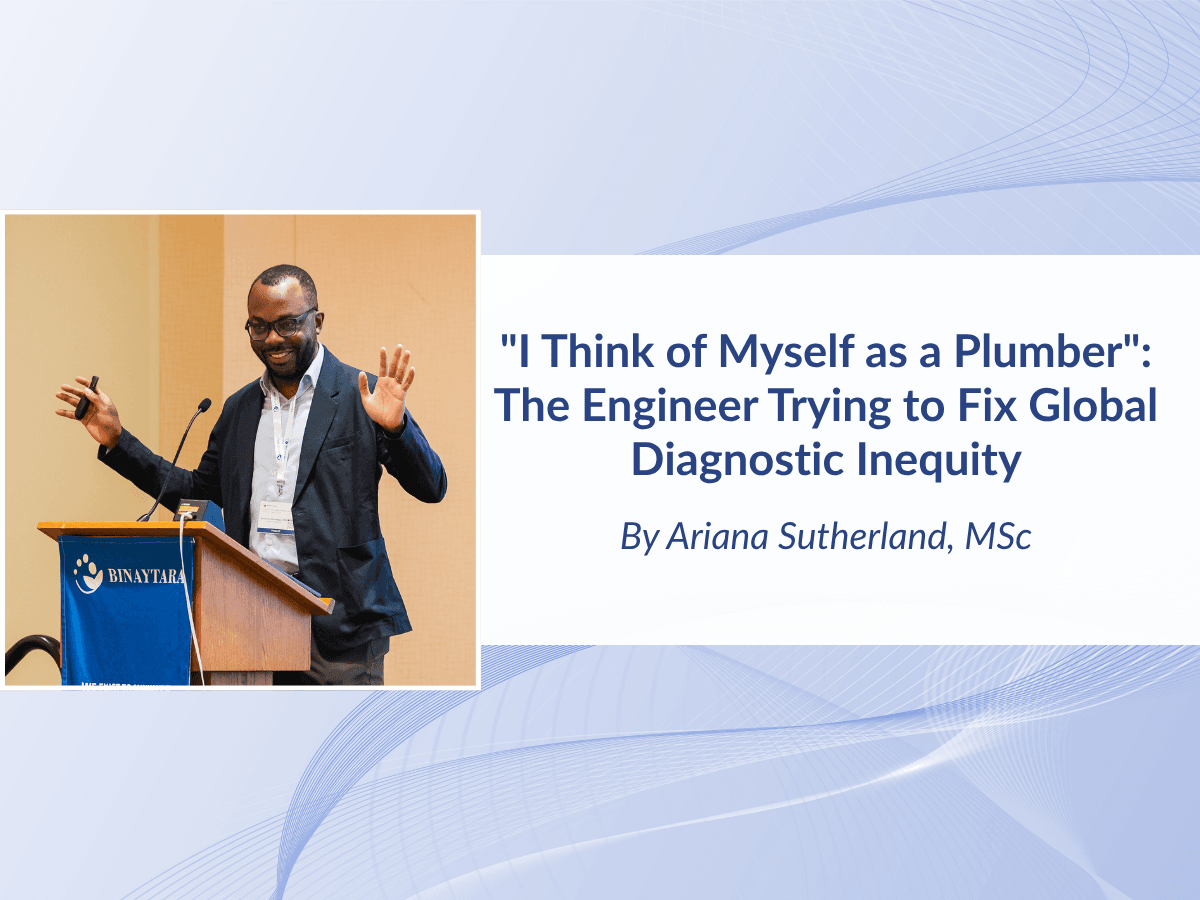
"I think of myself as a plumber by training," Ayokunle Olanrewaju, PhD, says to a room of oncology healthcare providers. "I'm an engineer. In many of these rooms, I actually don't feel like I belong that much. You all are in the business of saving lives. I'm more the person that's trying to make sure that everything else is working well."
Olanrewaju presented "Equity-Driven Innovations in Global Oncology: Microfluidics and Point-of-Care Diagnostics" at Binaytara's 2026 Summit on Cancer Health Disparities in Bellevue, WA. His talk was an assessment of where his field, microfluidics, stands: a transition point. Olanrewaju outlined a tension between technological achievement and real-world implementation. The promise of miniaturized, portable diagnostics is tangible, and even theoretically reachable; but the distance between laboratory demonstration and real-world deployment remains wide.
Still, the possibilities are revolutionary. Can we put laboratory diagnostics in everyone’s pocket? And what would it take?
What Microfluidics Is, and Why the Gap Persists
The concept behind microfluidics is straightforward: manipulate very small volumes of liquid within miniaturized channels, performing the same operations a clinical laboratory does (mixing reagents, separating components, detecting targets) on a device that could fit in a pocket and cost a dollar to manufacture. The appeal for global health equity is obvious. If the laboratory can be brought to the patient, rather than requiring the patient to reach the laboratory, the implications for diagnostic access in low-resource settings are substantial.
Olanrewaju offers a familiar analogy to explain where the field stands. "I often think about it like where the microelectronics and telecommunications industry was in the 80s," he says. "There was a time where if you wanted access to world-class communication, you needed to have a satellite phone; you needed your battery pack, and only a few people could really afford it. But now all of us carry the computing and communications power that's more capable than what we had to send people on the moon."
Microfluidics is roughly at that early transition point; the technology is demonstrated, but it has not yet undergone the maturation that made telecommunications universal. The deeper problem, he argues, is something the field rarely shows in its publications. "A lot of these lab-on-a-chip systems," he explains, "they're actually more of a chip in a lab. You need pumps and valves, and that's not necessarily bad, but it adds to the cost and complexity. It also means you need a lot of different infrastructure to run."
The Specific Problem: Capillary-Driven Microfluidics
Olanrewaju's laboratory works in a subfield called capillary-driven or surface tension-driven microfluidics, where the goal is to encode liquid handling operations into the geometry and surface chemistry of the channels themselves, eliminating the need for external pumps and valves entirely. "The shapes of your microchannels can actually be all you need to control liquid delivery operations," he explains.
The practical vision is a device that integrates with wearable blood collection systems (technology that already exists from companies like Tasso, which enables capillary blood collection without conventional phlebotomy) and connects to a microfluidic processing cartridge. Olanrewaju describes this combination as potentially enabling "phlebotomy-free” —that is, without a needle in the vein— “access to blood collection, and then presumably something else that's slightly more complex than a lateral flow test” — think the at-home COVID-19 test.
He is careful about the timeline. "Is it reality now? No, this is very much still sci-fi," he says. "But the 3D printer that can make it exists." Current work in the lab focuses on therapeutic drug monitoring for HIV, testing whether patients are receiving effective drug concentrations, but the underlying platform is application-agnostic. "A lot of these devices are just application-agnostic liquid handling devices," he notes.
Three Barriers
Olanrewaju identifies three barriers that explain why microfluidics has not yet delivered on its promise. He does not soften any of them.
The world-to-chip interface. "Everything works really well with various clean systems," he acknowledges. "I can get really nice videos with spiked samples. Everything looks great. There often are complications when you look at clinical samples. Blood matrices are weird and messy." Getting a real clinical blood sample to behave reliably inside a microfluidic channel is where a majority of promising devices fail in translation.
Scale and reproducibility. "We can make these single-use, very prototype devices," he says. "But making them in a way that's scaled up and reproducible, with quality control so that you can use any random device as though it were a product and not a prototype that an engineer was running, is also a big challenge."
The business case. "For a lot of diagnostics, unfortunately, the calculation that many people will make is that this is not going to make us our 10 or 100x return," he says. "A lot of diagnostics tend to get left behind, at least things that are focused on low- and middle-income or low-resource settings." Foundation funding can de-risk early development to the point where larger diagnostics companies ("the Cepheids, the Roches of the world") might be willing to acquire mature technology. Differential pricing models, where a test carries a premium in high-income markets and is sold at or below cost elsewhere, offer another partial solution. But Olanrewaju is clear-eyed: "That keeps me up at night too. I think there are a lot of very valid innovations that will die because of the unwillingness to fund them."
The Theranos Shadow
Theranos was a Silicon Valley diagnostics startup that raised nearly a billion dollars on the claim that its proprietary technology could run hundreds of laboratory tests from a single drop of blood. In short, the claims were fraudulent; the technology never worked as advertised. Founder Elizabeth Holmes was convicted of fraud in 2022. The collapse reverberated across the diagnostics field in ways that are still felt today.
Olanrewaju addresses the impact directly. "I don't know anyone who does the stuff that we do that ever believed that was legit," he says. "We knew it was hype and a hoax from the beginning. So how they got so many investors to spend money on it, supposedly smart people, is completely befuddling to me."
The consequence for legitimate microfluidics researchers has been a lasting layer of investor and regulatory skepticism. His response is not defensiveness, but commitment to rigor: do the science, be honest about what works and what does not, and build toward applications that are undeniably useful before asking anyone to deploy them in clinical settings.
Diagnostics Without Treatment: An Ethical Obligation
One of the most pointed exchanges in the session came when an audience member raised the question that implementation scientists have long flagged: what is the ethical responsibility when diagnostic capacity expands into settings without corresponding treatment infrastructure? "Even if we do mass production, and it's available in Asia, in Africa," the questioner noted, "in the absence of treatment centers, we are creating a different kind of ethical responsibility. We are diagnosing people without the ability to treat."
Olanrewaju pointed to the Max Foundation's model as a framework worth emulating. The organization built drug access and distribution networks for CML patients in low- and middle-income countries, reaching 100,000 patients with a global staff of 90, before expanding diagnostic capacity. "They can't offer diagnostics unless they already have the solution of how to get the drug to the patient," he explained. "So they don't get themselves in the bind of diagnosing people and saying, 'Great, now what?'"
The principle is consequential: expanding the ability to identify disease without a parallel investment in access to care is not equity. Building treatment infrastructure is its own enormous challenge, and the Max Foundation's model—laying drug access networks before expanding diagnostics—offers one framework for keeping both in view simultaneously. The diagnostic and the therapeutic have to move together.
For Patients
Most cancer diagnostic tests currently require a laboratory: equipment, trained personnel, and often a clinic or hospital to access them. Research in autonomous microfluidics is working toward a future where diagnostic tests could be performed with a simple wearable device, delivering results without a laboratory visit. For patients in rural areas, remote communities, or low-income countries, that future could mean the difference between a cancer identified early and one never caught at all. The science is real, and the direction is right, though the distance remaining is longer than many headlines suggest.
Key Takeaways
-
Autonomous, capillary-driven microfluidics, powered by surface tension rather than external pumps, represents a path toward portable, infrastructure-free diagnostic devices deployable in resource-limited settings.
-
The gap between laboratory demonstration and real-world deployment is wide: the world-to-chip interface, manufacturing scale-up, and an unfavorable commercial calculus for low-resource diagnostics all contribute.
-
Integration with wearable blood collection systems could enable phlebotomy-free, home- or community-based diagnostic testing, a paradigm shift for access in both high- and low-income settings.
-
The Theranos fraud created lasting regulatory and investor skepticism that legitimate researchers must actively overcome through rigorous, honest science.
-
Expanding diagnostic reach into low-resource settings is only equitable if pathways to treatment exist; the Max Foundation's model of building drug access networks before expanding diagnostics offers a useful framework.
References
-
Olanrewaju A. "Equity-Driven Innovations in Global Oncology: Microfluidics and Point-of-Care Diagnostics." Presented at Binaytara's 2026 Summit on Cancer Health Disparities, Bellevue, WA, March 2026.
-
Olanrewaju A, et al. Autonomous microfluidic capillaric circuits replicated from 3D-printed molds. Lab on a Chip, 2016; 16(19): 3804–3814.
-
Yafia M, Ymbern O, Olanrewaju AO, Parandakh A, Sohrabi Kashani A, Renault J, Jin Z, Kim G, Ng A, Juncker D. Microfluidic chain reaction of structurally programmed capillary flow events. Nature. 2022 May;605(7910):464-469. doi: 10.1038/s41586-022-04683-4. Epub 2022 May 18. PMID: 35585345.
-
Olanrewaju AO, et al. REverSe TranscrIptase Chain Termination (RESTRICT) for selective measurement of nucleotide analogs used in HIV care and prevention. Bioengineering & Translational Medicine, 2022.