

The Question Most Clinicians Get Wrong
Ask a room full of oncologists who among them is an advocate, and most hands stay down. Now ask whether they educate patients about their care, push back on insurance denials, or speak up when something is wrong. Framed this way, there’s a shift: nearly every hand goes up.
That gap between identity and practice is at the center of Brian Persing, MD’s work as a clinician-advocate. Persing, Director of the USA Health Mitchell Cancer Institute at the University of South Alabama, has testified before the U.S. House of Representatives Appropriations Subcommittee and previously chaired ASCO's State Affiliate Council. He moderated a panel on advocacy at Binaytara's 2026 Summit on Cancer Health Disparities alongside three policy leaders who have spent their careers at the intersection of clinical medicine and health policy. His argument, consistent throughout his advocacy work, is that clinical practice and policy engagement are not separate endeavors: advocacy is an extension of what clinicians already do for their patients, applied to the systems that determine whether patients can access care in the first place.
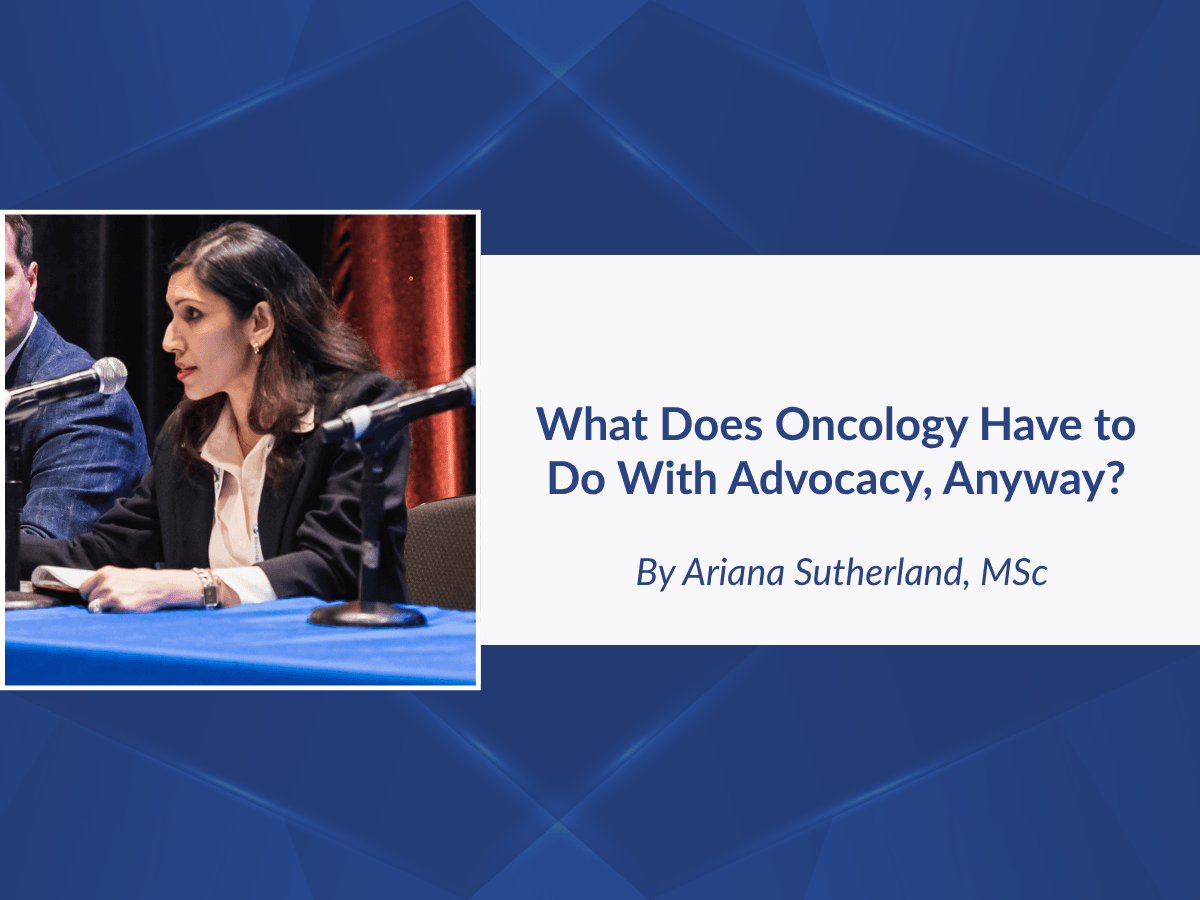
Persing led the panel discussion "Advocacy in Action: Improving Access Through Policy and Community Partnerships" at Binaytara's 2026 Summit on Cancer Health Disparities in Bellevue, WA.
Three Paths Into Policy: How the Panelists Got Here
Dr. Jasmine Kamboj, MD, who leads ASCO's Community of Practice on Policy and won ASCO's Advocate of the Year award in 2021, traces her entry into advocacy to a two-day ASCO Advocacy Summit in 2019. Day one was training. Day two was walking the halls of Congress.
"I went in thinking, 'I whine about things in my clinic every day. Here, I get to do that at the Capitol,'" Kamboj recalls. What she did not expect was the actionable impact. Prior authorization, step therapy, white bagging, cancer research funding — the frustrations of daily practice were suddenly being discussed with people who had the power to change them but lacked the clinical perspective to understand what was at stake. "None of this required special training or a particular personality," she says. "It required showing up."
Dr. Nicole Saint Clair, MD, Executive Medical Director at Regence Blue Shield in Washington State, came to advocacy by crossing to the other side of the table. As a clinician who moved into health plan leadership, she spent years trying to bring clinical perspective into the coverage decisions that shape patient care—asking, as she has described it, why these barriers exist and why they haven't been solved, and deciding to be part of the answer.
Shelley Fuld Nasso, MPP, CEO of Cancer Nation (formerly the National Coalition for Cancer Survivorship, the oldest survivor-led cancer advocacy organization in the country) came to the work through caregiving. Watching a close friend, a physician diagnosed with stage IV cancer before his 42nd birthday, navigate a healthcare system that was at once remarkable and profoundly flawed shaped her conviction: policy change is the lever most capable of improving the cancer experience en masse.
Persing's own entry into advocacy centered on a patient with an EGFR mutation who needed osimertinib, a drug that had been approved but was not yet covered by most health plans. Taking that patient's story to Capitol Hill, during the same period the Safe Step Act was being debated, illuminated something he has returned to repeatedly in his advocacy work: legislators want to help, but they lack the clinical perspective to know what helping actually looks like. That perspective is what clinicians bring to the table.
Prior Authorization: Complex and Unresolved
No topic generated more discussion than prior authorization, a cost-control process used by health insurance plans requiring providers to obtain approval before covering specific services, treatments, or prescription drugs. An oncologist in the audience described a reality many in the room recognized: in her practice, prior authorization is required for every single treatment plan, across every major payer, including Medicare Advantage. Her question was pointed: should evidence-based, NCCN-guideline-driven oncology practice require prior authorization at all?
Saint Clair offered a candid response from the health plan perspective. Plans vary significantly: some are for-profit, some are not, and that influences how prior authorization is structured. Regence, a non-profit, reviews substantially less prior authorization volume than some large national carriers. When plans and providers can sit down together to address specific patterns creating friction, she noted, progress is often possible.
This alleviates some tensions, but introduces others. For one, what place do administrative burdens have in oncology, a field where healthcare provider time is spread thin? And certainly, the undertaking of administrative burdens does not necessarily guarantee payment after authorization is granted.
The complexity is structural. Commercial plans are regulated at the state level; Medicare Advantage at the federal level; employer-sponsored plans under ERISA, which often supersedes state law. Legislative advocacy must be targeted accordingly. State-level oncology societies are often the right venue for commercial plan reform, while federal advocacy is required for Medicare Advantage. The panel's consensus: keep speaking up at national, state, and grassroots levels simultaneously, with unified and coherent messaging.
Coverage Access: The Problem Before the Problem
Prior authorization only matters to patients who have insurance. Fuld Nasso raised a point that recentered the disparities conversation: in 2025, a significant number of Americans lost insurance coverage through Medicaid cuts included in federal legislation.
"Sometimes I get a little frustrated," she said, "because we need help from clinicians and professional societies on coverage issues. We get asked to help on things like prior authorization, and we do, but we also need help making sure people even have insurance to begin with."
The Medicaid expansion and ACA premium tax credits that have lapsed represent coverage losses that translate directly into later-stage diagnoses, foregone treatment, and preventable deaths, particularly in the populations most affected by cancer health disparities. State-level implementation of federal Medicaid changes is still ongoing, and meaningful opportunity for advocacy remains at the state level. The ask from Cancer Nation is direct: clinicians and professional medical societies need to join the fight for coverage access, not only coverage quality.
The Case for a Unified Voice
When legislators hear conflicting messages from different parts of the oncology community, or when different specialties undermine each other's positions, they disengage. Organizations like ASCO work actively to build coherence — partnering with One Voice Against Cancer, coordinating with the NCI and NIH on funding numbers so that every advocate presenting to Congress presents the same figure, and cultivating relationships with specialties that share overlapping policy interests.
Kamboj made an essential point: this coalition-building cannot only happen at the organizational level. Individual clinicians can build relationships with counterparts in cardiology, rheumatology, and primary care — understanding their priorities, finding common ground, and presenting a unified front at the state and local level. A primary care physician at the session who pushed back on eliminating all prior authorization offered a useful reality check: the answer is targeted, evidence-based advocacy that builds broad coalitions.
How to Start: Entry Points for Any Clinician
For clinicians new to advocacy, the panel's guidance was consistent: personal patient stories are among the most powerful tools available. Legislators hear from many constituencies. What they rarely hear is what actually happens to a patient when a drug is denied, when a prior authorization takes weeks, or when someone loses insurance mid-treatment. That story, told plainly and specifically, changes the frame of the conversation.
ASCO's ACT Network allows any member to send a letter to their legislator in under five minutes. ASCO's Advocacy Summit offers a structured, beginner-friendly pathway to Congressional engagement. State oncology societies — in many cases open to nurses, patient advocates, and cancer survivors working in healthcare — are natural starting points for state-level influence.
Saint Clair also extended a standing offer: most health plans are more open to direct engagement with providers than providers assume. When a specific medication or prior authorization pathway is consistently creating problems, going to the source can sometimes move the needle faster than legislation.
Cancer Nation's annual Survivorship Survey, conducted for seven years, provides the data backbone for Capitol Hill advocacy. Combining that data with clinical perspective and patient stories creates the most powerful advocacy case possible — grounded in evidence, human in its impact, and difficult for legislators to dismiss.
For Patients and Families
The policies that govern your cancer care — what your insurance covers, how quickly you can access new drugs, whether you have insurance at all — are not fixed. They are shaped by ongoing decisions made by legislators, regulators, and health plan administrators, often without the input of patients or the clinicians who care for them. Cancer Nation conducts an annual survey to understand what survivors are experiencing and brings those findings directly to lawmakers. If you are a cancer survivor, caregiver, or patient, your story matters — and there are organizations, advocacy summits, and legislative outreach programs that actively need your voice. Ask your oncology team how you can get involved.
Key Takeaways
-
Most clinicians are already practicing advocacy in their daily work; the question is whether to extend that instinct into policy channels where systemic change is possible.
-
Prior authorization reform requires advocacy at multiple levels: commercial plan regulation at the state level, Medicare Advantage at the federal level, and ERISA-governed employer plans at the federal level.
-
Medicaid coverage loss is a cancer disparities crisis; professional societies and clinicians need to join the fight for coverage access, not only coverage quality.
-
A unified advocacy voice across specialties and organizations is far more effective than competing ones; coalition-building at the individual clinician level matters as much as at the organizational level.
-
The entry barrier to advocacy has never been lower: ASCO's ACT Network, the Advocacy Summit, state oncology society policy committees, and Cancer Nation's infrastructure allow any clinician to make a meaningful contribution.
References
-
Persing B, Kamboj J, et al. (2024). Using Federal, State, and Grassroots Advocacy to Effect Change in Cancer Care Delivery and Patient Outcomes in the United States. ASCO Educational Book.
-
ASCO ACT Network. asco.org/advocacy
-
ASCO Advocacy Summit. asco.org/advocacy-summit
-
Cancer Nation. Annual State of Survivorship Survey. canceradvocacy.org
-
One Voice Against Cancer (OVAC). ovac.org
-
Persing B. "Advocacy in Action: Improving Access Through Policy and Community Partnerships." Presented at Binaytara's 2026 Summit on Cancer Health Disparities, Bellevue, WA, March 2026.